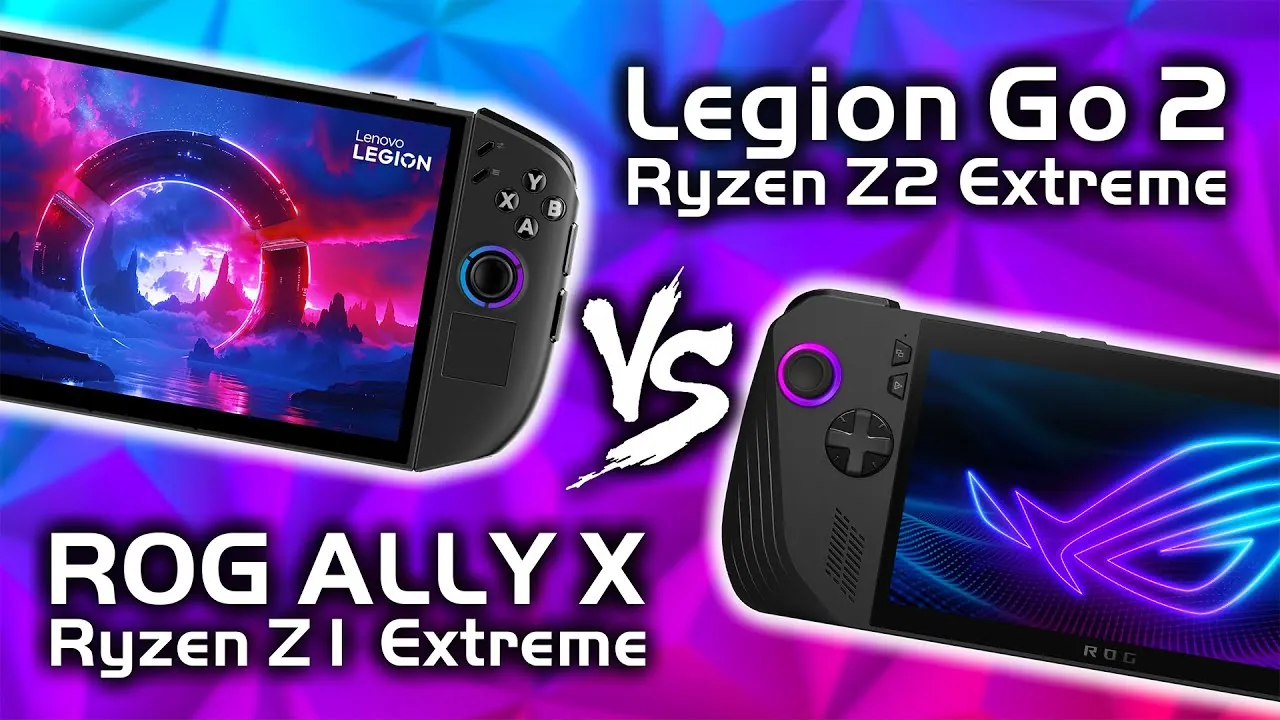
Is the era of handheld gaming entering a new golden age? With devices like the Legion Go 2 and the ROG Ally X pushing the boundaries of portable performance, gamers are now faced with tough decisions. The Legion Go 2, boasting the latest AMD Ryzen Z2 Extreme processor and a stunning OLED display, promises to redefine what handheld gaming can be. Meanwhile, the ROG Ally X, with its tried-and-true Ryzen Z1 Extreme and competitive price point, remains a fan favorite. But which device truly delivers the ultimate gaming experience? The stakes are high, and the differences are more nuanced than they might seem. Whether you’re chasing innovative visuals or raw processing power, the choice between these two titans is anything but straightforward.
In this benchmark testing, ETA Prime breaks down the Legion Go 2 and ROG Ally X across critical categories like performance benchmarks, display technology, and design innovation. You’ll discover how the Legion Go 2’s hybrid Zen 5 architecture stacks up against the Zen 4 foundation of the ROG Ally X, and whether the leap in GPU performance justifies the upgrade. We’ll also explore real-world gaming scenarios, from graphically intense titles to lighter workloads, to see which device truly shines under pressure. By the end, you’ll have the insights needed to decide whether the Legion Go 2 is the future of handheld gaming, or if the ROG Ally X still holds its ground as a worthy contender.
Legion Go 2 vs ROG Ally
TL;DR Key Takeaways :
- The Legion Go 2 features an 8.8-inch OLED display with superior color accuracy, deep contrasts, and a 144Hz refresh rate, while the ROG Ally X has a smaller 7-inch LCD display with less visual fidelity.
- The Legion Go 2 is powered by the AMD Ryzen Z2 Extreme (Zen 5 architecture), offering better multicore and GPU performance, while the ROG Ally X uses the AMD Ryzen Z1 Extreme (Zen 4 architecture) with a higher base clock for single-core tasks.
- Performance benchmarks show the Legion Go 2 outperforms the ROG Ally X in GPU-intensive and multitasking scenarios, though the ROG Ally X remains competitive in single-core efficiency.
- The Legion Go 2 introduces detachable controllers and advanced thermal management, providing versatility and consistent performance during extended gaming sessions.
- The ROG Ally X is a more budget-friendly option, making it suitable for users who prioritize affordability and single-core performance over the Legion Go 2’s advanced features.
Display: OLED Excellence vs. LCD Functionality
The Legion Go 2 sets itself apart with an 8.8-inch OLED display, offering vivid colors, deep contrasts, and a 144Hz refresh rate. The inclusion of variable refresh rate (VRR) support ensures smooth gameplay, particularly in fast-paced or graphically demanding titles. This display technology enhances immersion, making it ideal for gamers who prioritize visual fidelity.
In contrast, the ROG Ally X features a 7-inch LCD display. While the LCD is functional and delivers acceptable performance, it lacks the color accuracy and visual depth of OLED. The smaller screen size and lower-quality panel may feel limiting for users who value a premium viewing experience. For gamers who prioritize immersive visuals, the Legion Go 2 clearly holds the advantage.
Processor Comparison: Zen 5 Innovation vs. Zen 4 Efficiency
At the heart of the Legion Go 2 is the AMD Ryzen Z2 Extreme processor, which combines Zen 5 and Zen 5C cores for a hybrid architecture. Its specifications include:
- 8 cores, with 3 Zen 5 cores and 5 Zen 5C cores
- Base clock of 2 GHz and boost clock up to 5 GHz for Zen 5 cores
- Integrated RDNA 3.5 iGPU with 16 compute units (CUs) clocked at 2900 MHz
- 32GB of RAM running at 8000 MT/s
The ROG Ally X, on the other hand, is powered by the AMD Ryzen Z1 Extreme, built on the Zen 4 architecture. Its specifications include:
- 8 cores and 16 threads
- Base clock of 3.3 GHz and boost clock up to 5.1 GHz
- RDNA 3 iGPU with 12 CUs clocked at 2900 MHz
- 24GB of RAM running at 7500 MT/s
While the Z2 Extreme introduces architectural advancements, such as improved efficiency and hybrid core design, the Z1 Extreme remains competitive. Its higher base clock speed gives it an edge in single-core tasks, though the Z2 Extreme excels in multicore and GPU-intensive workloads. The Legion Go 2’s faster RAM also contributes to better overall performance, particularly in demanding applications.
Legion Go 2 vs ROG Ally X Benchmark Testing

Below are more guides on handheld games consoles from our extensive range of articles.
- LinkSquare Handheld Spectrometer And SDK Launches From $399
- AMD Ryzen Z2 Extreme: Powering the Next Handheld Gaming
- PyGamer open source handheld games console $39.95
- Aya Neo handheld gaming PC prototypes teased
- Evercade retro handheld game console from $80
- Everything We Know About the ASUS ROG Ally 2 Handheld
- PrintPod pocket handheld printer prints on any surface
- AOKZOE A1X Handheld Console: Specs & Performance Review
- AOKZOE A1 Ryzen 7 6800U PC handheld console
- Win Max 2 handheld gaming PC pricing announced
Performance Benchmarks: Synthetic and Gaming Tests
Synthetic benchmarks provide a clear picture of the performance differences between the two devices:
- In Geekbench 6, the Z2 Extreme outperforms the Z1 Extreme in both single-core and multicore tests when operating at a 25W TDP.
- In 3DMark Time Spy, the Z2 Extreme achieves higher overall scores, highlighting its superior iGPU performance.
- The Z1 Extreme occasionally edges out in single-core performance due to its higher base clock speed, but the gap is minimal.
Real-world gaming benchmarks further emphasize the Legion Go 2’s strengths:
- At 25W TDP, the Legion Go 2 consistently delivers higher frame rates in graphically demanding games like Shadow of the Tomb Raider and Forza Horizon 5.
- In less GPU-intensive titles such as Horizon Zero Dawn Remastered, the performance gap narrows, with both devices offering comparable experiences.
- At 17W TDP, the Legion Go 2 maintains a slight edge, though the differences become less pronounced as power consumption decreases.
These results indicate that the Legion Go 2 is better suited for gamers who prioritize GPU performance and multitasking capabilities, while the ROG Ally X remains a solid choice for users focused on single-core efficiency.
Thermal Management and Design Features
Thermal performance is a critical factor in handheld gaming, as overheating can lead to throttling and reduced performance. The Legion Go 2 excels in this area, thanks to its advanced cooling system, which keeps temperatures lower than the ROG Ally X, even at higher TDPs. This ensures consistent performance during extended gaming sessions, making it a more reliable option for intensive use.
In terms of design, the Legion Go 2 introduces detachable controllers, offering a level of versatility not found in the ROG Ally X. This feature allows users to customize their gaming setup, catering to different playstyles and preferences. The ROG Ally X, while more affordable, lacks such innovative design elements, which may limit its appeal to gamers seeking a more adaptable device.
Key Takeaways for Gamers
The Legion Go 2 represents a significant step forward in handheld gaming, offering meaningful improvements over the ROG Ally X in several key areas:
- An OLED display with superior color accuracy and refresh rate
- Enhanced multicore and GPU performance, thanks to the AMD Ryzen Z2 Extreme
- Faster RAM for smoother multitasking and gaming
- Detachable controllers for increased versatility
However, the AMD Ryzen Z2 Extreme does not deliver a dramatic generational leap, and the ROG Ally X remains a competitive option, particularly for users who prioritize single-core performance or are working within a tighter budget. For current ROG Ally X owners, the improvements offered by the Legion Go 2 may not justify the investment unless features like the OLED display or detachable controllers are of particular importance.
Ultimately, the choice between these two devices will depend on your gaming priorities. If you value innovative visuals, enhanced performance, and innovative features, the Legion Go 2 is a compelling option. For those satisfied with their current setup or seeking a more cost-effective solution, the ROG Ally X remains a strong contender in the handheld gaming market.
Media Credit: ETA PRIME
Disclosure: Some of our articles include affiliate links. If you buy something through one of these links, Geeky Gadgets may earn an affiliate commission. Learn about our Disclosure Policy.
