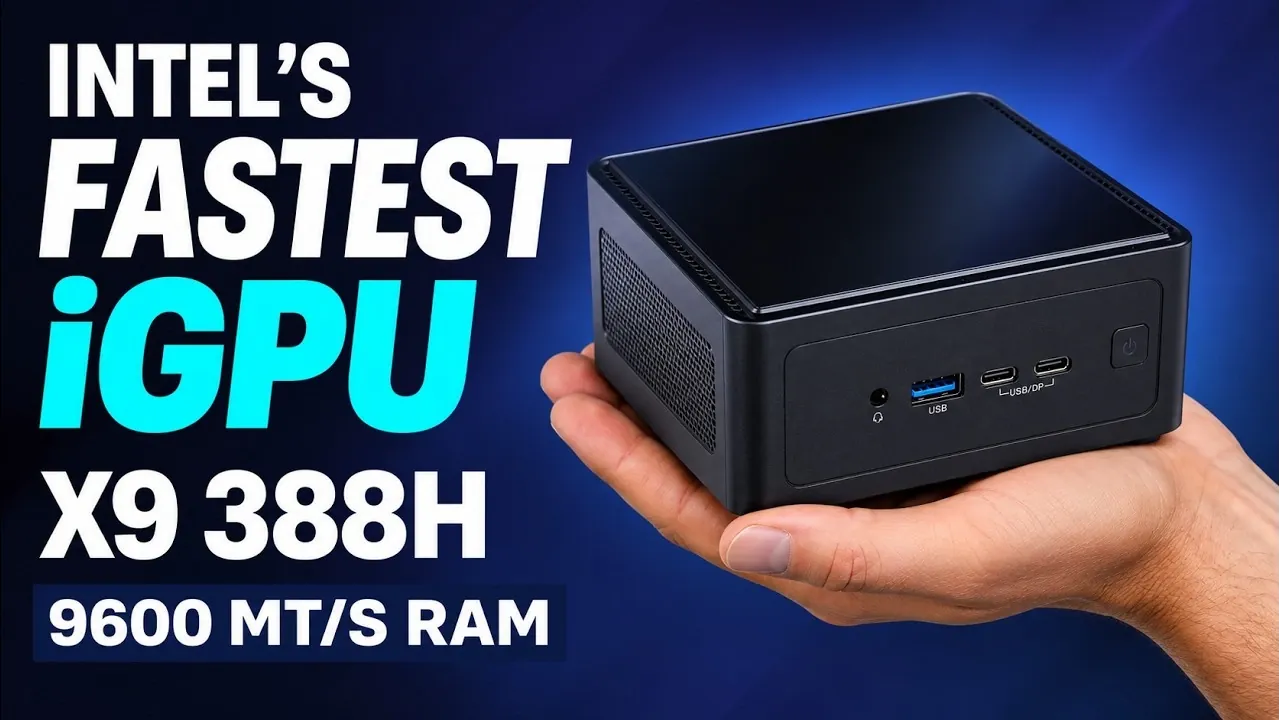
The Intel Core Ultra X9 388H mini PC lets you play demanding games without a separate graphics card. Its Arc B390 integrated graphics and 9,600 MT/s RAM delivered over 80 fps in Cyberpunk 2077 at 1440p ultra with frame generation, though gains over X7 systems were smaller than expected. Although the unit has not been released and may never reach the market, you can see what the faster memory means for graphics performance and how other games run, as ETA Prime explains.
Fast RAM Gives the iGPU a Boost
TL;DR Key Takeaways :
- The X9 mini PC has a 16-core, 16-thread CPU boosting to 5.1 GHz, Intel Arc B390 graphics and 32 GB of soldered RAM running at up to 9,600 MT/s.
- In 3DMark Steel Nomad, the X9 scored 1,611: around 20% faster than an X7 with slower RAM and almost 10% faster than an X7 with 8,335 MT/s RAM.
- CPU gains over the X7 were modest in most benchmarks. The largest was an 11% Geekbench 7 multi-core uplift, while single-core performance rose about 3%.
- Cyberpunk 2077 averaged over 80 fps at 1080p high with XeSS quality, and over 80 fps at 1440p ultra with X2 frame generation.
- Crimson Desert performance appeared to fall after recent updates, running in the low 70s with X3 frame generation and ray tracing off. The X9 unit remains unreleased; ETA Prime thinks faster RAM availability and X9 pricing may explain why.
The mini PC’s memory gives its integrated GPU more bandwidth than the slower RAM in many X7 358H systems. The X9 and X7 have the same core count. Core clocks are the main CPU difference.
- CPU: 16 cores and 16 threads, boosting up to 5.1 GHz.
- Graphics: Intel Arc B390, boosting up to 2,500 MHz in this unit.
- RAM: 32 GB soldered onboard, running at up to 9,600 MT/s.
- VRAM: 18 GB automatically allocated from the factory.
Comparable systems commonly use RAM around 7,500 or 8,300 MT/s. The X7 358H units used for comparison included models at 8,335 MT/s and the more commonly seen 7,345 MT/s.
In 3DMark Steel Nomad, the X9 scored 1,611. That was around 20% faster than the X7 with slower RAM and almost 10% faster than the X7 at 8,335 MT/s. In Time Spy, its total score was around 14% higher than the commonly seen slower-memory X7. Its graphics score of 7,277 was around 13% higher.
CPU Gains Are Modest in Most Benchmarks
The X9’s clearest CPU advantage over the X7 came in Geekbench 7 multi-core, where it scored 17,918 vs 16,119, an 11% uplift. Single-core scores were 2,712 and 2,623 respectively, about a 3% increase and a smaller gain than expected.
In Cinebench R24 single-core, the X9 scored 124 and the X7 scored 118, a 5% uplift. Multi-core performance rose by around 3%.
In Geekbench AI, the X9 gained around 5% in single precision, 2% in half precision and 4% in quantized performance against the X7.

Explore further guides and articles from our vast library that you may find relevant to your interests in Intel Panther Lake mini PCs.
- KhadasMind Pro Mini PC : Intel Panther Lake & ARC B390 Graphics Benchmarks Revealed
- Intel Panther Lake Handheld PCs Expected at $599 To $799
- Intel Panther Lake iGPU Makes High Settings Real on Thin Notebooks
- Intel Panther Lake Processor : Redefining Handheld Gaming Performance
- Intel Readies Custom Panther Lake Chips Built for Portable Gaming
Cyberpunk 2077 Tops 80 FPS With Frame Generation
Cyberpunk 2077 delivered a strong result for the Arc B390 as an iGPU. At 1080p high with XeSS quality, it averaged over 80 fps. Without XeSS at the same resolution and settings, it averaged around 69 fps.
At 1440p high with XeSS quality, the game sat close to 60 fps, though large explosions would probably cause dips below that mark. XeSS balanced was expected to push the frame rate higher.
With the game’s 2.5 update, you can use XeSS multi-frame generation on the B390 through the game settings. At 1440p ultra with frame generation set to X2, Cyberpunk 2077 averaged over 80 fps. Intel’s graphics software also offers X3 and X4, but ETA Prime did not think they were needed here and predicted that going beyond X2 would add latency and some ghosting.
Other Games Need Different Settings
Red Dead Redemption 2 averaged around 70 fps with ultra texture quality, high settings elsewhere and no FSR. The game does not support XeSS. Performance fell substantially with ultra settings across the board.
Ratchet & Clank: Rift Apart began in the 80s at 1440p high without XeSS, then dipped and finished with a 65 fps average. The very high preset reduced performance enough that XeSS was needed.
Doom: The Dark Ages needed XeSS at 1440p high, where MSI Afterburner showed almost 10 GB of VRAM in use. At 1080p, it ran natively without scaling.
Crimson Desert Performance Appears to Have Fallen
Crimson Desert felt less smooth on Intel Arc, even at 1080p, and recent game updates appear to have caused a substantial performance drop. With XeSS multi-frame generation at X3 and ray tracing off, the current test ran in the low 70s. An earlier game update had reached the mid-80s on a B390 with slower RAM and X3 frame generation.
The change also appeared on the MSI Claw EX. It has a B390 and G3 Extreme CPU. A recent patch driver allows XeSS to work on XMX engines and Linux, where it previously did not work correctly. SteamOS is expected to perform well on the X9, particularly at higher TDPs.
ETA Prime calls the gaming performance amazing for an iGPU, making the X9 mini PC a demonstration of what integrated graphics can do. For anyone expecting a large gain over the X7, though, ETA Prime says the uplift was not as big as hoped. This unit remains unreleased, and ETA Prime thinks faster RAM availability and X9 pricing may explain why.
Media Credit: ETA PRIME
Disclosure: Some of our articles include affiliate links. If you buy something through one of these links, Geeky Gadgets may earn an affiliate commission. Learn about our Disclosure Policy.
