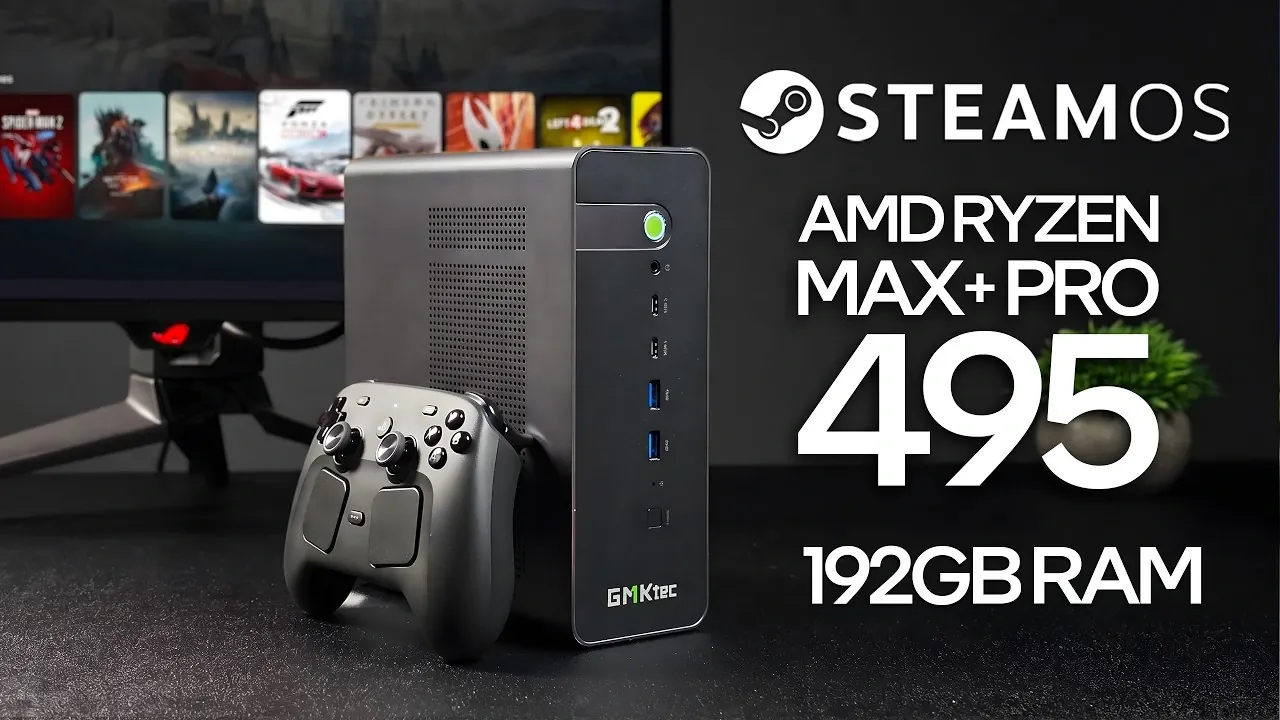
SteamOS finds a remarkable pairing in the GMK Tech Evo X5 Pro, a compact PC powered by AMD’s Ryzen AIAX Plus Pro 495 APU. As highlighted by ETA Prime, this system combines a 16-core, 32-thread processor with a Radeon 8065S integrated GPU, delivering impressive performance for gaming and productivity alike. Its standout feature is the inclusion of 192 GB of unified memory, which supports demanding tasks like AI model training and high-resolution gaming. With SteamOS 3.10 pre-installed, the Evo X5 Pro offers a streamlined gaming experience, though its default settings may not satisfy users looking for advanced TDP customization.
Explore how the Evo X5 Pro handles 1440p gaming across titles like Forza Horizon 6 and Red Dead Redemption 2, balancing graphical fidelity with smooth frame rates. Gain insight into its three performance modes, which adapt to varying workloads and learn about its robust thermal management that supports sustained high performance. Whether you’re curious about its gaming benchmarks or its potential for professional applications, this feature provides a comprehensive look at what the Evo X5 Pro has to offer.
Exceptional Hardware for High-Performance Computing
TL;DR Key Takeaways :
- The GMK Tech Evo X5 Pro is powered by the AMD Ryzen AIAX Plus Pro 495 APU with 16 cores, 32 threads and a Radeon 8065S iGPU, delivering exceptional performance for gaming, productivity and AI workloads.
- Equipped with 192 GB of unified memory (up to 160 GB allocatable as VRAM) and three M.2 SSD slots, it offers ample resources for memory-intensive tasks and storage expansion.
- The system features advanced thermal management, a 330 W power supply and customizable performance modes (high-performance, balanced and quiet) for optimized versatility and stability under heavy workloads.
- Integrated with SteamOS 3.10, the Evo X5 Pro provides a streamlined gaming experience, though it lacks native TDP adjustment support, which may limit advanced performance tuning.
- Excelling in 1440p gaming, it delivers smooth performance across demanding titles, using FidelityFX Super Resolution (FSR) for enhanced visuals and frame rates when needed.
At the heart of the Evo X5 Pro lies the AMD Ryzen AIAX Plus Pro 495 APU, a processor built for demanding tasks. Featuring 16 cores and 32 threads with a Zen 5 architecture clocked at 5.2 GHz, this APU delivers exceptional computational power. Complementing the CPU is the Radeon 8065S integrated GPU, which features 40 compute units and clock speeds reaching up to 3100 MHz. Together, these components ensure top-tier performance for both gaming and productivity.
The Evo X5 Pro is equipped with 192 GB of unified memory, operating at an impressive 8,533 MT/s. This memory configuration is particularly advantageous for tasks requiring substantial resources, such as high-resolution gaming or running large AI models. Users can allocate up to 160 GB as VRAM, making it a standout choice for memory-intensive applications. Storage needs are addressed with three M.2 2280 SSD slots, offering ample expansion options for those with significant data requirements.
A 330 W power supply ensures stable energy delivery, even during heavy workloads. The system’s advanced thermal management supports a TDP of 120 W without thermal throttling and can reach 160 W with third-party tools, maintaining consistent performance during intensive operations.
Performance Modes for Versatility
The Evo X5 Pro offers three distinct performance modes—high-performance, balanced and quiet—which can be toggled using the front power button. This feature provides flexibility, allowing users to optimize the system for gaming, productivity, or casual browsing based on their specific needs.
During testing, the Evo X5 Pro demonstrated reliable performance across all modes, maintaining stability even under high-performance settings. This ensures that users can push the hardware to its limits without concerns about overheating or performance throttling, making it a dependable choice for demanding scenarios.

Explore further guides and articles from our vast library that you may find relevant to your interests in AMD Ryzen systems.
- 128GB AMD Ryzen AI Halo Allocates 96GB VRAM for Local AI
- MINISFORUM 895D7 Fits AMD Ryzen 9 8945HX in 8.7-Liter PC
- MSI Crosshair A16 HX Hands-on: 16-Core Laptop Scores 14,134
- Ryzen AI Halo vs NVIDIA DGX Spark: Which PC Wins for Local AI
- World’s Smallest RX 9060 XT Gaming PC Fits in a 4.6-Ltr Case
- Why This Tiny Ryzen Mini PC Outperforms Intel’s N100 Options
- 680 Edge Ryzen X86 single board computer (SBC)
- Two AMD Ryzen AI Halo PCs Run 397B Quen 3.5 in Local Test
- AMD 4700S 8-Core processor desktop PC kit based on PlayStation 5 SoC
- Minisforum EliteMini AI370 AMD Ryzen AI 9 HX 370 Mini PC
SteamOS: A Streamlined Gaming Experience
One of the standout features of the Evo X5 Pro is its integration with SteamOS 3.10, which delivers a smooth and intuitive gaming experience. Installing SteamOS via USB is straightforward and both stable and beta versions performed reliably during testing. The operating system supports essential features such as Wi-Fi, Bluetooth and a desktop mode, making it versatile for both gaming and productivity tasks.
However, SteamOS does not offer native support for TDP adjustments, which may be a limitation for advanced users seeking to fine-tune performance. Despite this, the default settings are well-optimized for most gaming scenarios, making sure a hassle-free experience for the majority of users.
Gaming Performance at 1440p: A Detailed Analysis
The Evo X5 Pro excels in gaming, particularly at 1440p resolution, delivering smooth gameplay across a variety of demanding titles. Below is a closer look at its performance:
- Forza Horizon 6: Delivered fluid gameplay on ultra settings without requiring FidelityFX Super Resolution (FSR).
- Hogwarts Legacy: Maintained 60+ FPS with FSR enabled, making sure a seamless experience.
- The Witcher 3 Remastered: Required FSR for stability on ultra settings but retained stunning visuals.
- Spider-Man 2: Performed exceptionally well on high settings without the need for FSR.
- Red Dead Redemption 2: Achieved 60+ FPS with a mix of high and ultra settings, though all-ultra settings posed minor challenges.
- Doom: The Dark Ages: Ran smoothly on nightmare settings with FSR, using significant VRAM for optimal performance.
These results highlight the Evo X5 Pro’s ability to handle graphically intensive games with ease. The inclusion of FSR further enhances its performance, making it a reliable choice for gamers seeking high-quality visuals and smooth gameplay.
Balancing Strengths and Limitations
While the Evo X5 Pro offers impressive hardware and performance, its premium price point may deter casual users. The inclusion of 192 GB of RAM, while beneficial for AI model training and video editing, is excessive for most gaming needs. Additionally, the system’s compatibility with Windows 11 Pro provides an alternative for users who require greater flexibility and advanced performance optimization.
On the other hand, the Evo X5 Pro’s compact form factor, robust thermal management and customizable performance modes make it a versatile option for professionals and enthusiasts. Its ability to handle demanding tasks, from gaming to AI workloads, positions it as a standout choice in the mini PC market.
Is the Evo X5 Pro Worth It?
The GMK Tech Evo X5 Pro represents a significant leap in compact computing, offering a blend of powerful hardware, advanced features and versatility. Its AMD Ryzen AIAX Plus Pro 495 APU, Radeon 8065S iGPU and 192 GB of unified memory make it a compelling option for those who demand top-tier performance in a small form factor. However, its premium pricing and specialized features may limit its appeal to a niche audience of enthusiasts and professionals. For those who prioritize performance and versatility, the Evo X5 Pro is a remarkable investment that delivers on its promises.
Media Credit: ETA PRIME
Disclosure: Some of our articles include affiliate links. If you buy something through one of these links, Geeky Gadgets may earn an affiliate commission. Learn about our Disclosure Policy.
