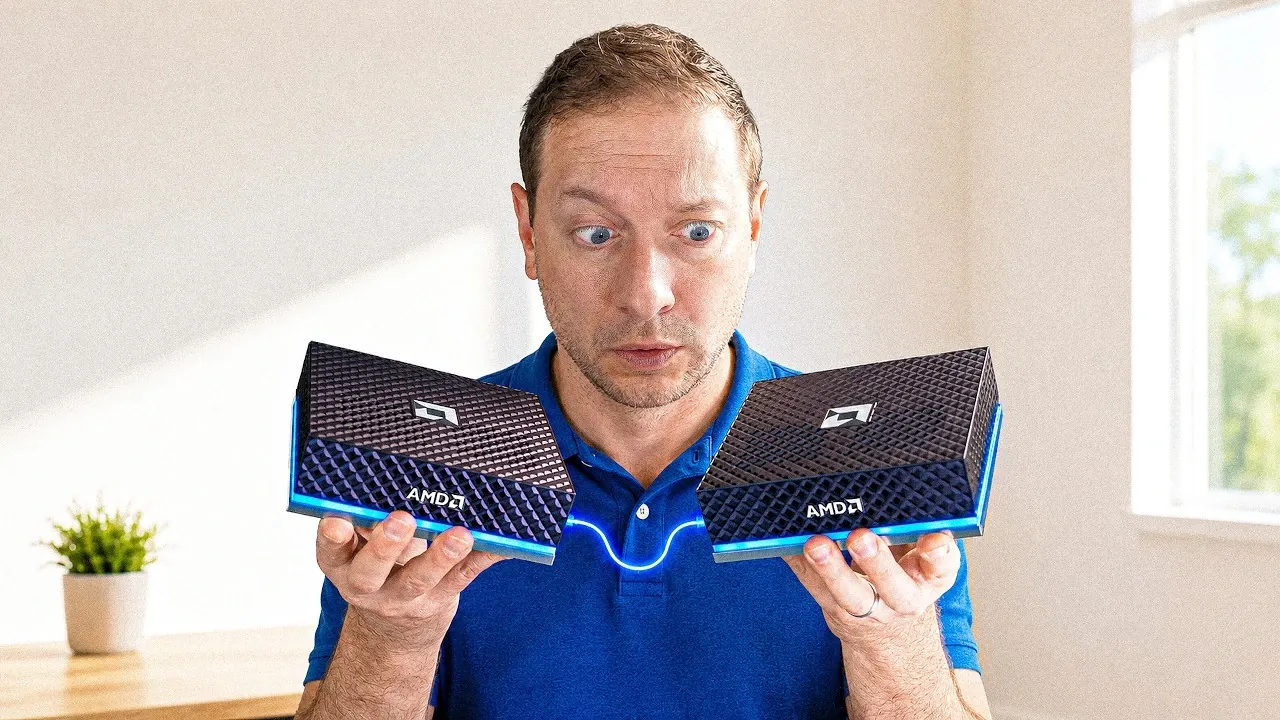
AMD’s Ryzen AI Halo introduces a compact yet capable solution for handling large-scale AI models, using its integrated APU architecture to streamline processing. With 128 GB of shared memory per unit, a single device can execute models with up to 200 billion parameters, while clustering two devices doubles this capacity to accommodate 400 billion-parameter models. Alex Ziskind explores this system’s performance, focusing on its ability to manage complex workloads like GLM 4.7 and Quen 3.5, while also addressing the technical challenges of setup and memory optimization.
Gain insight into the practical considerations of deploying the Ryzen AI Halo, including the role of Linux-based clustering configurations, quantization techniques for efficient memory use and the necessity of high-speed networking infrastructure. This overview also highlights the trade-offs between clustering methods such as Llama CPP and Rickle (RCCL), helping you understand which approach best suits specific workloads. Whether you’re exploring scalability for research labs or small-scale data centers, these findings provide a clear framework for maximizing the system’s potential.
AMD Ryzen AI Halo
TL;DR Key Takeaways :
- The AMD Ryzen AI Halo integrates CPU and GPU functionalities into a single APU, offering 128 GB of shared memory per device, allowing seamless execution of AI models with up to 200 billion parameters, or 400 billion when clustered.
- Clustering two devices doubles memory and computational power, requiring a Linux-based OS, memory pooling and high-speed networking (10 GB Ethernet switch) for optimal performance.
- Two clustering methods are available: Llama CPP for simpler setups and Rickle (RCCL) for advanced tensor parallelism and high concurrency workloads.
- Performance tests demonstrated speeds of up to 18 tokens per second and successful execution of large models like GLM 4.7 (358 billion parameters) and Quen 3.5 (397 billion parameters).
- Scalability and future applications include multi-node configurations for advanced workloads, making the Ryzen AI Halo suitable for small-scale data centers, AI research labs and organizations expanding their AI infrastructure.
The Ryzen AI Halo is specifically designed to address the increasing demands of AI research and deployment. Its integrated APU architecture eliminates the need for separate CPU and GPU components, reducing latency and enhancing overall efficiency. Some of its standout features include:
- 128 GB of Shared Memory: This high memory capacity allows seamless processing of large-scale AI models, reducing bottlenecks in execution.
- Compact and Efficient Design: The device’s small form factor makes it ideal for use in small-scale data centers and AI research labs where space and power efficiency are critical.
- Scalability: The system supports clustering, allowing users to combine multiple devices to handle even larger models and workloads.
With the ability to execute models containing up to 200 billion parameters on a single device, the Ryzen AI Halo is a powerful tool for researchers and organizations working with complex datasets.
Clustering: Unlocking Greater Potential
To extend its processing capabilities, the Ryzen AI Halo supports clustering, allowing two devices to work in tandem. This configuration effectively doubles the system’s memory and computational power, allowing the execution of models with up to 400 billion parameters. The clustering process involves several critical components:
- Linux-Based Operating System: A Linux environment is required to enable advanced clustering configurations and memory pooling between devices.
- Memory Pooling: The 128 GB of memory from each device is combined into a unified pool, making sure efficient resource utilization and seamless execution of large models.
While clustering significantly enhances the system’s capabilities, it requires precise setup and adherence to AMD’s configuration guidelines to achieve optimal performance.

Learn more about AMD Ryzen AI Halo with other articles and guides we have written below.
- 128GB Ryzen AI Halo Replaces Cloud Servers for Local AI
- Ryzen AI Halo vs Nvidia DGX Spark: Which PC Wins for Local AI
- New AMD’s $1,500 Strix Halo PC Runs 120B AI Models Locally
- 128GB AMD Ryzen AI Halo Allocates 96GB VRAM for Local AI
- AMD Ryzen AI Halo Replaces Cloud Servers with 128GB RAM
The Role of Networking in Clustering
High-speed networking is a crucial element in the dual-device setup. A 10 GB Ethernet switch is mandatory to assist low-latency communication between the devices. Direct cable connections are insufficient to handle the data transfer rates required for large-scale AI models. The Ethernet switch ensures smooth and efficient data flow, which is essential for maintaining performance during model execution. Proper networking infrastructure is, therefore, a critical consideration for users aiming to maximize the Ryzen AI Halo’s potential.
Clustering Methods: Choosing the Right Approach
AMD provides two primary methods for clustering and memory pooling, each suited to different workloads and performance requirements:
- Llama CPP with RPC: This method offers a straightforward approach to memory sharing between devices. It is well-suited for single or limited concurrent tasks but may face limitations when handling larger models or workloads requiring high concurrency.
- Rickle (RCCL): A more advanced method that uses tensor parallelism through VLM and Ray. It provides superior scalability and is ideal for scenarios requiring high concurrency and efficient resource distribution.
The choice between these methods depends on the specific needs of the workload. While Llama CPP is simpler to implement, Rickle offers greater flexibility and performance for demanding applications.
Performance Insights: Testing the Ryzen AI Halo
Performance testing of the Ryzen AI Halo revealed its impressive capabilities in handling large-scale AI models. During testing, models such as GLM 4.7 (358 billion parameters) and Quen 3.5 (397 billion parameters) were successfully executed. Key performance metrics included:
- Processing Speed: The system achieved speeds of up to 18 tokens per second with a concurrency level of four, demonstrating its ability to handle complex tasks efficiently.
- Memory Utilization: The 128 GB shared memory per device was used effectively, making sure smooth execution of large models.
However, challenges such as memory allocation limits and the complexity of setup were noted. Proper quantization techniques were essential to optimize model quality and execution efficiency, highlighting the importance of careful planning and configuration.
Addressing Setup Challenges
Configuring the Ryzen AI Halo for optimal performance requires attention to several critical factors. Key considerations include:
- Linux Compatibility: A Linux-based operating system is essential for advanced memory allocation and clustering configurations.
- System Consistency: Making sure uniform configurations across devices is crucial for maintaining consistent performance in clustered setups.
- Quantization Techniques: Reducing model size through quantization without compromising accuracy is vital for enhancing execution efficiency and overcoming memory limitations.
By addressing these challenges, users can unlock the full potential of the Ryzen AI Halo and achieve optimal performance for their AI workloads.
Scalability and Future Applications
The Ryzen AI Halo offers significant scalability, making it a versatile solution for a wide range of AI applications. Beyond clustering two devices, multi-node configurations can further extend the system’s capabilities, allowing it to handle even more advanced workloads. By using advanced clustering methods such as Rickle (RCCL), organizations can scale their AI infrastructure to meet growing demands while maintaining efficiency and performance.
This scalability positions the Ryzen AI Halo as an ideal choice for small-scale data centers, AI research labs and organizations seeking to expand their AI capabilities. Its ability to handle models with up to 400 billion parameters ensures that it remains relevant for future advancements in AI research and deployment.
Media Credit: Alex Ziskind
Disclosure: Some of our articles include affiliate links. If you buy something through one of these links, Geeky Gadgets may earn an affiliate commission. Learn about our Disclosure Policy.
