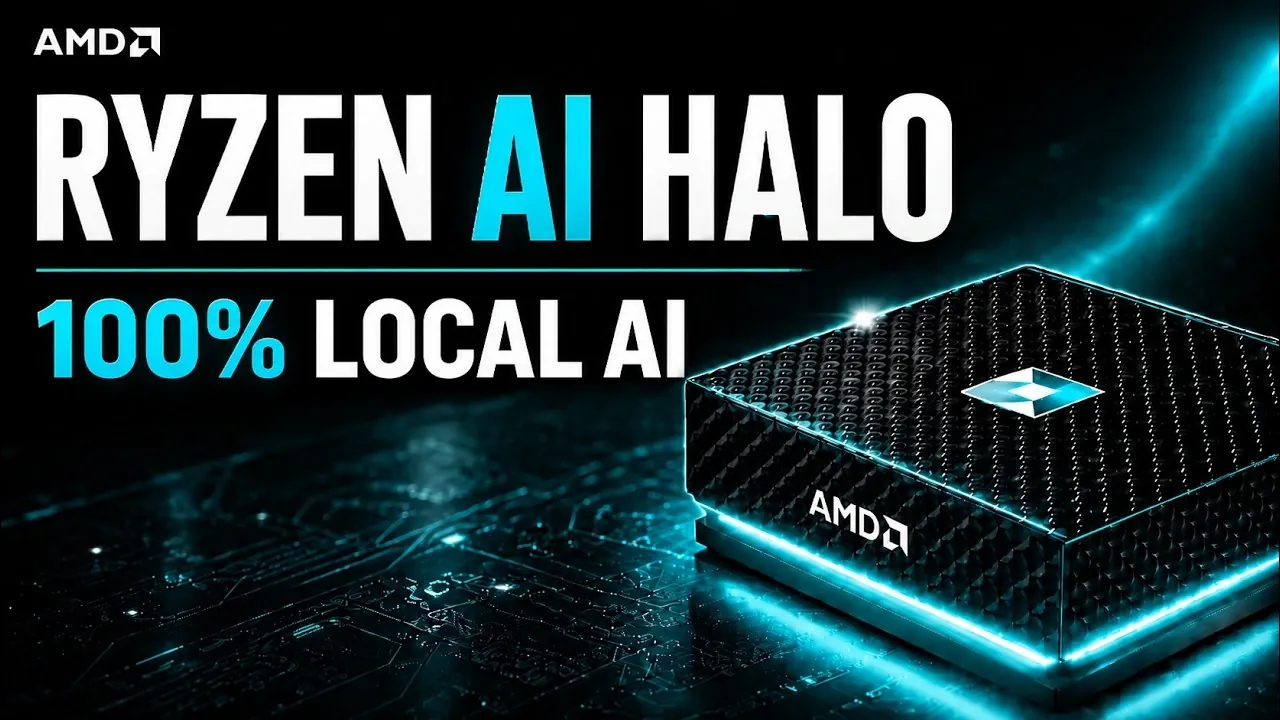
The AMD Ryzen AI Halo represents a significant development in local AI processing by focusing on privacy and eliminating reliance on cloud services. Equipped with the Ryzen AI Max Plus 395 chip and 128 GB LPDDR5X unified memory, it is built to handle resource-intensive tasks such as running large language models or fine-tuning neural networks. According to Sam Witteveen, the system’s unified memory architecture allows the CPU and GPU to share resources efficiently, reducing bottlenecks during operations like image generation and video rendering.
Explore how the Ryzen AI Halo supports a wide range of AI workflows with its pre-installed software ecosystem, including LM Studio and Comfy UI, which enable tasks like natural language processing and creative content generation. Learn about the performance capabilities of its Radeon 8060S GPU, delivering 60 teraflops at FP16 precision and its 50 TOPS Neural Processing Unit, designed for emerging AI applications. This deep dive offers a detailed look at the hardware and software features that make the system suitable for developers and researchers.
Key Features and Capabilities
TL;DR Key Takeaways :
- The AMD Ryzen AI Halo is a high-performance workstation designed for local AI computing, eliminating the need for cloud services and offering a private, scalable and cost-efficient solution for AI developers and researchers.
- Key hardware features include a Ryzen AI Max Plus 395 chip with 16 CPU cores, a Radeon 8060S GPU delivering 60 teraflops at FP16 precision and a Neural Processing Unit (NPU) with 50 TOPS for advanced AI workloads.
- Its 128 GB LPDDR5X unified memory architecture enables seamless CPU-GPU resource sharing, optimizing performance for tasks like running large language models, image generation and video rendering.
- The system comes pre-configured with AI tools and operating systems, such as Llama CPP and Comfy UI, allowing users to perform tasks like natural language processing, model fine-tuning and creative content generation immediately.
- Future upgrades, including a Pro495 version with 192 GB memory, are planned to enhance capabilities for handling larger models and more complex workloads, making sure the system remains innovative.
The AMD Ryzen AI Halo is engineered to meet the increasing demand for local AI processing. Its standout features include:
- 128 GB LPDDR5X unified memory for seamless CPU-GPU resource sharing, making sure efficient memory utilization.
- Ryzen AI Max Plus 395 chip with 16 CPU cores, delivering exceptional computational power for demanding tasks.
- Radeon 8060S GPU capable of achieving 60 teraflops at FP16 precision, ideal for high-performance AI workloads.
- Neural Processing Unit (NPU) with 50 TOPS, designed to handle emerging AI applications with ease.
- Pre-installed AI tools and operating systems for immediate usability, reducing setup time.
These features collectively make the Ryzen AI Halo a robust platform for AI development, offering both performance and convenience.
Unified Memory Architecture: Redefining Efficiency
At the core of the Ryzen AI Halo’s performance lies its 128 GB LPDDR5X unified memory architecture, which enables the CPU and GPU to share memory resources seamlessly. This eliminates bottlenecks in resource allocation, a common issue in traditional systems. The unified memory is particularly beneficial for running large language models (LLMs) such as GPT OSS 120 or Quen 3.6. Tasks like image generation, video rendering and AI model fine-tuning are executed with remarkable efficiency, thanks to this dynamic resource-sharing capability. This architecture ensures that the system remains responsive and capable of handling complex workflows without compromise.

Here are additional guides from our expansive article library that you may find useful on local AI.
- Ollama Runs 32B Local AI Models on a $599 Mac via Quantization for Free
- How DeepSeek Fits a 284B Parameter AI Model on a Single Laptop
- Awesome DIY Raspberry Pi 5 Offline AI Companion Inspired by BMO from Adventure Time
- Forget the Cloud: This Tiiny Pocket PC Packs 80GB RAM for Local AI
- New AMD’s $1,500 Strix Halo PC Runs 120B AI Models Locally
- Build Your Own AI Assistant an Local AI Agent Quickly with Cursor AI (No Code)
- 128GB Ryzen AI Halo Replaces Cloud Servers for Local AI
- Revive Your Old Tech: Running a Local LLM on a 12-Year-Old Raspberry Pi
- Why NVIDIA’s New 748GB Desktop is Replacing Enterprise Cloud AI Subscriptions
- Meet oMLX : Apple Silicon’s Fastest Local AI Model Runner
Hardware Optimized for AI Workloads
The AMD Ryzen AI Halo’s hardware is carefully designed to cater to the demands of intensive AI tasks. Key components include:
- CPU: The Ryzen AI Max Plus 395 chip, featuring 16 cores, delivers unparalleled processing power for complex computations.
- GPU: The Radeon 8060S GPU achieves 60 teraflops at FP16 precision, making it ideal for high-performance AI tasks such as training and inference.
- NPU: With 50 trillion operations per second (TOPS), the Neural Processing Unit is optimized for emerging AI applications, making sure future-proof performance.
This combination of CPU, GPU and NPU creates a balanced and powerful system capable of running advanced AI models and executing demanding workflows with ease.
Pre-Configured for Immediate Productivity
The Ryzen AI Halo is designed to be ready for use straight out of the box. It comes pre-installed with Linux or Windows operating systems that are optimized for AI development. Additionally, the AMD Ryzen AI Developer Center simplifies software and driver management, while pre-configured tools such as Llama CPP, Comfy UI and LM Studio enable users to perform tasks like:
- Natural language processing for chatbots and virtual assistants.
- Image and video generation for creative projects.
- Fine-tuning AI models for specific applications.
This plug-and-play approach minimizes setup time, allowing users to focus on their projects immediately.
Performance and Versatility for Diverse Applications
The Ryzen AI Halo is designed to excel in handling large-scale AI workloads, making it a versatile tool for various applications. Its capabilities include:
- Running large language models (LLMs) with billions of parameters for research and development.
- Fine-tuning pre-trained models using advanced tools like Unsloth.
- Generating high-quality images and videos through programmatic workflows.
- Deploying local AI agents, such as Hermes, for continuous tasks or integration into applications.
These features make the Ryzen AI Halo an invaluable asset for developers, researchers and content creators, offering the flexibility to adapt to a wide range of use cases.
Advanced Features for Technical Users
For users with advanced technical requirements, the Ryzen AI Halo offers additional capabilities to enhance productivity and performance:
- Support for writing custom GPU kernels, allowing users to optimize computational workflows for specific tasks.
- Speculative decoding and gradient accumulation, which improve the efficiency of model fine-tuning processes.
- Remote access via SSH, allowing users to manage workloads from virtually anywhere, making sure flexibility and convenience.
These advanced features empower power users to push the boundaries of AI development and tailor the system to meet their unique needs.
Applications Across Industries
The AMD Ryzen AI Halo is well-suited for a variety of industries and applications, including:
- Running large open-weight models with over 40 billion parameters locally, eliminating the need for cloud-based solutions.
- Creating and curating AI-driven images and videos for content production in media and entertainment.
- Developing AI agents to automate tasks or serve as interactive tools in fields such as healthcare, finance and education.
Its versatility and performance make it a valuable tool for professionals across multiple domains, allowing innovation and efficiency in their respective fields.
Future Developments and Upgrades
AMD has announced plans to release an upgraded version of the Ryzen AI Halo, the Pro495, which will feature an expanded 192 GB memory capacity. This enhancement will enable the system to handle even larger models and more complex workloads. Additionally, improvements in NPU utilization and model efficiency are expected, further solidifying the Ryzen AI Halo’s position as a leader in local AI processing. These future developments underscore AMD’s commitment to staying at the forefront of AI technology.
Who Should Choose the Ryzen AI Halo?
The AMD Ryzen AI Halo is an ideal choice for AI developers, researchers and enthusiasts who prioritize local, private AI solutions over cloud-based alternatives. Its cost-efficient architecture appeals to users looking to reduce expenses associated with API usage while maintaining high performance. Whether you are working on research, development, or creative applications, the Ryzen AI Halo offers the scalability, power and flexibility needed to meet diverse AI workloads effectively.
Media Credit: Sam Witteveen
Disclosure: Some of our articles include affiliate links. If you buy something through one of these links, Geeky Gadgets may earn an affiliate commission. Learn about our Disclosure Policy.
