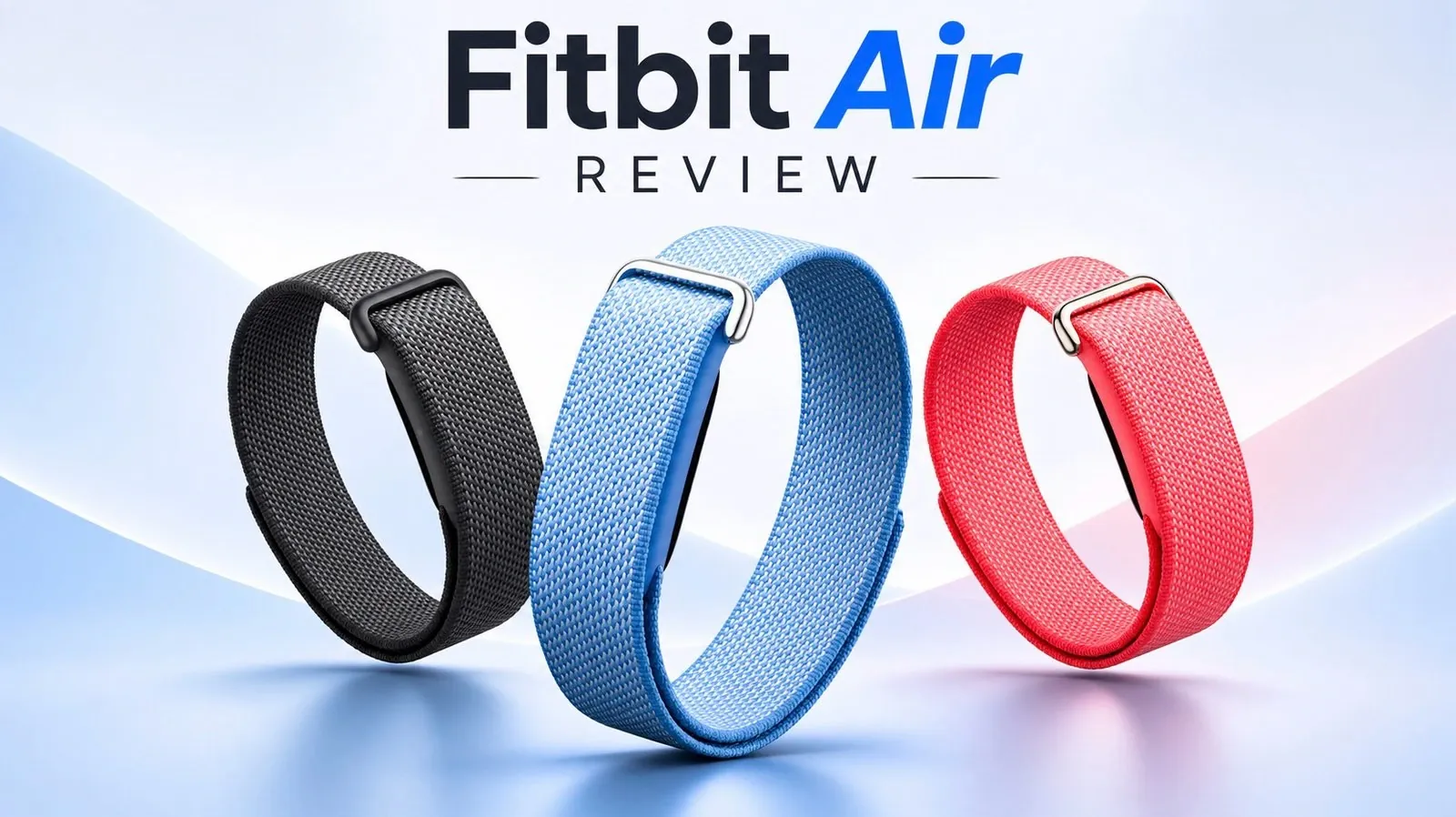
The Fitbit Air has emerged as a noteworthy contender in the realm of health and fitness tracking, offering a mix of affordability and precision. Its heart rate tracking stands out, particularly during indoor cycling, where it achieved a perfect correlation of R = 1.00 with the Polar H10 ECG chest strap, a widely regarded benchmark. However, challenges were noted in activities like weightlifting, where the device occasionally missed peak heart rates. These findings were rigorously tested by The Quantified Scientist.
Explore how the Fitbit Air performs across multiple dimensions, from sleep stage tracking with 94% deep sleep agreement to its ability to monitor trends in heart rate variability. You’ll also gain insights into its automatic activity detection, app usability, and the trade-offs it presents for specific use cases like outdoor biking or low heart rate monitoring. This review provides a detailed breakdown of its strengths and limitations.
TL;DR Key Takeaways :
- The Google Fitbit Air demonstrated exceptional accuracy in heart rate tracking, achieving a perfect correlation (R = 1.00) with the Polar H10 ECG chest strap during indoor cycling and strong results for running (R = 0.99), though outdoor biking (R = 0.94) and weightlifting posed more challenges.
- Sleep stage tracking was benchmarked against the Zmax EEG device, showing 94% agreement for deep sleep, 76% for light sleep, and 79% for REM sleep, ranking it among the best devices tested in 2026 for sleep tracking.
- Health monitoring features include blood pressure and insulin trend tracking, as well as high and low heart rate alerts, though low heart rate alerts may occasionally produce false positives during inactivity.
- Nighttime heart rate tracking was highly accurate for average heart rates between 44 and 49 BPM but struggled with very low heart rates below 37-38 BPM. Heart rate variability tracking showed a bias, underestimating higher HRV values but reliably tracking trends over time.
- Priced at approximately $100, the Fitbit Air offers a strong price-to-performance ratio, excelling in heart rate and sleep tracking, though it has limitations with weightlifting detection and extremely low heart rate monitoring.
Fitbit Air: A Reliable Tracker for Heart Rate and Sleep Monitoring
The Fitbit Air has been extensively tested for heart rate tracking, sleep stage monitoring, and health insights. Designed for ease of use, it passively tracks activities and health metrics without requiring manual input. Its “wear it and forget it” approach offers convenience for users. Here’s a detailed look at its performance across key metrics.
Heart Rate Tracking: Highly Accurate Across Activities
The Fitbit Air demonstrated exceptional accuracy in heart rate tracking, particularly when worn on the biceps. During indoor cycling, it achieved a perfect correlation of R = 1.00 with the Polar H10 ECG chest strap, a widely recognized gold standard. It accurately captured entire spinning sessions, with near-perfect alignment to the reference.
Running tests also showed strong results, with a correlation of R = 0.99. Most data points closely matched the reference, though minor discrepancies occurred, such as slightly low readings during brief moments and occasional missing data during breaks. A small cluster of points below the blue line was noted, but no cadence lock was detected.
Outdoor biking posed more challenges, with a correlation of R = 0.94. While most readings were accurate, occasional underestimations of heart rate occurred during specific moments. Despite these issues, the Fitbit Air outperformed 63% of devices tested for outdoor biking and 80% for indoor cycling.
Weightlifting was more difficult for the device. It requires manual initiation to track sessions and sometimes missed heart rate peaks. Performance varied by exercise type (e.g., back and biceps vs. chest and triceps), though it was unclear which performed better. Overall, the Fitbit Air surpassed 81% of devices tested for weightlifting.

Here is a selection of other guides from our extensive library of content you may find of interest on Fitbit Air comparisons.
- Fitbit Edge vs Fitbit Air: Trades Lightweight Design for GPS
- Fitbit Air vs Garmin CIRQA: Tracking Accuracy Compared
- Fitbit Air vs Garmin Cirqa vs Hume Band 2.0: Which One’s for You?
- Garmin CIRQA vs Google Fitbit Air: Which Fitness Tracker Suits You Best?
- Garmin CIRQA vs Fitbit Air: $200 Premium Beats $100 Value
- Fitbit Air vs Garmin Cirqa: Weighing the Steep $201 Price Gap
- Luna Band vs Fitbit Air: Which Fitness Tracker is Better?
- WHOOP vs FitBit Air vs Garmin CIRQA vs Amazfit Helio
- Fitbit vs Whoop vs Oura Ring 5: REM Sleep Tracking Compared (One Month Test)
- The Best Fitbit Air Features You Probably Aren’t Using Yet
Sleep Stage Tracking: Among the Best in 2026
The Fitbit Air’s sleep stage tracking was benchmarked against the Zmax EEG device, a “silver standard” for measuring brain waves and eye movements. It showed 94% agreement for deep sleep, 76% for light sleep, and 79% for REM sleep. While it slightly overestimated deep sleep and occasionally missed REM sleep near the end of the night, its overall performance was rated excellent. Awake moments were harder to detect, though these were excluded from analysis due to electrode issues.
Among devices released or tested in 2026, the Fitbit Air ranked as a top performer for sleep stage tracking, alongside the Fitbit Edge, Fitbit Charge 6, and Pixel watches. It achieved a sleep score of 83, rated as “great.” Its performance was comparable to the Eight Sleep Pod, a mattress-integrated sleep tracker with advanced features like temperature control but at a significantly higher cost. The Eight Sleep Pod, described as a favorite sleep improvement device, is “super expensive.”
Health Monitoring Features
The Fitbit Air includes several health monitoring features under Google’s “health guardian” system. These track blood pressure trends, insulin trends, and heart rate alerts. The blood pressure trends feature uses heart rate patterns to suggest whether a user should consult a doctor, while the insulin trends feature assesses diabetes risk. Testing indicated no high blood pressure or diabetes risk for the user.
The device also provides high and low heart rate alerts. Low heart rate alerts may occasionally produce false positives during inactivity but not during sleep. High heart rate alerts, though rare, could offer meaningful warnings when triggered.
Heart Rate Variability and Nighttime Metrics
For nighttime heart rate tracking, the Fitbit Air showed strong agreement with the Polar H10, particularly for average heart rates between 44 and 49 BPM, where it was described as “super accurate.” However, it struggled to detect heart rates below 37-38 BPM, even when the user’s heart rate occasionally dropped to 34 BPM. For example, the Fitbit Air recorded 40.5 BPM when the ECG measured 38 BPM.
Heart rate variability (HRV) tracking revealed a systematic bias. While the Fitbit Air aligned well with the ECG chest strap for lower HRV values, it tended to underestimate higher HRV values. Despite this, the order of nights based on HRV measurements was nearly identical between the two devices, making it reliable for tracking trends over time.
Automatic Activity Detection and App Experience
The Fitbit Air’s automatic activity detection has improved, now distinguishing between activities like trail running and regular running. It can also identify recurring activities, such as tennis, based on movement patterns.
The Fitbit Air app, while functional, was noted to be cluttered. Despite its layout, all necessary information is accessible, and it remains superior to many competing apps.
Price and Value
Priced at approximately $100, the Fitbit Air offers an impressive price-to-performance ratio. Its heart rate tracking score of 98 and sleep score of 83 place it among the top-tier devices for both metrics. While it struggles with very low heart rates and requires manual input for weightlifting, its overall performance is highly reliable.
The Fitbit Air is a strong choice for users seeking accurate heart rate and sleep tracking at an affordable price. Its strengths in automatic tracking and health monitoring make it a standout in its category, especially when worn on the biceps. However, those with specific needs, such as weightlifting detection or extremely low heart rate monitoring, may encounter limitations.
Media Credit: The Quantified Scientist
Disclosure: Some of our articles include affiliate links. If you buy something through one of these links, Geeky Gadgets may earn an affiliate commission. Learn about our Disclosure Policy.
