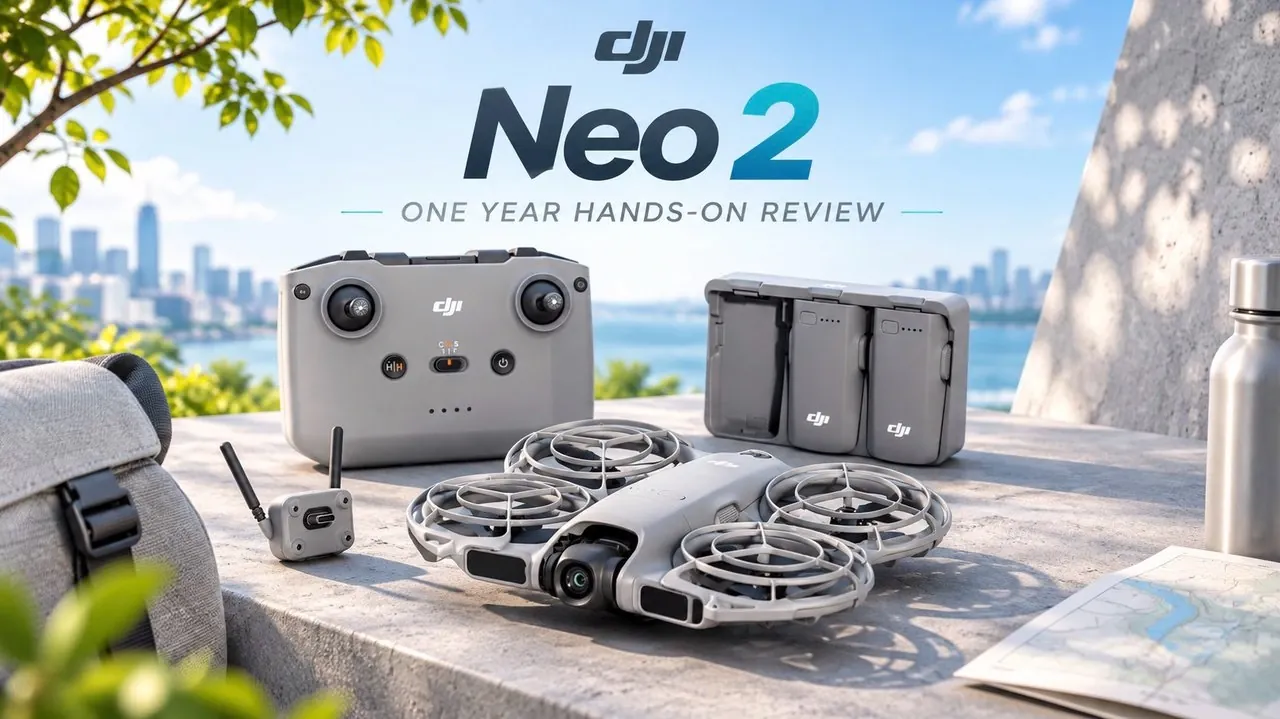
With the DJI Neo 2 camera drone, you can film yourself without learning conventional flight controls. Flying Filmmaker rates it the best subject-tracking drone they have used. Hand gestures let you shift its position while it follows you, so you don’t have to reach for your phone, but realistic flight times mean spare batteries are worth carrying. Explore how those controls work and where its tracking excels, as well as why limited editing options and built-in storage make it better suited to casual filming than demanding cinematic work.
DJI Neo 2: Portable Tracking With Camera Limits
TL;DR Key Takeaways :
- The Neo 2 launches from your palm and follows subjects without a remote, but tracking a car requires a dedicated remote.
- It weighs 151 g without the digital transceiver, but its light body makes it less suited to very windy conditions than larger drones.
- The camera records 4K video at up to 60 fps, but 8-bit color and no log profile limit color grading.
- Expect roughly 10 to 15 minutes of flight time in realistic use, making spare batteries useful for frequent flying.
- The drone-and-battery package costs about $259 to $260 on Amazon in the US and does not include an external remote.
After a year of use, the DJI Neo 2 stands out for its portability and automated tracking, though its camera and flight characteristics limit the footage you can capture. The small camera drone can take off from your palm, follow you and return to your hand.
DJI designed it for filming everyday activities, travel and outdoor adventures without always needing a separate controller. It launched on November 13, 2025, following the original DJI Neo.
Hand Launch and Controls Simplify Flying
The Neo 2 lets you capture footage without learning conventional drone controls, while also suiting experienced pilots looking for convenient, casual shots. Press a button on the drone to launch it from your hand, and it can follow, orbit or carry out automated shots. The front display shows the selected mode, while buttons on the drone let you adjust settings such as flight height and distance.
All follow and automated flight modes are available without a remote, and the drone generally works with few bugs. The DJI Fly phone app adds settings and virtual joysticks for manual flight, with phone control rated by DJI at up to 500 m in open conditions, and less in practice.
Raise your palm during tracking to reposition the drone: gesture control moves it sideways, up, down, closer or farther away without requiring you to retrieve your phone or land it.
For conventional stick control, the Neo 2 supports remotes including the DJI RC-N3, which holds and connects to a phone, and DJI RC 2. It also works with DJI Goggles 3 or Goggles N3 and compatible FPV controllers for a camera-eye view. A DJI Neo 2 Digital Transceiver is required for remote-controller or goggles operation. It is included in the Fly More Combo and the Motion Fly More Combo, and sold separately for the drone-only package.

Expand your understanding of DJI Neo 2 with additional resources from our extensive library of articles.
- One Year of DJI Neo 2 Flights Exposes a 13-Minute Battery Flaw
- How to Connect Your DJI Neo 2 to the Meta Quest 3
- Modified DJI Neo 2 Hits 163 Km/h with Custom 3D Printed Mounts
Tracking Keeps Up, but Cars Need a Remote
In testing, the Neo 2 followed its subject through difficult environments and found paths around obstacles where other drones had become lost or crashed. Flying Filmmaker rates it the best subject-tracking drone the channel has used, though obstacle avoidance is not perfect.
The drone uses omnidirectional vision sensing, forward-facing LiDAR and downward infrared sensing. It can detect and avoid obstacles while tracking from the front or sides, and its ActiveTrack mode includes a cycling option.
After a hand launch, it can follow a visible person riding a bike or four-wheeler. However, it cannot track a car using hand-launched or phone-controlled tracking; car tracking requires a dedicated remote.
Compact and Tough, but Limited in Wind
The Neo 2 is easy to carry and held up well to crashes during demanding tracking and obstacle-avoidance use, with no resulting problems. Its flexible plastic body has no long projecting arms and does not fold, making it tougher than a traditional camera drone. It weighs 151 g without the digital transceiver or 160 g with it, both below the 250 g threshold above which some countries apply more rules.
For four-wheeler rides, it is more convenient than bulkier drones such as the Mini 5 Pro and Air 3S, which require a remote. DJI recommends the Neo 2 for users aged 16 and above, and the drone is not waterproof.
Full-coverage propeller guards reduce exposure to the spinning blades, though a finger can still reach them. Flying Filmmaker found that in one full-speed collision, the drone bounced off its user without causing injury. It is not indestructible, and you should not deliberately fly it into yourself.
Wind is a more consequential limitation: the light body and propeller guards make the Neo 2 less suited to very windy conditions than larger camera drones, although you can still use it in some wind. Its small propellers spin quickly to generate enough lift, producing a high-pitched sound that can be loud and annoying, although it is less loud than the original Neo in use.
With a regular remote, the drone is relatively slow for longer flights, even compared with the Mini 5 Pro. DJI rates its maximum horizontal speed at 8 m/s in Normal mode and 12 m/s in Sport mode under controlled conditions. Tracking was nevertheless quick in confined spaces, where it is about as fast as any drone.
Good 4K Footage Comes With Editing Limits
The Neo 2’s video is usable for documenting adventures, YouTube and social media, though it falls short of higher-end DJI drones for professional cinematic work. Some inexpensive drones advertise 4K but produce poor footage. The Neo 2’s principal camera specifications include:
- 1/2-inch sensor: Captures photos at up to 12 megapixels.
- 4K video: Records horizontal footage at 30, 50 or 60 frames per second.
- 4K slow motion: Records at 100 fps with remote or motion control.
- Vertical video: Reaches 2.7K at 30, 50 or 60 fps.
A two-axis mechanical gimbal stabilizes tilt and roll, alongside RockSteady electronic stabilization. The camera offers 8-bit color and no log or flat color profile, giving you less flexibility for extensive color grading. In use, its low-light footage also falls behind the DJI Mini 5 Pro or a larger drone.
Photos are JPEG only, with no raw option for more flexible editing, although that matters less for a drone primarily used for video. The drone records to 49 GB of internal storage rather than a removable microSD card. Flying Filmmaker assumes this saves weight, but you must empty a full drive before recording can continue, transferring footage to a computer over USB-C, which can interrupt a long filming session.
Short Flights Make Spare Batteries Useful
Battery life is modest compared with larger drones. DJI claims up to 19 minutes under controlled conditions without the propeller guards or digital transceiver, or 17 minutes with the guards fitted and no transceiver. You can expect roughly 10 to 15 minutes in realistic use. The Fly More Combo’s extra batteries are recommended for frequent flying, as drones do not achieve their rated flight times in practice.
The drone-and-battery package costs about $259 to $260 on Amazon in the US and does not include an external remote, placing it among the cheapest drones worth considering.
We think the Neo 2 suits people who want to film their own outdoor activities with little effort and little risk. Automated tracking reduces the work, while its tough body and propeller guards offer some reassurance, though obstacle avoidance is not perfect and the blades remain reachable. Alongside its grading limitations, fixed storage and vulnerability to strong wind make it a poor fit for anyone who needs editing flexibility, swappable storage or steady flying in those conditions. Having to transfer files before a full drive can record again is a particular constraint on longer outings.
Flying Filmmaker would buy the DJI Neo 2 again for casual adventure filming, but advises professional filmmakers needing advanced camera controls to look elsewhere. You can record yourself without carrying a remote, while the lack of log profiles and raw photos leaves less room for editing than higher-end drones. The deciding factor is whether you want an easy way to capture your activities or footage with the flexibility for demanding cinematic work.
Media Credit: Flying Filmmaker
Disclosure: Some of our articles include affiliate links. If you buy something through one of these links, Geeky Gadgets may earn an affiliate commission. Learn about our Disclosure Policy.
