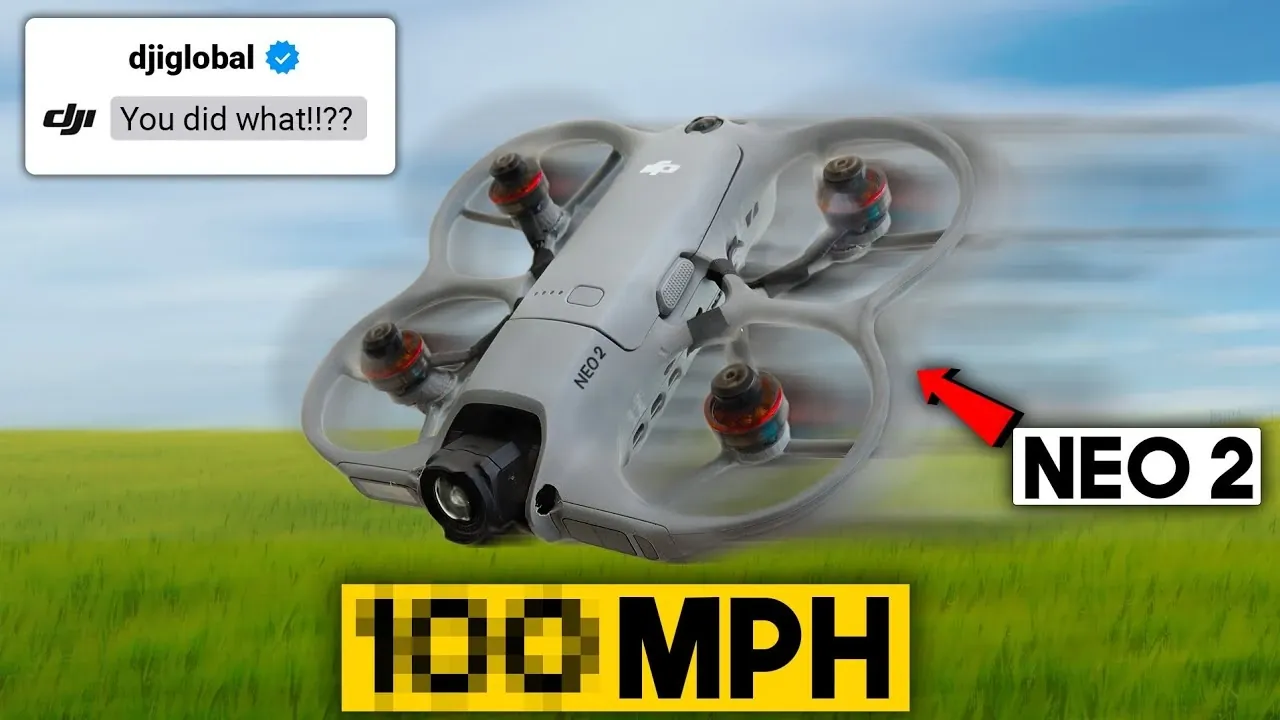
The DJI Neo 2, originally designed as a user-friendly consumer drone with a modest top speed of 61 km/h (37.9 mph), has undergone a remarkable transformation. Through a series of targeted modifications, a team of enthusiasts pushed its performance to an astonishing 163 km/h (101.5 mph), more than doubling its original speed. As highlighted by Justin Bainbridge, this achievement required balancing structural integrity with high-speed capabilities. Key changes included upgrading the motors, optimizing the flight controller and integrating advanced heat management systems to handle the increased stress and energy demands.
In this breakdown, you’ll gain insight into the specific modifications that enabled this record-breaking performance. Discover how weight reduction and motor upgrades worked in tandem to improve agility and learn about the challenges of maintaining stability at extreme speeds. You’ll also explore the role of advanced electronics and tuning in achieving precise control under demanding conditions. Whether you’re a drone enthusiast or curious about engineering ingenuity, this guide offers a detailed look at the process behind turning a casual-use drone into a high-speed machine.
DJI Neo 2 Speed Mod
TL;DR Key Takeaways :
- The DJI Neo 2, originally designed as a budget-friendly and stable consumer drone, was transformed into a high-performance machine capable of reaching 163 km/h (101.5 mph), more than doubling its original speed of 61 km/h (37.9 mph).
- Key modifications included weight reduction, motor upgrades, an electronics overhaul, battery enhancements, structural reinforcements, improved heat management and meticulous tuning optimization.
- Challenges such as increased vibrations, heat generation and maintaining structural integrity were addressed through innovative solutions like custom motor mounts, heat sinks and airflow improvements.
- The project demonstrated the untapped potential of consumer drones, showcasing how engineering expertise and creativity can push technological boundaries.
- This achievement serves as inspiration for drone enthusiasts and hobbyists, highlighting the possibilities of optimizing entry-level drones for extraordinary performance.
Starting Point: The DJI Neo 2’s Original Capabilities
The DJI Neo 2 was designed with simplicity and accessibility in mind. Its lightweight frame and modular design made it an ideal choice for beginners and casual users. However, these same features also provided a solid foundation for modifications. The drone’s stock configuration prioritized stability, with features like propeller guards and a balanced power-to-weight ratio making sure smooth operation. While these characteristics limited its speed, they also offered a reliable platform for experimentation.
The challenge for the team was to push the Neo 2 beyond its intended limits without compromising its structural integrity or flight stability. This required a careful balance of performance enhancements and structural reinforcements, making sure that the drone could handle the stresses of high-speed flight.
Key Modifications That Made the Difference
Transforming the DJI Neo 2 into a record-breaking drone required a series of targeted upgrades. Each modification addressed specific limitations, working together to achieve a dramatic improvement in performance. The key changes included:
- Weight Reduction: The team removed non-essential components, such as propeller guards and certain structural supports, reducing the drone’s weight by 10 grams. This seemingly minor adjustment significantly improved the power-to-weight ratio, allowing faster acceleration and more agile handling.
- Motor Upgrades: The stock motors were replaced with larger, more powerful alternatives capable of generating greater thrust. Custom 3D-printed mounts were used to secure the new motors, making sure proper alignment and balance. While these upgrades provided the necessary power for high-speed flight, they also introduced challenges such as increased vibrations and heat generation.
- Electronics Overhaul: High-performance components, including an FPV-specific flight controller and an advanced electronic speed controller (ESC), replaced the stock electronics. These upgrades allowed for precise tuning and faster response times, making sure stability and control even at extreme speeds.
- Battery Enhancements: The original battery was swapped for a high-capacity 6-cell LiPo battery. This provided the voltage and current required to power the upgraded motors. However, the increased energy output necessitated improved thermal management to prevent overheating.
- Structural Adjustments: Reinforcements were added to critical areas of the frame to handle the stresses of high-speed flight. Despite these changes, the team preserved the Neo 2’s recognizable design, maintaining its aesthetic appeal.
- Heat Management: To address the heat generated by the upgraded motors and battery, the team integrated heat sinks and improved airflow channels. These measures ensured consistent performance during extended high-speed flights.
- Tuning Optimization: The flight controller was carefully calibrated to balance thrust, stability and responsiveness. Extensive trial and error, combined with favorable wind conditions during test flights, allowed the team to fine-tune the drone for peak performance.

Find more information on DJI Neo by browsing our extensive range of articles, guides and tutorials.
- What DJI Actually Changed in the New Neo 2 Drone
- How to Connect Your DJI Neo 2 to the Meta Quest 3
- DJI Neo 2 vs Lito Series: the Best Sub-$500 Drone Guide
- Are You Making These 10 DJI Neo 2 Mistakes?
- Why Insta360’s Rumored Modular Drone Could Be the Ultimate DJI Neo 2 Alternative
- Insta360 May Challenge DJI Neo 2 with Rumored 360-Degree Drone
- DJI Neo 2 vs Avata 2, the Honest Test That Flips Our Best Drone Pick Today
- Why the RayNeo Air 4 Pro is the Perfect DJI Neo 2 Upgrade
- DJI Lito X1 vs Neo 2: Hidden Trade-Offs in DJI’s Budget Drone Lineup
- How to Stop Crashing Your New DJI Neo 2 Drone
Overcoming Challenges Along the Way
Each modification introduced its own set of challenges, requiring innovative solutions to ensure success. For example, the upgraded motors generated significant vibrations, which threatened to destabilize the drone. To counter this, the team fine-tuned the motor mounts and adjusted the flight controller settings to minimize oscillations. Similarly, the increased heat output from the motors and battery posed a risk of overheating. This was addressed through the integration of heat sinks and improved airflow systems, which effectively dissipated excess heat.
Another challenge was maintaining the drone’s structural integrity while pushing it to higher speeds. The team reinforced critical areas of the frame without adding excessive weight, striking a balance between durability and performance. These efforts ensured that the Neo 2 could handle the stresses of high-speed flight without compromising its stability or reliability.
The Record-Breaking Achievement
After months of meticulous planning, testing and refinement, the modified DJI Neo 2 achieved a top speed of 163 km/h (101.5 mph), more than doubling its original capability. This remarkable feat demonstrated the potential of consumer-grade drones when paired with engineering expertise and creativity. Despite the extensive modifications, the team managed to preserve the Neo 2’s original aesthetic, making the transformation even more impressive.
This achievement not only set a new benchmark for drone performance but also showcased the ingenuity and determination of the team behind the project. Their success serves as a testament to the possibilities of innovation and the rewards of pushing technological boundaries.
What This Means for Drone Enthusiasts
The transformation of the DJI Neo 2 highlights the untapped potential of consumer drones. For hobbyists, engineers and enthusiasts, this project serves as a case study in the art and science of drone optimization. By focusing on key areas such as weight reduction, motor upgrades and tuning optimization, even entry-level drones can achieve extraordinary performance.
This achievement also underscores the importance of creativity and technical expertise in overcoming challenges. Whether you’re a seasoned engineer or a curious hobbyist, the lessons from this project offer valuable insights into the possibilities of drone modification. With the right approach, the limits of consumer drones can be redefined, opening the door to new opportunities in recreational and professional applications.
Media Credit: Justin Bainbridge
Disclosure: Some of our articles include affiliate links. If you buy something through one of these links, Geeky Gadgets may earn an affiliate commission. Learn about our Disclosure Policy.
