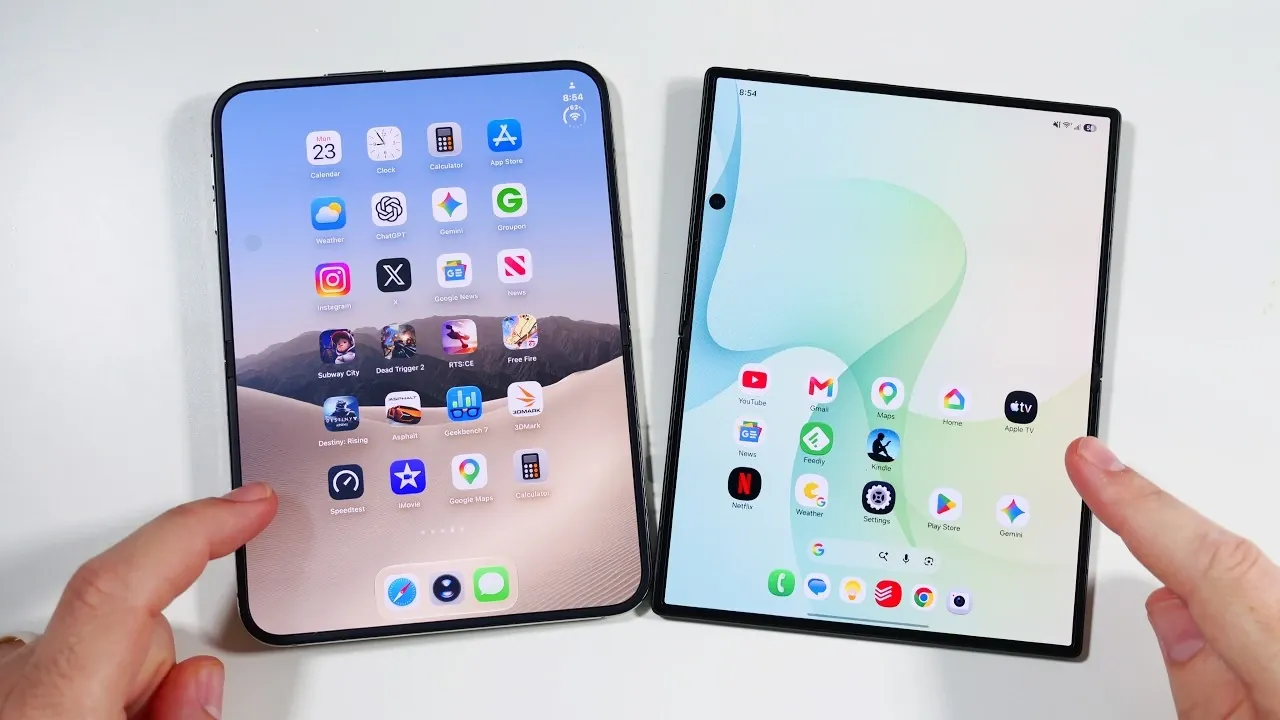
Choosing a foldable means balancing battery life against how well apps use the larger screen. The Apple iPhone Duo lasted about one to one and a half hours longer than the Samsung Galaxy Z Fold 8 in use. Nick Ackerman finds that the Galaxy is lighter and better suited to multitasking, while the Duo still has app and layout quirks. Find out why the Galaxy makes more of its inner screen and how using each phone’s displays affects battery life. The video below from Nick Ackerman gives us more details.
TL;DR Key Takeaways :
- Battery life: The iPhone Duo lasted about one to one and a half hours longer than the Galaxy in use.
- Multitasking tools: The Galaxy offers three-app split screen and separate layouts for its outer and inner displays.
- App support: The Duo has over 100,000 apps, but incomplete support and layout quirks prevented its use as a main phone.
- Durability ratings: The Duo has an IP68 rating, while the Galaxy has an IP48 rating.
- Daily performance: The Duo wins synthetic benchmarks, but the Galaxy felt snappier in everyday tasks.
The Apple iPhone Duo brings iOS to a first-generation foldable, while the Samsung Galaxy Z Fold 8 runs Android and follows years of Samsung foldable phones. This comparison draws on one month with the Duo and longer with the Galaxy.
For durability, the Galaxy Z Fold 8 is the safer choice: Samsung has more foldable experience, and the Samsung models used have avoided serious issues. The Duo’s titanium shell feels sturdy, and its hinge held up through the first month.
Some early Duo units may have hinge problems, but the unit used for the comparison held up well, and neither of the two units was defective. Apple offers replacements under its one-year warranty if something happens to the Duo.
The Duo has an IP68 rating, compared with IP48 for the Galaxy. Dust can enter the Samsung’s hinge, and its screen protector can lift and make a crackling sound that might be mistaken for a hinge problem; the sound was heard occasionally on the unit used here.
The Galaxy is Lighter, but Both Hinges Hold Angles
The Galaxy Z Fold 8 feels lighter and is easier to hold for extended periods, while the Duo’s extra weight is noticeable in a pocket and when holding it to watch content.
Both hinges hold the screens at different angles, but the Duo’s feels stronger when propped up in the positions used for the comparison. It can also display its Standby clock with the phone on its hinge.
Both inner-screen creases were visible at extreme light angles but hard to see head-on. The Galaxy’s taller, more square inner display gives two apps more vertical space, while the Duo’s has a more rounded shape.

The Galaxy Makes Better Use of Its Screens
For multitasking, the Galaxy offers a more developed layout, with three-app split screen, edge panels and separate arrangements for its outer and inner displays. Its cover screen feels like a phone, while the inner screen behaves more like a tablet.
The Duo carries more of its cover-screen interface inside, where it feels like a larger iPhone. Its app library does not fill the inner display, its dock sits higher than the Galaxy’s, and side controls take up some screen space, although some apps do fill the inner screen.
On the Duo’s cramped cover display, certain apps show a black bar, and icons shift over rather than fully using the display. Its uninterrupted matte inner screen has anti-reflection and is less reflective for extended reading, while the Galaxy’s glossier display fills out more of the screen but has a prominent camera cutout.
App Support Still Holds the iPhone Back
The Galaxy Z Fold 8 is the stronger choice for everyday productivity: its multitasking tools and the apps used in the comparison make better use of the foldable screen. Almost all those apps were configured for the Galaxy’s display, whereas support for the Duo remains incomplete.
More than 100,000 apps are available on the Duo, but not all are specifically designed for it. Many have been updated, though not all, and updates continue to appear that are not Duo-specific. Biblio Times is one app designed for the Duo, presenting a newspaper-like layout on the foldable display.
Recent Duo updates have reduced the bugs and crashes encountered when moving from the outer screen to the inner one. Even so, remaining app and layout quirks prevented its use as a main phone at the time of the comparison.
The Galaxy Feels Faster in Daily Use
The Duo wins in synthetic benchmarks, but the Galaxy Z Fold 8 felt snappier in everyday tasks. Its animations run faster and can be adjusted to go faster still, while the Duo also remains quick in ordinary use.
With its A20 chip, the Duo may sustain better performance when pushed in a game. Its Touch ID scanner felt a little slower than the Galaxy’s in daily use.
What the Cameras and Controls Offer
Neither phone offers iPhone Max-level cameras, though most regular camera users do not use variable aperture or pro features. The Duo has a fairly wide front camera, and its rear cameras can be used with a screen preview. The Galaxy also has an outer-screen front camera, while its rear camera zooms up to 10x and can record in 8K.
The Duo offers a kids preview that the Galaxy lacks, though Samsung offered similar features on previous phones. The Duo has camera-control buttons but no action button, while the Galaxy has no extra camera buttons and does not really support the S Pen.
Calls, Colors and Resale Value
For calls, the Galaxy’s speaker is centered, and either phone can be paired with earbuds such as AirPods or Galaxy Buds.
The Duo comes in night sky and star white, while the Galaxy comes in graphite, cream, lavender and pistachio. Both foldables have higher price tags than ever, and limited stock has contributed to high demand for the Duo. Samsung phones usually fetch less secondhand or in trade-ins, except when traded back to Samsung for another Samsung phone.
The iPhone Lasts Longer on Battery
The Duo delivered about one to one and a half hours more battery life than the Galaxy Z Fold 8 in use. Heavy inner-display use took a major toll on both phones, while the Duo lasted much longer when its outer screen was used instead.
We think the Z Fold 8 suits people who want a foldable that just works and costs less. The Duo suits those who value portability and can live with a few rough edges, but it is a harder sell for lefties.
For a lightweight foldable that prioritises getting work done, the Galaxy Z Fold 8 is the stronger choice on this comparison. The iPhone Duo is better suited to you if you want iOS and longer battery life and can accept its current app limitations. Both can handle day-to-day needs, but the Duo’s software still has more work to do.
You may also find these earlier articles from our collection useful.
- Apple vs. Samsung Foldable Wars: Is the iPhone Duo Actually Better Than the Z Fold 8?
- iPhone Duo vs. Galaxy Z Fold 8: Did Apple Just Catch Samsung?
- iPhone Duo vs. Galaxy Z Fold 8: The Truth About Apple’s First Foldable
- iPhone Duo: 5 Features That Make It Worth the Price
- iPhone Duo: Key Details Apple Barely Mentioned on Stage
Source & Image Credit: Nick Ackerman
Disclosure: Some of our articles include affiliate links. If you buy something through one of these links, Geeky Gadgets may earn an affiliate commission. Learn about our Disclosure Policy.
