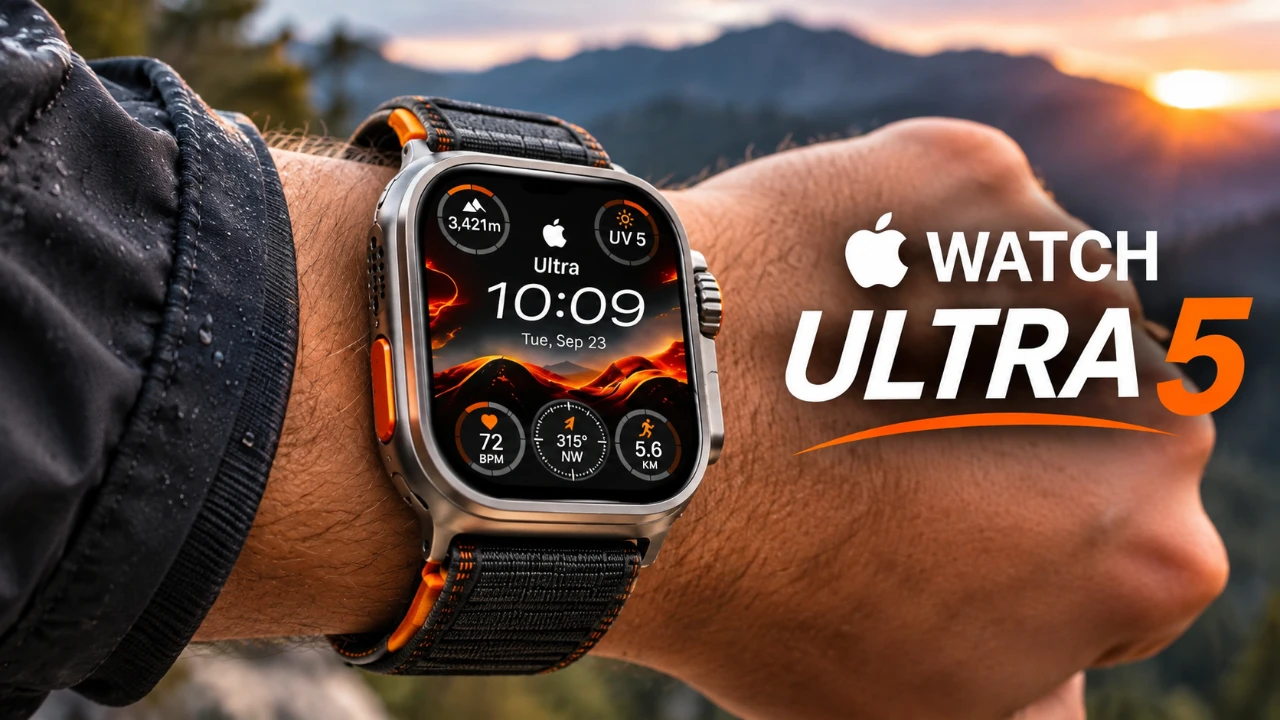
Apple has not yet officially announced the Apple Watch Ultra 5, yet early display supply-chain reports and wearable leaks suggest the next-generation rugged smartwatch could target meaningful battery efficiency gains and a potential band-attachment redesign in 2027. Following the September 2026 debut of the Apple Watch Ultra 4—which pushed everyday battery ratings to 50 hours while keeping the familiar 49mm titanium silhouette—rumors around the Ultra 5 center on power-saving high-mobility oxide (HMO) OLED panels, expanded AI-driven health insights, and a possible change to how watch straps lock into the case. The video below from Tech Town breaks down what early leaks reveal.
TL;DR Key Takeaways :
- Unannounced 2027 Target: Apple has not confirmed the Apple Watch Ultra 5 or any hardware changes; September 2027 remains a speculative window based on Apple’s annual watch cycle.
- High-Mobility Oxide (HMO) OLED Rumors: Supply-chain reports indicate Apple is evaluating HMO OLED backplanes—offering roughly three to five times higher electron mobility than LTPO—to cut display power draw starting around 2027.
- Building on Ultra 4’s 50-Hour Benchmark: With the current Apple Watch Ultra 4 already rated for 50 hours of normal use and 84 hours in Low Power Mode, HMO panels could stretch multi-day endurance without thickening the watch.
- Band Connector Compatibility Risk: Leaks tip a broader 2027 Apple Watch exterior redesign that could replace the longstanding slide-in lug system—potentially freeing internal room while breaking compatibility with existing straps.
Unveiled on September 9, 2026, the Apple Watch Ultra 4 focused primarily on internal upgrades—pairing the S11 chip and an updated Health Sensing System with a 50-hour battery rating while preserving the external casing and band compatibility introduced on the original Ultra.
By contrast, early rumors looking ahead to 2027 point toward both display-level power savings and potential chassis changes. Because these reports come from early supply-chain chatter rather than Apple announcements, final hardware details and launch timing remain subject to change.
A More Efficient HMO OLED Display May Arrive
According to Korean display industry reports, Apple is evaluating high-mobility oxide (HMO) OLED backplane technology—being developed by LG Display alongside competing oxide/ALD display work from Samsung Display—as a successor to current LTPO panels.
Compared with conventional LTPO panels, HMO backplanes allow roughly three to five times higher electron mobility, reducing the electrical power needed to drive an Always-On Retina display. If mass-production yields and uniformity targets stay on track for 2027, adopting HMO OLED on the Apple Watch Ultra 5 could trim screen power consumption directly—extending real-world runtime without forcing Apple to pack in a heavier cell.

Battery Life Progression Across Apple Watch Ultra Models
Every step forward in battery endurance makes a tangible difference for multi-day backpacking, trail races, and overnight sleep tracking. Across existing generations, Apple’s official ratings have climbed steadily:
- Apple Watch Ultra (2022) & Ultra 2 (2023): Up to 36 hours of normal use, and up to 60 hours (Ultra 1) or 72 hours (Ultra 2) in Low Power Mode.
- Apple Watch Ultra 3 (2025): Up to 42 hours of normal use and 72 hours in Low Power Mode, plus up to 20 hours in Extended Workout mode.
- Apple Watch Ultra 4 (2026): Up to 50 hours of normal use, 84 hours in Low Power Mode, 25 hours in Extended Workout mode, and 45 hours in Max Extended Workout mode with one-second GPS sampling.
| Generation | Normal Use Rating | Low Power Mode | Display & Key Battery Driver |
|---|---|---|---|
| Apple Watch Ultra / Ultra 2 | Up to 36 hours | Up to 60h / 72h | LTPO OLED; S8 / S9 SiP |
| Apple Watch Ultra 3 (2025) | Up to 42 hours | Up to 72 hours | LTPO3 OLED + larger internal battery |
| Apple Watch Ultra 4 (2026) | Up to 50 hours | Up to 84 hours | LTPO3 OLED + S11 chip & updated Health Sensing System |
| Apple Watch Ultra 5 (Rumored 2027) | 50+ hours targeted (unconfirmed) | 84+ hours potential (unconfirmed) | Rumored HMO OLED panel + internal layout/band changes |
Health, AI Coaching, and Band Attachment Trade-Offs
Alongside display efficiency, future watchOS iterations are expected to deepen Siri AI and personalized recovery insights—building on Ultra 4’s Readiness scoring, Vitals metrics, and Workout Buddy coaching to turn daily sleep and training load data into more proactive guidance.
The biggest potential catch for longtime Apple Watch owners is the rumored band-attachment redesign. Tipster leaks pointing to a broader Apple Watch chassis overhaul in 2027 suggest Apple has explored replacing its classic slide-in strap lugs with a sleeker or magnetic connector to save internal volume. While freeing up case space could help engineers fit larger batteries or new health sensors, breaking backward compatibility would frustrate buyers with large strap collections.
Should You Wait for the Rumored Ultra 5?
If you need a rugged smartwatch now, the Apple Watch Ultra 4 already delivers multi-day 50-hour battery ratings, 45-hour GPS ultra-marathon tracking, and full compatibility with every existing 44mm/45mm/46mm/49mm band. Waiting for the rumored Apple Watch Ultra 5—speculatively penciled in for September 2027—makes the most sense only if you are comfortable holding out for unconfirmed HMO display efficiency and potential exterior changes.
Expand your understanding of Apple Watch Ultra with additional resources from our extensive library of articles.
- Apple Watch Ultra 4 vs Ultra 3: the Biggest Upgrades Explained
- Apple Watch Ultra 4: is It Worth Upgrading from Ultra 1 Or 2?
- Apple Watch Ultra 4 vs. Older Models: Is It Finally Time to Upgrade?
- Apple Watch 12 & Ultra 4: Leaks Reveal a Big Hardware Change
- Apple Watch Ultra 4: Is This Massive Battery Upgrade Worth It?
Source & Image Credit: Tech Town
Disclosure: Some of our articles include affiliate links. If you buy something through one of these links, Geeky Gadgets may earn an affiliate commission. Learn about our Disclosure Policy.
