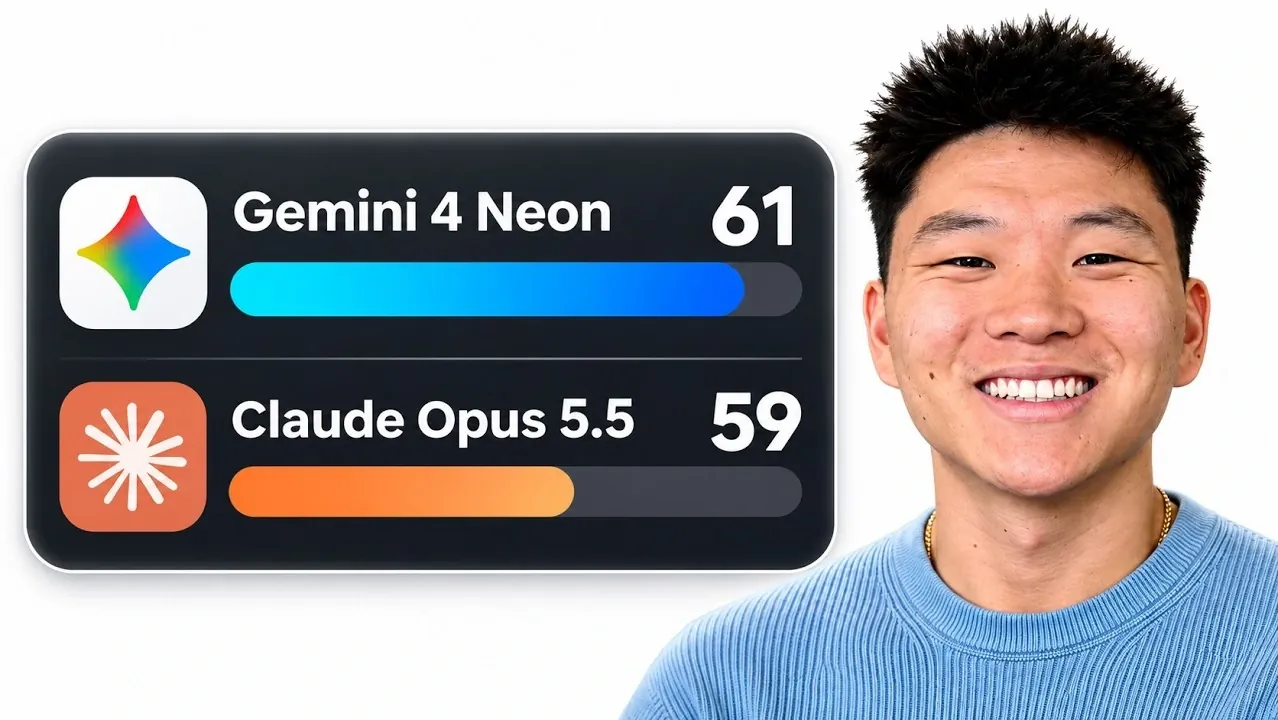
Google Gemini 4 Neon, an AI model available through an API, generated 283 million output tokens during a benchmark evaluation at its highest reasoning setting. Nate Herk has the details on why you’re billed for its internal reasoning as well as the answers you receive. That makes the reasoning setting important to your budget: Neon’s benchmark task costs were lower than Claude’s at low and medium effort, but higher at high and extra-high effort. Find out why reasoning effort changes the bill and how that played out in practical tests.
Gemini 4 Neon: Lower Rates, Variable Task Costs
TL;DR Key Takeaways :
- Gemini 4 Neon’s standard API rates are 25% lower than Claude Opus 5.5’s for input, output and cached input tokens.
- At xhigh effort, Neon generated 283 million billable output tokens across the Artificial Analysis Intelligence Index evaluation, versus a 65.4 million median.
- Artificial Analysis found Neon cheaper per task at low and medium effort, but more expensive at high and xhigh.
- On the Intelligence Index, Neon scored 60 against Opus’s 52 at high effort and 61 against 57 at xhigh.
- In a coastal-city API test, Neon used about 25,000 tokens and cost 37 cents, versus Opus’s 16,000 tokens and 32 cents.
Google introduced Gemini 4 Neon on November 18, 2026, following Anthropic’s September release of Claude Opus 5.5. Neon’s API rates are lower, but its total cost can be higher when it uses more tokens for a task.
Neon Charges Less Per Token
Gemini 4 Neon’s standard API rates are 25% lower than Claude Opus 5.5’s for input, output and cached input tokens. The following prices are per million tokens:
- Input: $3 for Gemini 4 Neon; $4 for Claude Opus 5.5.
- Output: $15 for Gemini 4 Neon; $20 for Claude Opus 5.5.
- Cached input: $0.15 for Gemini 4 Neon; $0.20 for Claude Opus 5.5.
Neon supports implicit caching, but not explicit caching. Claude Opus 5.5 also charges for cache writes: $5 per million tokens for a five-minute cache and $8 for a one-hour cache.

Expand your understanding of Gemini 4 Neon and competitors with additional resources from our extensive library of articles.
- Google Gemini 4 Neon Arrives as Faster, Cheaper Carbon Option
- OpenAI GPT-6.2 Astra vs Fable 5.2: Performance Comparison
- New Fable 5.2 AI Built a Complete Operating System in 8 Days
- Anthropic’s Fable 5.2 Codes a Gears of War Clone for About $15,000
- Claude Fable 5.2 Example Projects from Games to 3D Simulations
Reasoning Tokens Add to the Bill
Google includes Gemini 4 Neon’s internal reasoning tokens in its billable output tokens. Neon has four thinking levels that vary its reasoning depth and token consumption, with high as the default.
At xhigh effort, Neon generated 283 million output tokens across the Artificial Analysis Intelligence Index evaluation, compared with a median of 65.4 million among comparable models. A larger number of billable tokens can offset a lower output rate when comparing task costs.
Benchmark Costs Change With Reasoning Effort
Artificial Analysis recorded higher average costs per benchmark task for Neon at high and xhigh effort, but lower costs at low and medium effort. Its Intelligence Index v5.0.1 combines nine evaluations, and its average task cost accounts for input, cache reads and writes, reasoning and answer tokens, weighted by evaluation.
- Low: Gemini 4 Neon cost $0.75 per task; Claude Opus 5.5 cost $0.98.
- Medium: Gemini 4 Neon cost $1.90 per task; Claude Opus 5.5 cost $2.45.
- High: Gemini 4 Neon cost $3.74 per task; Claude Opus 5.5 cost $3.46.
- Xhigh: Gemini 4 Neon cost $6.44 per task; Claude Opus 5.5 cost $6.05.
Artificial Analysis also recorded $10.04 per task for Claude Opus 5.5 at max effort. On the Intelligence Index, Neon scored 60 against Opus’s 52 at high effort and 61 against 57 at xhigh. Nate Herk cites a score of 59 for Opus at the setting costing about $10 per task.
He also compares Neon with Fable 5.2, which he puts at $26 per task. At $6.44, Neon gets close to that level of intelligence for about a quarter of the price, in his view.
A City Prompt Used More Tokens With Neon
A direct API test produced a higher bill for Neon despite its lower token rate. Nate Herk had Claude send the same prompt for a 3D coastal city to both models through the API. Neon generated about 25,000 tokens and cost 37 cents, while Opus generated about 16,000 tokens and cost 32 cents. Both ran at their default settings: Neon took about 3 minutes and 17 seconds, compared with 2 minutes and 16 seconds for Opus.
The visual result was judged a tie, although the comparison was subjective and the models chose different styles. Neon produced a scene with sun, water and hills, while Opus built a street grid with cars and a sweeping lighthouse beam.
Other Jobs Produced Different Cost Gaps
For a coffee-subscription dashboard, the API costs were nearly identical: 40 cents for Neon and 41 cents for Opus. Both outputs kept numbers consistent across their cards, and the result was judged roughly a tie.
In a watch-configurator comparison by a tester the video cites, Neon cost $1.86 and produced a nine-part watch with broken interactions; Opus cost $2.74 and produced a 42-part watch. Another person’s similar comparison put Neon at $3.50 and Opus at $7.20. That tester liked Neon’s added detail but preferred the Opus
Disclosure: Some of our articles include affiliate links. If you buy something through one of these links, Geeky Gadgets may earn an affiliate commission. Learn about our Disclosure Policy.
