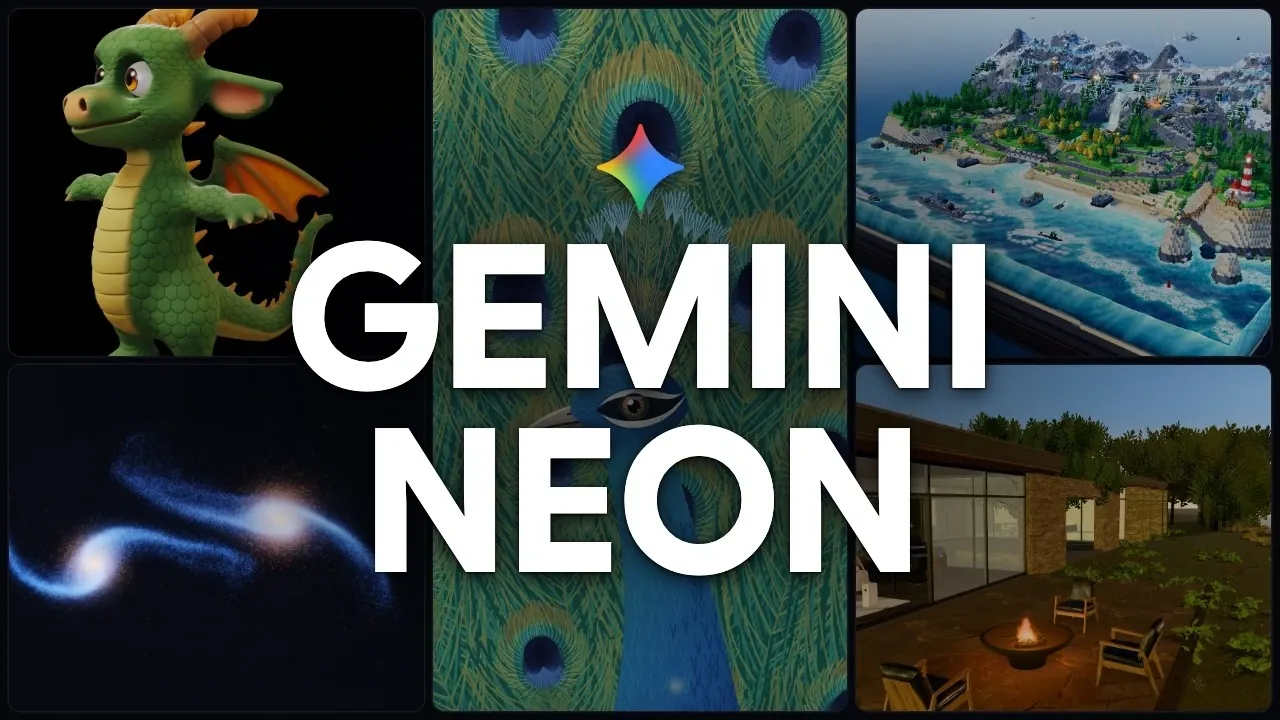
If you want to turn visual ideas into code or build an agent that can help manage an app, the new Google Gemini 4 Neon is an AI model that can do both. Prompt Engineering reports that Google’s latest Neon AI model created animated visuals, coordinated a group of agents and built a cloud agent that fixed a payment problem after human approval. Its work also shows limits: a multi-agent project consumed about 16 million tokens, and a generated lizard failed to regrow a front leg. See what Neon did, how it checked its work and where human oversight matters.
Building and Checking Visual Code
TL;DR Key Takeaways :
- Neon turned visual references into code: it created a dragon using a signed distance function and a critique tool, produced a looping animated SVG of a peacock, and revised a house tour to move through doors.
- In Antigravity, a seven-member swarm built a browser-based military diorama over 15 improvement rounds in about four hours. It used about 16 million tokens; Prompt Engineering cautions that swarms consume many tokens.
- Neon built Pager, a cloud agent that identified a faulty payment timeout in under a minute and, after human approval, restored the last working version, reducing errors to zero.
- Neon coded research experiments including a neural cellular automaton that grew and partially regrew a lizard, and a four-legged robot that reached about twice its target score.
- Without tools, Neon wrote the weights of a Breakout network that averaged about 550 points per game, versus about 25 for the best trained network in the published results. It also beat the trained network on Asterix but scored less than half as much on Seaquest.
Neon can turn visual references into code and create tools to inspect the result. Given a baby dragon image, it spent about 38 minutes producing a signed distance function, a formula that describes the distance from any point to the surface. It wrote a critique tool that rendered the dragon from five angles per round and measured how closely its outline matched the reference.
The task came from an experiment by graphics researcher Kenan Crane. Neon’s dragon was entirely code rather than a 3D model file; 3D software could produce it more easily and in less time.
Neon also converted a short peacock reference video into an animated SVG that loops for almost a minute. It wrote Python programs to generate the bird, forest and camera movement, then rendered and checked the animation over three rounds.
For a walk-through house, Neon found a floor plan online and selected a 1959 house by architect Marcel Breuer. Its first automatic tour ran into walls. After a request for more realistic visuals and movement through doors, the revised tour went room by room through the doors.
Coordinating Agents in Antigravity
Antigravity’s swarm feature lets one agent coordinate a group, with each member responsible for part of a job. Neon used a single agent for the dragon, peacock and house work, but a swarm for a browser-based military diorama made from small 3D blocks.
The coordinator divided the work among seven members, including agents responsible for terrain, vehicles and checking the frame rate. The group completed 15 improvement rounds in about four hours, checking for a steady frame rate each time.
The swarm used about 16 million tokens, mostly as agents repeatedly read the code and task board. Prompt Engineering considers swarm suitable for complex work but cautions that it consumes a lot of tokens.

Take a look at other insightful guides from our broad collection that might capture your interest in Gemini 4 and Antigravity.
- Leaked Gemini 4 Pro Enters Arena Testing for Multimodal AI
- Google Confirms Gemini 4 Replaces Gemini 3.5 Pro Entirely
- Gemini 4 Could Autonomously Refine Code via Leaked RSI
- Upgrade Google’s Antigravity With Real-Time Data Sync
- Multi-Agent Plans Stall Without Precision, Antigravity with OpenCode Delivers
Creating an On-Call Cloud Agent
With access to a Google Cloud project, Neon built Pager, an agent designed to monitor an app, identify a fault and apply a fix after human approval. Neon researched Cloud Run and its documentation, then deployed the project there after about 65 minutes of work. Cloud Run hosts apps on Google Cloud without requiring server management.
The project used Google Cloud’s Agent Development Kit and included a small coffee shop app, simulated shoppers and a console for approving fixes. Neon continued until its own end-to-end test passed against the live app, from deployment through the fix.
A bad deployment then changed the shop’s payment timeout from seconds to milliseconds, causing about a quarter of checkouts to fail. Pager identified the changed setting in under a minute and used a memory bank to recall an earlier occurrence. After approval, it restored the last working version, and errors fell to zero.
Pager could read logs and move traffic but could not delete anything, by design. Prompt Engineering recommends human approval for fixes by an agent that touches a live app.
Running Research Experiments
Neon can write code for computational experiments and check a simpler task before attempting a larger one. With access to a DGX Spark cluster, it implemented Growing Neural Cellular Automata, a research paper in which pixels run the same small neural network to grow an image from a single cell.
Neon wrote the training code and trained it in about 23 minutes. The resulting lizard grew from one cell and regrew after being cut, although a cut across its body produced a lizard without a front leg.
For a reinforcement learning task, Neon wrote an algorithm from scratch, checked it by balancing a pole and then trained a four-legged robot. The robot progressed from falling over to running and reached about twice the target score.
For a collision between two galaxies containing more than half a million particles, Neon first simulated one galaxy to check its stability. Its total energy stayed within a hundredth of a percent throughout that run.
Writing Neural Networks Directly
Weight-space programming is an idea from an MIT research paper in which a language model writes a neural network’s weights directly rather than obtaining them through training. Weights are the numbers inside a network that determine its behavior.
Given only the source code for a simple version of Breakout and no tools, Neon wrote every weight of a small network in one reply. The network averaged about 550 points per game, compared with about 25 points for the best trained network in the published results for the same game.
Neon’s network also beat the best trained network on Asterix, but scored less than half as much as the trained network on Seaquest. On Breakout, Neon used more than 100,000 thinking tokens before deciding to change or write a weight; Prompt Engineering says extra-high reasoning might have been excessive for that task.
Prompt Engineering calls Gemini 4 Neon a very capable model and recommends checking it out. For agents that touch a live app, Prompt Engineering recommends human approval before a fix is applied. Its advice is to match the reasoning level to the task’s complexity: extra-high might have been too much for Breakout. Prompt Engineering also recommends watching results personally, since agents checking their own work can miss small nuances.
Media Credit: Prompt Engineering
Disclosure: Some of our articles include affiliate links. If you buy something through one of these links, Geeky Gadgets may earn an affiliate commission. Learn about our Disclosure Policy.
