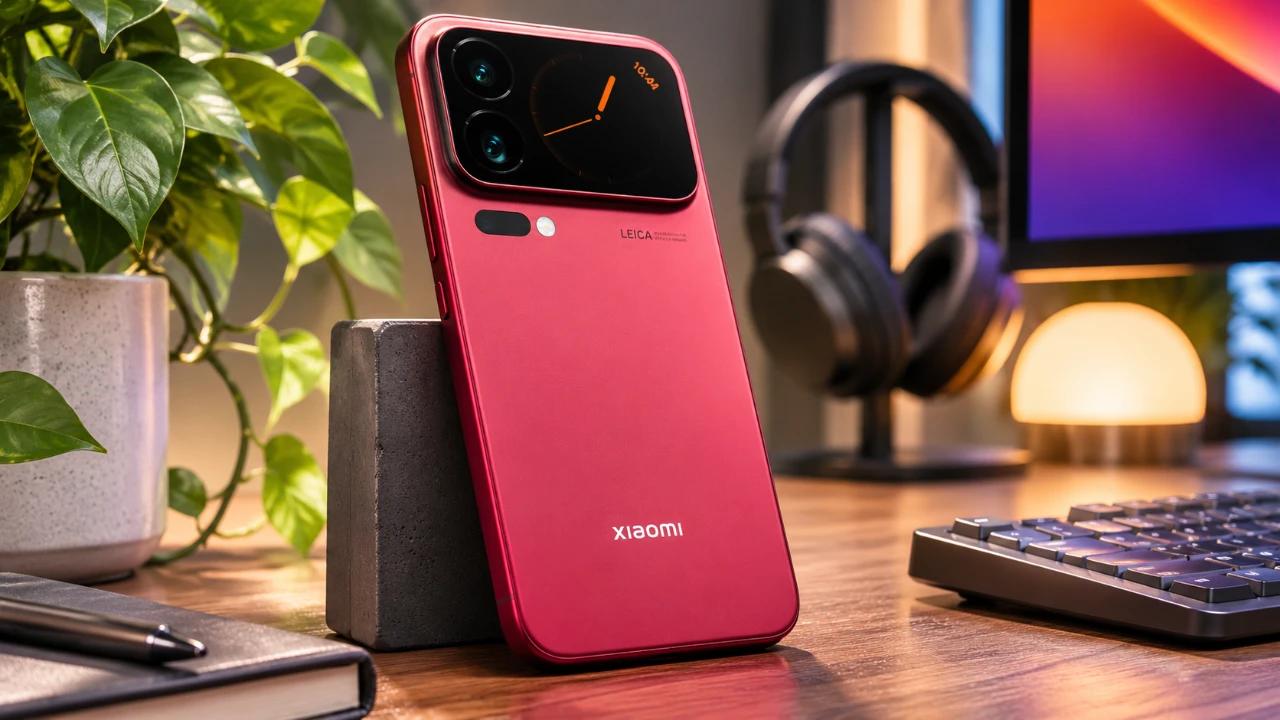
The new Xiaomi 18 Pro Max gives you longer battery life than rival phones, but its privacy display does little to hide content when viewed from above or below. The Tech Chap video below reports that it lasted one to two hours longer than the iPhone 18 Pro Max and Galaxy S26 Ultra in testing. Xiaomi’s phone also has a rear screen that works as a camera viewfinder, plus a telephoto camera suited to portraits. Find out why the rear screen is useful for selfies and how the cameras perform, including their weaker ultrawide lens.
TL;DR Key Takeaways :
- Price and availability: The Xiaomi 18 Pro Max starts at £1,399 in the UK, but its global release excludes North America.
- Rear screen: The 2.9-inch rear display doubles as a viewfinder for the rear cameras and supports a teleprompter mode.
- Privacy display: The 6.9-inch main screen hides content from horizontal side views but has almost no privacy effect vertically.
- Battery life: In testing, the global model lasted one to two hours longer than the iPhone 18 Pro Max and Galaxy S26 Ultra.
- Camera system: The main and telephoto cameras both have 200MP sensors, while the telephoto offers 3.2x optical zoom.
The Xiaomi 18 Pro Max succeeds the 17 Pro Max with a refreshed design, a newer Snapdragon chip and upgrades to its main and telephoto cameras. Xiaomi unveiled the global model in Paris on 17 November 2026, after its release in China. The global release does not include North America.
In the UK, the phone starts at £1,399 with 12GB of RAM and 256GB of storage. That is about £100 less than the Oppo Find X10 Pro Max and about £100 more than the iPhone 18 Pro Max.
The Rear Screen Does More Than Show Notifications
A 2.9-inch rear display sets the Xiaomi apart from rivals and offers uses beyond novelty. It can serve as a viewfinder for the rear cameras, so you can see yourself while recording, and the phone also has a teleprompter mode.
Running at 1-120Hz for smooth animation and always-on operation, the screen can show the time, notifications, and calendar events. You can also use interactive wallpapers and play a couple of games.

The Privacy Display Works Best From the Side
The 6.9-inch main screen hides its contents effectively from someone looking across it horizontally, but the privacy effect has almost no impact when viewed vertically. Despite Xiaomi’s claim that its implementation is better than the Galaxy S26 Ultra’s, Samsung’s screen obscured content sooner from the side and worked in both orientations.
Viewing angles involve a compromise even with privacy mode off: in testing, the Xiaomi lost more colour and brightness off-angle than the Samsung. However, it remained usable outdoors, particularly with sunlight mode on, and dimmed enough for night use.
Its main panel has a 2624 × 1208 resolution, a 1-120Hz refresh rate and up to 4,000 nits of peak brightness. Its 0.99mm bezels give it a narrow border.
Battery Life Outlasts Two Flagship Rivals
In testing, the global Xiaomi 18 Pro Max lasted a good one to two hours longer than the iPhone 18 Pro Max and Galaxy S26 Ultra. Its battery is smaller than the 17 Pro Max’s 7,500mAh pack, while the Chinese version has an 8,000mAh battery.
Xiaomi pairs the global model’s 7,050mAh battery with Qualcomm’s Snapdragon 8 Elite Extreme Gen 6 chip. Charging speeds carry over from the previous model:
- Wired charging: 100W.
- Wireless charging: 50W.
- Memory and storage: 12GB + 256GB, 12GB + 512GB, or 16GB + 1TB, depending on region.
The retail box includes a USB-C cable and protective case, but no power adapter. The phone has an IP68 dust and water resistance rating and comes in White, Black, Velvet Red and Cosmic Blue.
Two 200MP Cameras Lead the System
Both the main and telephoto cameras move to 200 megapixels, but the telephoto takes a different approach from its predecessor. It uses 3.2x optical zoom rather than 5x, with a larger 1/1.56-inch sensor instead of a 1/2-inch sensor. Long-range zoom may not be quite as good as before, but the new focal length is ideal for portraits.
The main camera uses a 1/1.28-inch sensor and retains LOFIC technology, which is designed to improve dynamic range. The 50MP ultrawide is the weak point: its roughly 102-degree field of view is narrower than those of other phones, and image quality dropped noticeably when switching to it, particularly in low light.
Rear cameras record video at up to 4K at 120fps or 8K at 30fps. The camera app also offers full-resolution 200MP photos, pro controls, dual video, time-lapse and panoramas.
Photos Keep Detail, but Skin Tones Divide Opinion
Compared with the iPhone 18 Pro Max, the Xiaomi produced more texture and retained more detail in bright highlights, including light-bulb filaments and neon light. Its zoom images also looked better at longer ranges in testing. Both phones produced good results up to around 20x or 30x, though at around 30x or 40x the trade-off became a noisy image or an AI image.
Colour was generally good, but in testing, skin appeared pale and overly bright on the Xiaomi, while the iPhone made people look tanned. You can adjust the camera’s rendering with Leica Vibrant, Leica Original, and Leica Authentic styles.
HyperOS 4 includes a reading mode that can turn the display black and white, a suite of AI tools, and Google Gemini integration. Its swipe-down menu also resembles the iPhone’s menu.
In our view, the rear screen is the one feature here that changes how you use a phone, because a viewfinder you can see from the back makes selfie-quality shots with the main cameras possible. Most flagship rivals rely on spec sheets alone.
The Tech Chap calls the Xiaomi 18 Pro Max an incredible phone and recommends it to buyers who can afford it and like its camera output and software. At £1,399 in the UK, it costs about £100 more than the iPhone 18 Pro Max. The recommendation is conditional on liking both the photos and HyperOS, not just the hardware.
Unlock more potential in Xiaomi flagship phones by reading previous articles we have written.
- Xiaomi 18 Fold Brings a 7.58-Inch OLED and Minimized Crease
- 2026 Flagship Shootout: S26 Ultra, iPhone 17 Pro Max, Pixel 10 Pro XL & Xiaomi 17 Ultra
- Flagship Battery Face-Off: Putting OnePlus, Oppo, Xiaomi, Vivo, Samsung, and Apple Head-to-Head.
Source & Image Credit: The Tech Chap
Disclosure: Some of our articles include affiliate links. If you buy something through one of these links, Geeky Gadgets may earn an affiliate commission. Learn about our Disclosure Policy.
