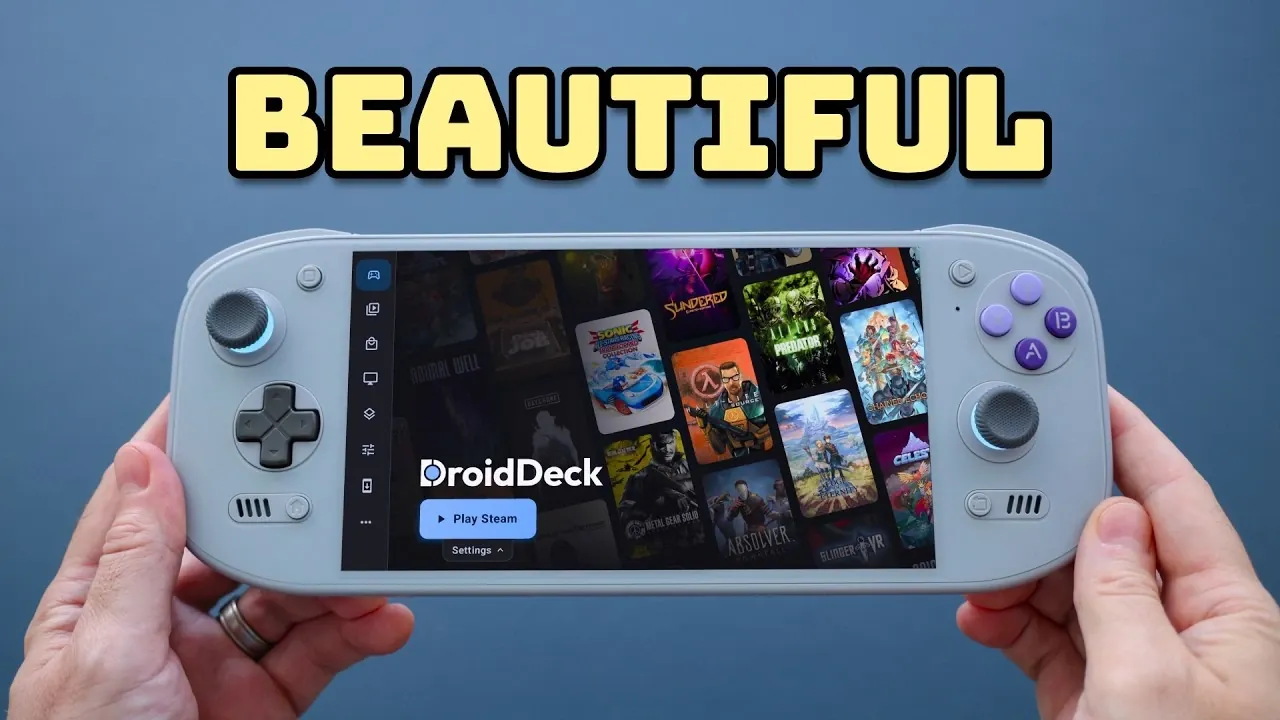
The AYN Odin 3 Portal is an Android gaming handheld with a 7-inch OLED screen and a starting price of $400. Its larger display and built-in controls give players a portable way to run Android games, stream from a PC and play games through emulators. It improves on the Odin 2 Portal, though the higher price makes the choice less straightforward, according to Retro Game Corps.
Compare emulation results across consoles, from reliably running PS2 games to the uneven performance of Xbox 360 titles. You can also see how battery life changes with demanding games and why internal temperatures raise concerns during extended play. For PC games, consider the time needed to select compatible apps and drivers alongside the option of buying a handheld PC.
TL;DR Key Takeaways :
- The Odin 3 Portal starts at $400 and has a 7-inch 1080p OLED display up to 120 Hz, a Snapdragon 8 Elite equivalent processor and a 9,000 mAh battery. It weighs 446 g but is not pocketable.
- In testing, the display showed rich colors and was bright enough for outdoor use. Larger built-in grips improved comfort, though comfort is personal.
- Local PC streaming averaged approximately 0.5 ms decoding time and lasted more than 12 hours at 1080p and 120 Hz. PSP, PS2, GameCube and Wii games played well, while Xbox 360 and PS3 emulation results varied by game.
- Battery life ranged from 8 hours and 20 minutes for PS2 emulation of Jak and Daxter to just under three hours for PS3 emulation of inFAMOUS. Demanding games reached 100-102°C; the long-term effects of high internal temperatures are unconfirmed.
- Retro Game Corps sees the Portal as an upgrade for high-end Android gaming, but prefers a handheld PC for higher-end PC games to avoid Android compatibility and configuration issues. The $260 Odin 2 Portal offers a similar experience for lighter games for less.
Display and Design
The Odin 3 Portal has roomy controls around its screen, but it is not pocketable. At 446 g, it weighs less than the 670 g ROG Xbox Ally, another 7-inch handheld. The smaller AYN Odin 3 has a 6-inch screen and the same Snapdragon 8 Elite equivalent processor.
- Display: 7-inch OLED, 1080p, up to 120 Hz
- Processor: Snapdragon 8 Elite equivalent
- Battery: 9,000 mAh
- Weight: 446 g
- Starting price: $400
- 16 GB RAM and 512 GB storage: $550 at pre-order pricing
- 1 TB storage: $670 at pre-order pricing
In testing, the display showed rich, saturated colors and was bright enough for outdoor use. Most play took place at 50% to 60% brightness, with lower settings in the dark. The speakers also performed well with music.
HDR support is less consistent than the screen itself. RetroArch has an HDR toggle, and HDR10 produced deeper tonal variation and an expanded color gamut, but Android does not often support HDR. Black frame insertion can reduce motion blur on a 120 Hz display, though it darkens the picture.
Controls and Comfort
The D-pad felt clicky and precise. The face buttons were easy to press and quieter than those on the previous Portal, but still audible enough to disturb someone sitting nearby during Hades 2. The original AYN Odin 3’s buttons were quieter in the same situation.
The analog sticks are larger than before and have a good range of motion, but they are not full-sized. The flat triggers have textured tops and a good amount of travel. A matte texture on the sides of the glass front reduced smudging.
The built-in grips are substantially larger than before, making the handheld more comfortable without an accessory. Comfort is personal, however, and some early owners like the new shape. AYN sells a grip for the Odin 3 Portal.

Here is a selection of other guides from our extensive library of content you may find of interest on AYN Odin handhelds.
- AYN Odin 3 Portal Features a 6-Inch 120Hz OLED and Emulates Switch Games at 60 FPS
- AYN Odin 3 Hands-On Review : OLED Handheld Built for 120 FPS Android Play
- How to Turn the Odin 3 Into an ARM-Based Steam Deck Alternative
- Retroid Pocket 6 vs AYN Odin 3 vs Anbernic RG556 Handheld Consoles Compared
- AYN Odin 2 Portal 7 inch OLED Handheld Games Console Outshining the Competition
Streaming and Emulation
Local PC streaming delivered an average decoding time of approximately 0.5 milliseconds, sometimes lower. At 1080p and 120 Hz over Wi-Fi, with Apollo on the PC and Artemis on the handheld, the Odin 3 Portal streamed for more than 12 hours at 50% brightness and volume.
PSP games ran at a 4x resolution upscale, and all PS2 games tried in ARMSX2 ran well. Champions of Norrath reached about 275% speed with fast-forward at 3x resolution. GameCube and Wii games also played well.
In Haku X, every original Xbox game tried ran at full speed at 3x resolution. The emulator is still early in development, however, and has graphical and gameplay glitches.
For Wii U, Wind Waker HD played at 1080p scaling, while Breath of the Wild averaged 30 frames per second in the open world at 1080p.
The Eden emulator works with the chipset out of the box for Switch games, and custom drivers improve graphical fidelity and accuracy. Lossless scaling can generate frames at 2x for supported games, including Mario Kart 8 Deluxe, but not every game supports it.
Xbox 360 results were uneven with Zenroid Plus and special drivers. Call of Duty 4: Modern Warfare held 60 fps, but Gears of War had texture problems and sometimes dropped below 20 fps. Fable 2 had graphical issues and substantial slowdown, while Too Human did not pass its loading screen. The review does not recommend buying the handheld specifically for Xbox 360 emulation.
PS3 emulation through ARM SX3 also varied by game. inFAMOUS ran at well over 30 fps, and God of War II ran around 40 fps, with pauses when new shaders were cached. Ratchet & Clank: Quest for Booty had lighting issues, Asura’s Wrath had texture issues and occasional slowdown, and Blur was playable but fell short of full frame rate.
Battery Life and Heat
Battery life varied widely with workload. At 50% brightness and volume, Jak and Daxter lasted 8 hours and 20 minutes in PS2 emulation at 3x resolution and high blending accuracy. The PS3 version of inFAMOUS lasted just under three hours at 1080p scaling and roughly 30-35 fps. The latest LEGO Batman game lasted just over two hours at 720p, low settings and XeSS performance mode.
In a PC-game comparison, Shovel Knight Treasure Trove averaged 11 hours on the Odin 3 Portal at 1080p in Droid Deck. The Odin 2 Portal averaged nine hours with the same app and settings. The Xbox Ally also averaged nine hours at 1080p, with default settings and a low-power profile under beta SteamOS.
Hades 2 averaged six hours on the Odin 3 Portal at 1080p and medium settings in Droid Deck. The Odin 2 Portal averaged 5.5 hours in Game Native after the game crashed in Droid Deck. The Xbox Ally averaged 6.5 hours under SteamOS at 1080p, medium settings and a 60 fps cap.
Demanding games raised internal temperatures. God of War II peaked around 101-102°C, close to the 105°C thermal limit found online. That prompted concern about prolonged heat and possible stress on other components. Star Wars Jedi: Fallen Order reached 100°C and averaged 2.5 hours at 1080p, medium settings and a 40 fps cap.
Cluster Tune offers small, medium and large underclock presets for the same chipset. In Devil May Cry, a small underclock reduced average CPU temperature to 74°C from 98-99°C without an underclock, while the game averaged 15-16 fps. A small underclock did not prevent God of War from reaching 100°C, though the handheld remained cool to hold and its audible fan lacked a high-pitched whine.
PC Gaming and Buying Choice
Game Native runs PC games in a Windows container and supplies a GPU-specific compatibility preview. That preview was not always correct in testing: BioShock Infinite moved from broken to working. Droid Deck supplies a SteamOS-like interface over Android, and some games work in one app but not the other. Armada can boot Linux from internal storage or an SD card.
You may also need to spend time selecting drivers. Different apps and games may need different custom drivers, and new drivers continue to appear. Steven MXZ’s drivers worked well as a starting point in testing, although other drivers can suit particular games better. Some recent PC games run only after reducing settings and making configuration changes.
The $260 Odin 2 Portal offers a similar experience for lightweight and mediumweight games, while the $599 ROG Xbox Ally has 16 GB of RAM, 512 GB of storage and an x86 platform.
Retro Game Corps sees the Odin 3 Portal as an upgrade for players who want a large OLED screen for high-end Android gaming. The long-term effects of its high internal temperatures are unconfirmed. For higher-end PC games, Retro Game Corps prefers a handheld PC to avoid Android compatibility and configuration issues. For lighter games, the $260 Odin 2 Portal offers a similar experience for less.
Media Credit: Retro Game Corps
Disclosure: Some of our articles include affiliate links. If you buy something through one of these links, Geeky Gadgets may earn an affiliate commission. Learn about our Disclosure Policy.
