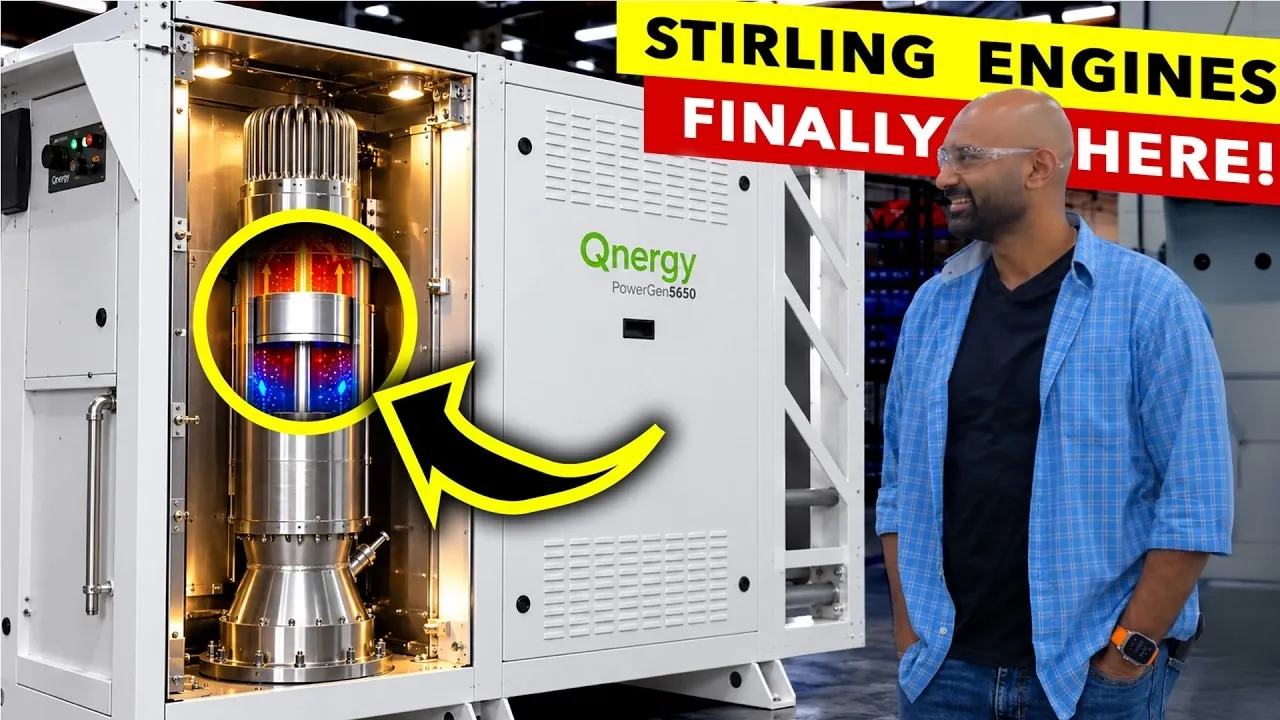
Qnergy builds Stirling engines for remote power, putting a two-century-old engine design to work in commercial equipment. Its sealed QB80 engine turns heat from an external source into power, keeping fuel contaminants away from its moving parts. That design helps meet the demand for dependable electricity at remote oil sites, according to Two Bit da Vinci.
Explore how the Stirling cycle moves gas between hot and cold ends, and how a regenerator recovers heat between strokes. You can also see why sealed components and precise manufacturing matter, along with the limits imposed by cost and fuel efficiency. Then compare the engine’s uses in compressed-air equipment and landfill methane destruction.
Qnergy Stirling Engines
TL;DR Key Takeaways :
- Qnergy builds Stirling engines for remote power, compressed air and landfill methane destruction. It has about 5,000 units operating in the field and was profitable as of 2024.
- The QB80 powers the 5.65 kW PowerGen 5650 generator. Its sealed engine has no oil, internal filters or scheduled service interval, and is rated for 70,000 to 80,000 operating hours.
- Qnergy’s compressed-air equipment replaces gas-powered pneumatic functions at oil wells, reducing methane venting. Alliance Technical Group measured 99.998% methane destruction for the Qnergy package using EPA test methods.
- At a closed landfill in Weber County, a Stirling engine powers a blower and combustor using landfill gas. A project representative says the system can extract and destroy the gas autonomously; Qnergy’s carbon credits filing says credit revenue is the only funding source for its landfill projects.
- The complete Qnergy package converts around 12% of its fuel into electricity and carries premium pricing. Its sealed engine is basically maintenance-free for a decade, but the overall system still needs technician attention.
Qnergy builds and ships Stirling engines for remote power, compressed air and landfill methane destruction. The company has about 5,000 units operating in the field and was profitable as of 2024.
Qnergy has found commercial uses for an engine that remained outside the mass market for two centuries because of its cost and a lack of suitable applications. Its QB80 engine uses heat from outside a sealed cylinder to generate power, keeping fuel contaminants away from the moving parts.
Remote Power and Compressed Air
The QB80 powers Qnergy’s PowerGen 5650 generator package. The engine is a welded steel cylinder roughly the size of a scuba tank. It has no oil, internal filters or scheduled service interval, and is welded shut in Ogden.
- Length: 33 inches
- Weight: 242 pounds
- Generator output: 5.65 kW
- Rated engine life: 70,000 to 80,000 operating hours
Remote oil sites are one market for the generator, and customers include major oil-industry players. A power failure can cost a site up to $50,000 a day and require technicians to reach it by helicopter. At such sites, PowerGen holds up where equipment such as diesel generators could not. Customers pay for uptime rather than fuel efficiency or emissions benefits.
Qnergy also sells compressed air pneumatics, or CAP, equipment. Oil-well operators can use natural gas from the ground to power tools and then vent it. Qnergy’s equipment replaces that gas-powered function with compressed air. Avoiding the venting also reduces methane emissions: methane traps about 80 times as much heat as carbon dioxide over a 20-year period.
A Qnergy representative says a gas connection can produce compressed air and electricity within 20 minutes, while waste heat can prevent freezing in cold environments. The higher-airflow CAP V can run from a PowerGen or the grid. The representative says the kits have become a major revenue source in the last few years.
Qnergy’s white paper relied on an EPA rule requiring US oil and gas operators to replace venting pneumatic controllers. Congress repealed the waste-emission charge in February 2025 and blocked its collection until 2034. The EPA loosened flare and vent gas requirements in April 2026.
Alliance Technical Group measured 99.998% methane destruction for the Qnergy package using EPA test methods. It measured carbon monoxide at 27 times below EPA limits and nitrogen oxides at seven times below them. A separate evaluator funded by the Canadian government found that the Qnergy generator had the highest carbon-chain destruction efficiency among the generation technologies assessed.

Deep dive into the latest in energy by exploring our other resources and articles.
- $20/kWh Compressed Air Energy Storage Undercuts Lithium-Ion
- Proxima Fusion Plans the Alpha Stellarator for the Early 2030S
- China Stores 1,000 Megawatts in Massive 10-Hour CO2 Battery
- Fraunhofer Small Wind Turbines Top Conventional Output By 83%
- Google Partner Project Red Yields Only 40-60% of Target Power
- Google Project Suncatcher Uses Space Solar Panels for AI
Destroying Landfill Methane
Landfills continue producing methane for decades after they close. Electricity plants can burn the gas when output is high, but generation stops making economic sense once production falls below a threshold. The US has more than 10,000 closed landfills.
Landfill gas contains hydrogen sulfide and siloxanes from discarded cosmetics and detergents. Burning siloxanes creates silicon dioxide. In a conventional generator, deposits could bog down the engine and require an overhaul every six months to a year. A Stirling engine keeps the fuel outside its sealed working parts, so it can use heat from burning the gas without sending it through the engine.
At Torch 4, a trailer near a closed landfill in Weber County, a Stirling engine powers a blower and combustor using gas drawn from the ground. The system also includes instrumentation. A project representative says it can extract and destroy landfill gas autonomously, without grid or external power.
Qnergy’s carbon credits filing says credit revenue is the only funding source for its landfill projects. The projects aim to destroy methane and earn credits rather than make electricity generation profitable.
How the Stirling Cycle Works
Robert Stirling patented the engine on September 27, 1816, eight days after his Church of Scotland ordination. Steam-boiler explosions had killed people, including members of his parish. His design kept the fire outside the machine and removed the boiler that could burst.
A displacer moves sealed working gas between hot and cold ends, cycling it between hundreds and tens of degrees Celsius 60 times per second. The gas expands and raises pressure at the hot end, then contracts as it cools. A second piston responds to the pressure changes and extracts power. Fuel contaminants do not contact the moving parts, avoiding the combustion residue that can contribute to early wear in internal-combustion engines.
Between the heat exchangers, a fine-mesh regenerator, which Stirling called the “economizer,” stores heat from gas travelling toward the cold end and returns it as the gas moves back. The engine can turn without it, but sending hot gas straight to the cold exchanger would waste most of the heat on each stroke. Its design must balance heat-storage surface area against flow resistance, because pressure lost to pumping reduces generating power. Qnergy’s engineers still devote substantial attention to it.
Qnergy’s free-piston design has no crankshaft. The piston and displacer move on springs at a resonant frequency near 60 hertz, without a mechanical stop or linkage limiting travel.
Power electronics control piston amplitude and temperature, using the generating alternator as a brake: drawing more current shortens the stroke, while drawing less increases it. Without restraint every millisecond, the piston could travel out of control and damage the engine. Sufficiently fast, affordable electronics for continuous control did not arrive until the 1990s.
That fixed-frequency operation also limits use in cars. In a car engine, fuel burns inside the cylinder and pushes a piston connected to a crankshaft; the stroke is fixed and cycle speed changes power. A Stirling-powered Ford Torino built by Philips and Ford in 1975 returned 10% to 20% worse fuel economy than the petrol car it was intended to replace. The free-piston design is also considered unsuitable for airplanes.
Manufacturing and Operating Limits
Inside the QB80, a clearance seal leaves a gap of a few microns between the piston and its bore. It prevents gas from passing without contact or friction; the engine has no piston rings. Spiral flexure bearings keep the displacer aligned while allowing it to move along its operating axis. They provide the spring rate and resonant frequency while resisting radial movement that could cause rubbing. Oil is unsuitable inside the engine because it would clog the regenerator’s mesh.
The working gas is helium, which is difficult to contain. About 400 laser welds must hold it inside the assembly. Laser welding concentrates heat in a small area, whereas the heat from TIG welding could distort parts with micron-scale clearances. Manufacturing decisions and quality assurance are critical because the engine is not reopened after welding. Hydrogen would be better thermodynamically, but it embrittles metals and is dangerous to work with.
Qnergy machines its own engine components because it cannot buy Stirling-engine parts from an established supply chain at scale. Stirling engines also have low power density and high build costs. As an engine grows, the surface that admits heat increases with the square of its radius, while the gas volume grows with the cube. That makes larger designs harder to heat.
Stirling engines have historically competed with diesel and natural-gas generators but have not been expected to beat them on cost and efficiency. Nearly silent Stirling engines power air-independent propulsion in Gotland-class submarines, which can remain submerged for weeks. In 2005 war games, a Swedish submarine virtually torpedoed the USS Ronald Reagan undetected.
The complete Qnergy package converts only around 12% of its fuel into electricity, and its pricing is deliberately premium. The sealed engine is basically maintenance-free for a decade, but the overall system still needs a technician to clean the radiator and check airflow and filters. Qnergy is working on engines intended to cost half as much and hazardous-location units for offshore rigs; its work on solar dishes and small modular reactors is non-commercial and will take time.
For operators seeking reliable power at remote oil sites, Qnergy’s PowerGen 5650 is worth checking out in more detail as an alternative to generators that struggle in those conditions.
Media Credit: Two Bit da Vinci
Disclosure: Some of our articles include affiliate links. If you buy something through one of these links, Geeky Gadgets may earn an affiliate commission. Learn about our Disclosure Policy.
