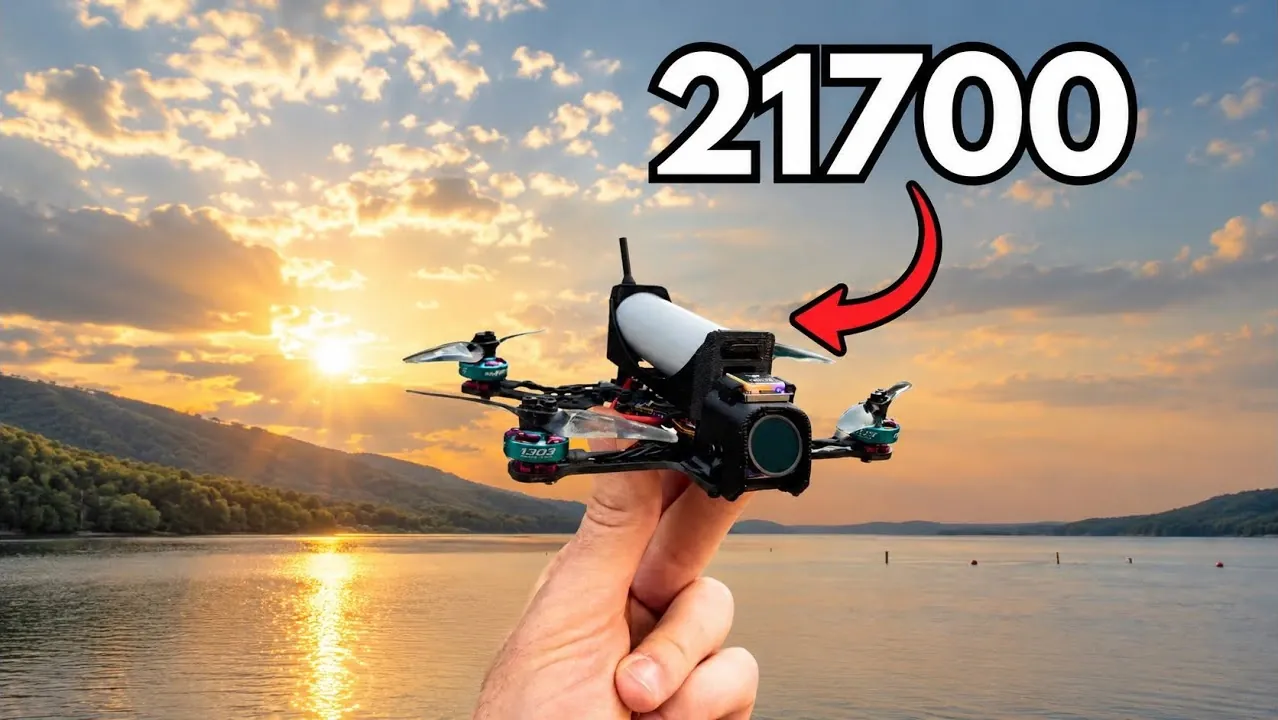
Swift is a single-cell lithium-ion FPV quadcopter built for longer flights, with a carbon frame that accommodates a choice of electronics and battery sizes. Its interchangeable trays fit either an 18650 or a larger 21700 cell. Swift flew more than 5 km, though its video signal weakened near that distance in windy conditions, according to Mediocre Nerd.
Compare 18650 and 21700 cells for their effects on flight time and handling, and see how the frame accommodates analog or digital electronics. You can also review the battery-holder test, including how the DIY holder retained voltage under load, along with the signal warnings and headwinds that complicated the long-distance return flight.
Using a Single Lithium-Ion Cell
TL;DR Key Takeaways :
- Swift is a single-cell lithium-ion FPV quad with a dead-cat frame that keeps the front arms out of the camera’s view. Builders can choose their own electronics and an analog or digital system.
- The initial build flew for 20 minutes. With 21700 cells, it flew for 27 minutes on an RS50 and reached 34 minutes on a Link Data 65P before telemetry was lost.
- In a full-throttle power-delivery test, the DIY battery holder had the lowest calculated resistance and best overall voltage retention. Mediocre Nerd considers all four tested connections viable given the close results.
- After the original carbon-fiber frame cracked, Swift was rebuilt with a thicker frame and larger 11,500 kV motors. The new motors provided better acceleration and handling, more low-end torque, and lower current draw.
- On a lake flight approaching 5 km, video-signal warnings and strong wind constrained the return. Mediocre Nerd warns that GPS return to home might not work reliably in a fail-safe under those windy conditions.
Lithium-ion cells have much higher energy density than lithium polymer batteries. An example 18650 cell has a 3,000 mA capacity and weighs just under 45 g. Three LiPos with a combined capacity of 2,000 mA weigh 48 g. In that comparison, the 18650 supplies 50% more capacity at roughly the same weight.
Long flight times do not remove every range constraint. Your video transmitter may lack power, your receiver may have an unsuitable antenna, or your flight controller may not support GPS. Swift’s build addresses those components alongside the battery and frame.
Larger 21700 cells have greater energy density than 18650s, but they also add size and weight. They are expected to trade some flight performance for longer endurance. In testing, the 18650 handled better, although the 21700’s flight performance exceeded expectations.
Frame and Electronics
Swift’s dead cat layout extends the front arms straight out to the sides, keeping them out of the camera’s view. The frame also has reinforced arms and mounting options intended to accommodate most electronics. You can choose your own electronics and use either an analog or digital system.
The earlier Crux 3 frame is extremely light but lacks durability and mounting options. The Lion B is heavier and stiffer than the Crux, with more room for electronics, but it fits only its proprietary electronics and seems somewhat brittle. Swift’s frame is slightly thinner and lighter than the Lion B, with more flex that can help absorb impacts in some cases.
A 3 mm Swift cutout weighed about 15 g and was relatively stiff, which can help with tuning and performance. The initial build used a lighter 9 g version instead. A later rebuild used a thicker 2.5 mm frame after the earlier carbon-fiber frame cracked. The build used these components and dimensions:
- Flywoo Goku HD flight controller: 12 amp ESCs and a T receiver antenna.
- DJI O4 Lite camera: mounted in a TPU canopy with a built-in GPS mount.
- 15,000 kV motors: fitted to the initial build.
- Gemfan Hurricanes propellers: bolted to the motors.
- 12.5 mm M2 standoffs: fitted at the front and rear.
An ND filter and adapter protect the camera lens in a crash and were chosen in the hope of reducing image distortion. Mediocre Nerd rates the DJI O4 Lite best in class for video quality and transmission distance.
The canopy bolts to the frame from below. The battery tray sits on the front standoffs and is secured at its corners. Rear TPU mounts fit most receiver T-type antennas. Plastic nylon bolts were planned for the flight controller and video transmitter to save weight, with metal M2 bolts for the standoffs, motors and camera.

Expand your understanding of drones with additional resources from our extensive library of articles.
- DJI Neo 3 Unboxing Reveals a 1/1.1-Inch Camera Sensor
- Leaked Flight Video Shows the DJI Neo 3 Spoke-Style Cage
- Rumoured DJI Neo 3 Drone Targets a September 2026 Launch
- DJI Neo 3 vs Neo 2: Leaks Show a 64% Battery Increase
- DJI Mini 6 Pro Speculation Points to a September 2027 Debut
Battery Holders and Power Delivery
The two battery holders use 0.2 mm copper strip, 10 mm wide, and 18-gauge wire. You can cut the strip with ordinary scissors, leave a small overhang and fold it flat into the holder. The wire and copper ends are tinned with solder, with flux applied to the copper. The finished wires can take a plug or be soldered directly to the power leads.
The terminals need clear positive and negative markings: connecting a cell backwards once can destroy the electronics. In the build, the soldering iron was kept around 370 degrees Celsius, and the thin copper strips soldered fairly easily.
For the power-delivery test, the quad was secured and run at 100% throttle for 10 seconds per trial. Wire gauge and length were kept as similar as possible while the BT2.0, XT30, Lion battery holder and DIY holder were compared using voltage and current data recorded through the goggles.
The DIY holder had the lowest calculated resistance and the best voltage retention overall. It also had the smallest initial voltage sag, although it later fell behind the XT30 plug. Mediocre Nerd considers all four viable given the close results and guesses that copper conductivity and the DIY holder’s large contacts contributed to its result.
The data was logged to Lithium Ion FPV, which contains test descriptions, raw data, quadcopter builds and guides. It also ranks promising cells from Nelvik’s testing. Performance represents weight-to-power ratio, endurance represents capacity-to-weight ratio, and the two scores are averaged for an overall rating.
Flight Time and Rebuild Results
The initial Swift build was about 25 g heavier than the old Crux build, yet hovered at 30% throttle rather than 45%. The difference was attributed to the 15,000 kV motors. Swift handled well without tuning and felt similar to the Crux on a full-throttle takeoff, despite its heavier digital setup.
The initial build reached 20 minutes with 2.45 V remaining. The lighter Crux build, which had more efficient motors, had flown for 25 minutes.
The 66 g RS50 cell appeared to give Swift a maximum speed of around 80 km/h. Vibrations were visible and might mostly be tuned out. The board, which contains the ESCs, heated quickly under excessive throttle but cooled during cruising.
A long-distance flight with the 5,000 mA RS50 Reliance 21700 lasted 27 minutes, although there was no DVR footage because the goggles had no SD card. The Link Data 65P is about 5 g heavier, has a slightly lower discharge rating and a much higher capacity. It reached 30 minutes, was still flying at 2.39 V and reached 34 minutes before telemetry was lost.
Afterward, an exposed negative lead contacted metal at the back of the camera and shorted the air unit. Liquid electrical tape was applied to exposed metal and the canopy was modified to prevent another short. The tape dries in about five minutes to a rubbery layer.
The rebuild also replaced the motors with larger 1303 11,500 kV units. They added 4 g, while the motors and thicker frame together added about 7 g. In that configuration, the motors gave more low-end torque, better acceleration and handling, and lower current draw. More efficient propeller operation is a possible explanation.
Long-Range Flight and Signal Limits
With tuning, Swift produced smooth footage on its lake flight. Its display showed current, speed, throttle, battery voltage, distance, flight-controller temperature, radio and video signal health, flight time and GPS satellite count. GPS return to home requires at least eight satellites, while more satellites improve location accuracy.
The video signal produced yellow and red warnings as Swift approached 5 km in wind. It dipped during the turn toward home and stabilized after the drone reoriented. Mediocre Nerd warns that GPS return to home might not work reliably in a fail-safe under those windy conditions.
An estimated 35 km/h tailwind helped Swift reach 90 km/h at 50% throttle on the outbound leg. On the return, an estimated 40 km/h headwind gust slowed it, and current draw doubled from the outbound 10-12 amps to travel above 30 km/h. Descending appeared to help speed, although the quad still drew more than 20 amps. Swift reached shore with the battery at 3 V.
The earlier frame cracked, while professionally manufactured frames felt stronger and did not crack under pressur”e; carbon quality was considered the main issue. The planned Swift kit contains the custom frame, hardware and both battery trays, but builders must supply their chosen electronics and battery.
The results show that the configuration reached its distance and flight-time goals, while the signal warnings and wind on the lake flight show the conditions that constrained its return.
Mediocre Nerd has made the frame kit available for those interested in building a long-distance lithium-ion FPV quad, allowing for either an analog or a digital build. Frame Kit w/ hardware or Frame Only.
Media Credit: Mediocre Nerd
Disclosure: Some of our articles include affiliate links. If you buy something through one of these links, Geeky Gadgets may earn an affiliate commission. Learn about our Disclosure Policy.
