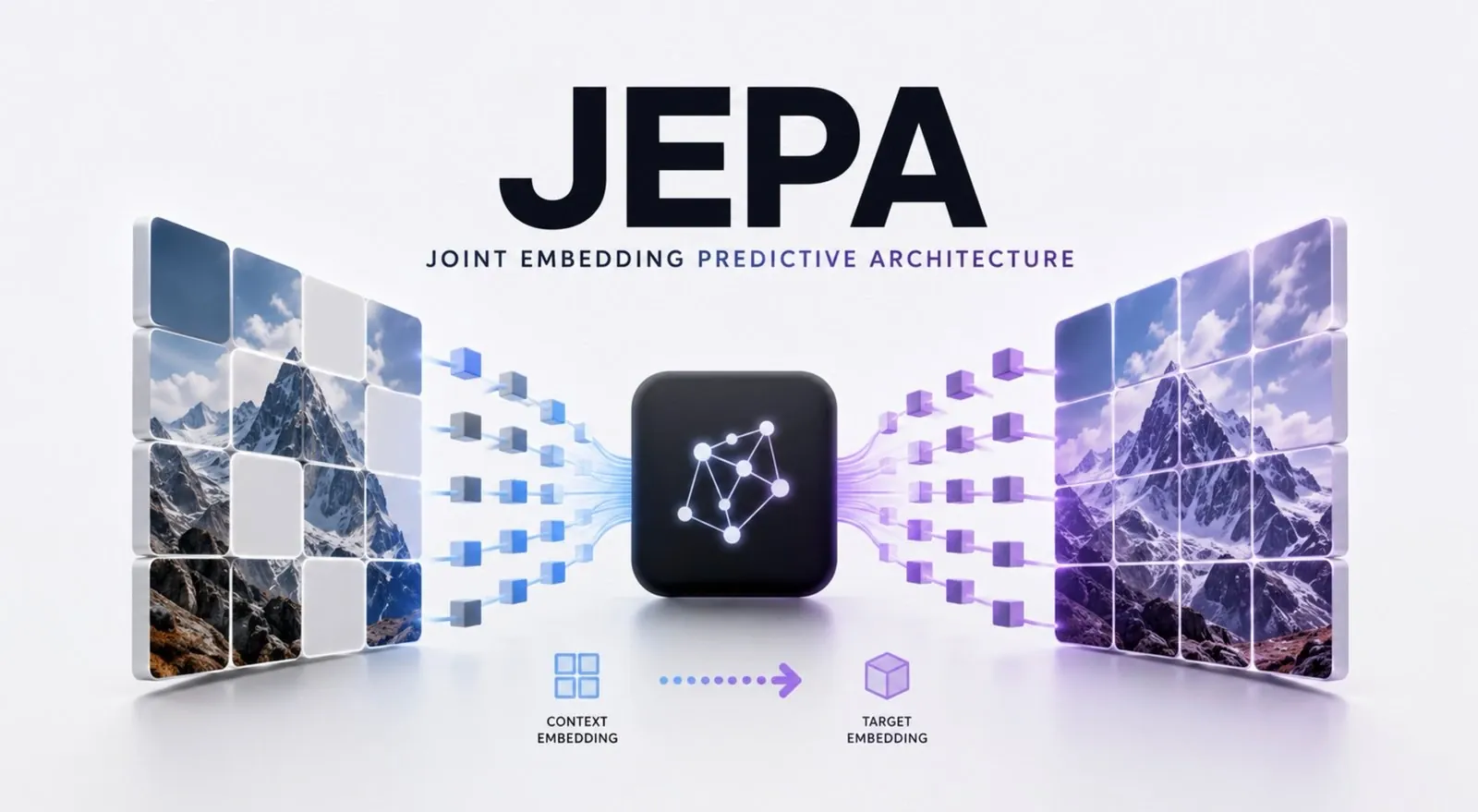
Yann LeCun, a Turing Award-winning AI researcher and former Chief AI Scientist at Meta, is challenging the dominance of large language models (LLMs) with a new paradigm called Joint Embedding Predictive Architecture (JEPA). Backed by $1 billion in funding, LeCun argues that LLMs, like OpenAI’s GPT series, are limited by their reliance on statistical language patterns, which fail to capture real-world understanding. JEPA, by contrast, focuses on modeling the physical world through abstract representations, drawing inspiration from how humans, particularly infants, learn by observing and interacting with their environment. Parthknowsai explores how JEPA’s reliance on raw video data and modular architecture could enable AI systems to generalize across tasks more effectively than LLMs.
Discover how JEPA’s six modular components, such as the Perception Module and World Model, work together to simulate, predict and act within dynamic environments. Gain insight into the computational challenges of modeling real-world dynamics and why LeCun believes grounded representations are essential for achieving true intelligence. This explainer also examines the broader implications of JEPA’s development, from its potential to reshape AI research priorities to its role in addressing the limitations of language-based systems.
Joint Embedding Predictive Architecture (JEPA)
TL;DR Key Takeaways :
- Yann LeCun is leading a $1 billion initiative to develop Joint Embedding Predictive Architecture (JEPA), a new AI paradigm focused on understanding the physical world rather than relying on language-based pattern recognition like large language models (LLMs).
- JEPA addresses key limitations of LLMs, including hallucinations, lack of real-world understanding and diminishing returns from scaling, by emphasizing grounded representations and causal understanding.
- JEPA’s approach involves training on vast amounts of raw video data to predict abstract representations of the physical world, allowing superior generalization and adaptability with minimal retraining.
- The architecture of JEPA is modular, consisting of six components (Configurator, Perception Module, World Model, Cost Module, Actor and Short-Term Memory) designed for dynamic and scalable functionality.
- JEPA represents a philosophical shift in AI, prioritizing real-world interaction and understanding over language-based systems, with the potential to redefine the future of artificial intelligence despite challenges like computational demands and complexity.
Why LLMs Fall Short
Large language models, such as OpenAI’s GPT series, have been pivotal in advancing AI capabilities. However, LeCun contends that these systems are fundamentally limited in their scope and potential. LLMs operate by predicting the next word in a sequence based on statistical patterns, but this process lacks a genuine understanding of the world. What may appear as reasoning or comprehension is, in reality, a sophisticated form of pattern matching, devoid of any grasp of causality or physical dynamics.
Several critical limitations of LLMs have been identified:
- Hallucinations: LLMs frequently generate inaccurate or fabricated outputs because their predictions are based on linguistic patterns rather than grounded knowledge.
- Lack of Real-World Understanding: These models are unable to plan or interact meaningfully with the physical world, which restricts their utility in tasks requiring real-world comprehension.
- Diminishing Returns: Scaling LLMs further yields limited improvements, raising questions about the sustainability and efficiency of this approach.
LeCun argues that these shortcomings underscore the need for a fundamentally different approach to AI, one that moves beyond the constraints of language-based systems.
What Sets JEPA Apart?
Joint Embedding Predictive Architecture (JEPA) represents a significant departure from the language-centric focus of LLMs. Instead of relying on linguistic patterns, JEPA seeks to predict abstract representations of the physical world, allowing AI systems to develop a deeper understanding of their environment. This approach draws inspiration from human learning, particularly the way infants acquire knowledge through observation and interaction.
A key feature of JEPA is its reliance on raw video data. By training on vast amounts of video, potentially exceeding a million hours, JEPA builds a comprehensive understanding of the physical world. This method reduces the need for extensive labeled data for specific tasks, such as teaching a robot to manipulate objects. The result is an AI system with superior generalization capabilities, allowing it to adapt to a wide range of scenarios with minimal retraining.

Advance your skills in LLM by reading more of our detailed content.
- Running Local Al Models on a Mac Studio 128GB : 4B, 20B & 120B Tested
- Why Stanford Researchers Say AI Architecture Isn’t the Real Key to Performance
- How to Build an AI Knowledge Vault Using Obsidian & Claude Code
- Pocket AI Mini PC with 80GB Memory, 1TB M.2 Storage, Offline Power Hands-On
- Dolphin Llama 3 the Future of Uncensored Offline AI
- Forget the Cloud: This Tiiny Pocket PC Packs 80GB RAM for Local AI
- Using MacBook clusters to run large AI models locally
- Dolphin 3.0 : The Uncensored AI Model Changing the Game – Open Source & Local
- Google Gemma 27B AI model performance tested
- Why Intel’s New Arc G3 Extreme Could Dethrone AMD in Handheld Gaming
Inside JEPA’s Architecture
JEPA’s architecture is designed to be modular, with six interconnected components that work in harmony to enable dynamic and adaptive functionality. Each module plays a distinct role in the system’s overall operation:
- Configurator: Establishes task-specific priorities, making sure the system focuses on relevant objectives and adapts to changing requirements.
- Perception Module: Observes and interprets environmental data, forming the foundation for informed decision-making.
- World Model: Simulates and predicts future events by using learned representations of the physical world.
- Cost Module: Evaluates potential actions for feasibility and efficiency, optimizing the decision-making process.
- Actor: Executes the most effective plan, translating predictions into tangible actions in the real world.
- Short-Term Memory: Tracks past actions and contextual information, allowing continuity and adaptability in dynamic environments.
This modular structure allows JEPA to adapt to new tasks and environments with minimal retraining, making it a versatile and scalable alternative to traditional LLMs.
A Paradigm Shift in AI Philosophy
JEPA embodies a philosophical shift in the field of artificial intelligence. While LLMs focus on optimizing language-based systems, JEPA prioritizes understanding the physical world. By modeling concepts such as position, movement and cause-and-effect relationships, JEPA aims to create AI systems capable of meaningful real-world interactions.
This approach challenges the prevailing assumption that scaling LLMs will eventually lead to true intelligence. LeCun asserts that grounded representations and causal understanding are essential for AI to transcend the limitations of language-based models. By focusing on these elements, JEPA seeks to redefine what it means for an AI system to be truly intelligent.
Implications for the Future of AI
The development of JEPA has the potential to reshape the AI landscape in profound ways. If successful, it could shift the industry’s focus from language-based systems to models that prioritize understanding and interacting with the physical world. However, this vision is not without its challenges:
- Computational Demands: Modeling real-world dynamics requires immense computational resources, which could pose scalability issues.
- Complexity: Developing systems capable of accurately simulating and predicting physical interactions is a highly complex and resource-intensive endeavor.
The debate between LLMs and JEPA highlights a broader question: can language-based systems evolve into true intelligence, or is a new paradigm necessary? The outcome of JEPA’s development over the coming years could have far-reaching implications for AI research, applications and the broader technological landscape.
Yann LeCun’s ambitious pursuit of JEPA represents a bold step toward redefining artificial intelligence. By prioritizing physical world understanding over linguistic pattern matching, JEPA offers a fundamentally different approach to achieving true intelligence. While the success of this paradigm remains uncertain, it underscores the need for innovation in an industry grappling with the limitations of existing technologies. As the AI community watches closely, the trajectory of JEPA could ultimately determine the future direction of artificial intelligence.
Media Credit: Parthknowsai
Disclosure: Some of our articles include affiliate links. If you buy something through one of these links, Geeky Gadgets may earn an affiliate commission. Learn about our Disclosure Policy.
