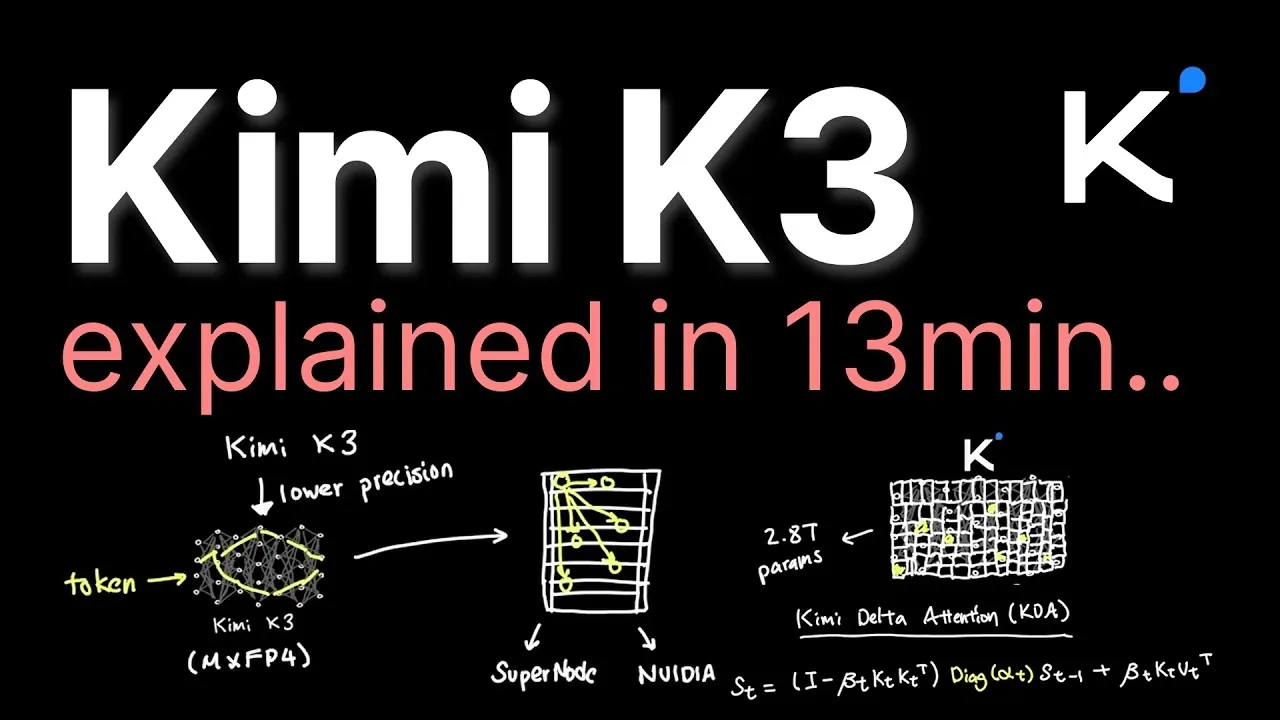
The Kimi K3 model represents a leap forward in artificial intelligence, combining efficiency, scalability and high performance to address challenges in large-scale AI deployments. As explained by Caleb Writes Code, the model’s “mixture of experts” architecture activates only a fraction of its 896 experts, just 16 per token, resulting in an activation ratio of 1.8%. This selective approach minimizes computational demands without sacrificing performance, making it particularly suited for resource-intensive applications. Additional features like Stable Latent MOI and Kimmy Delta Attention (KDA) further enhance its ability to manage memory and reduce communication overhead in distributed systems, solidifying its role in advancing AI infrastructure.
Dive into this overview to explore how Kimi K3 tackles real-world AI challenges with practical solutions. You’ll gain insight into its novel memory management techniques, such as KDA’s granular control over data retention and learn how Attention Residuals improve information flow across deep architectures. Additionally, discover how the model’s cost structure and GPU optimizations make it a viable option for industries with high computational needs. These takeaways provide a clear understanding of Kimi K3’s potential to shape the future of AI development and deployment.
Kimi K3 Overview
TL;DR Key Takeaways :
- The Kimi K3 model introduces a “mixture of experts” architecture, activating only 1.8% of its 896 experts per token, significantly improving computational efficiency and scalability for large-scale AI applications.
- Innovative features like Stable Latent MOI and Kimmy Delta Attention (KDA) enhance GPU communication efficiency, memory management and information processing, making it ideal for distributed AI systems.
- Attention Residuals improve information flow across model layers, making sure smoother operations and robustness in handling complex data structures in deep architectures.
- Kimi K3 is optimized for large-scale GPU deployments, addressing challenges like communication overhead and memory limitations, while offering cost-effective inference processes for industries with high computational demands.
- The model highlights the growing influence of Chinese AI innovations on the global stage, sparking discussions on international collaboration, semiconductor industry impacts and the future of AI development.
Key Features of Kimi K3
1. Mixture of Experts Architecture
At the core of Kimi K3 lies its “mixture of experts” design, which optimizes computational efficiency by activating only a small portion of the model during processing. This architecture operates as follows:
- Out of 896 experts, only 16 are activated per token, resulting in an activation ratio of just 1.8%.
- This selective activation minimizes computational demands while maintaining high performance.
Compared to its predecessor, Kimi K2, the Kimi K3 achieves improved scalability and efficiency, making it an ideal choice for large-scale AI applications.
2. Stable Latent MOI
Stable Latent MOI introduces a novel approach to token embedding compression, addressing a critical challenge in multi-GPU setups. Its key benefits include:
- Significantly reducing communication overhead between GPUs, which is a common bottleneck in distributed systems.
- Minimizing data transfer and compute demands, making sure smooth operation in large-scale deployments.
This feature is particularly advantageous for organizations managing distributed AI systems, where efficient communication between GPUs is essential for maintaining performance.
3. Kimmy Delta Attention (KDA)
Kimmy Delta Attention (KDA) enhances the model’s memory management capabilities by offering granular control over information retention and forgetting. Its functionality includes:
- Optimizing focus on relevant data while managing memory decay and updates to ensure efficient processing.
- Combining KDA with global attention in a hybrid linear attention framework, balancing computational efficiency with effective information processing.
This feature makes Kimi K3 particularly well-suited for handling complex tasks that require both precision and adaptability, such as natural language understanding and large-scale data analysis.
4. Attention Residuals
Attention Residuals improve the flow of information across the model’s layers, addressing challenges commonly encountered in deep architectures. This innovation works by:
- Grouping layers into logical blocks to reduce interconnect burdens on GPUs.
- Making sure smoother operations in large-scale systems while maintaining accuracy and consistency.
By enhancing the model’s ability to process intricate data structures, Attention Residuals contribute to the overall robustness and reliability of Kimi K3.

Enhance your knowledge on Kimi AI by exploring a selection of articles and guides on the subject.
- Leaked Kimi K3 Reportedly Beats GPT 5.6 Sol in Early Tests
- Kimi K3 a 2.8 Trillion Parameter Open Source ChatGPT 5.6 and Fable 5 Rival
- New Moonshot Kimi K3 AI Challenges Fable 5 and ChatGPT 5.6
- Kimi K3 Open Source AI Rivals GPT 5.6 Sol with 2.8T Parameters
- Critics Say Kimi K3 Struggles with Complex Code Debugging
- Claude Opus 5 is Poised to Challenge GPT-5.6 in Token Efficiency
- New Claude Opus 5 Leaks Detail High Reasoning Mode Features
- Moonshot’s Kimi K3 Needs 64 Cores for Open Source AI
- An OLED iPad Mini is Reportedly Arriving but Includes a Catch
Efficiency in Large-Scale Inference
Kimi K3 is optimized for large-scale GPU deployments, particularly in configurations involving 64 or 72 GPUs. Its design directly addresses common challenges faced in data centers, such as communication overhead and memory storage limitations. By using advanced GPU architectures, Kimi K3 achieves:
- Cost-effective and time-efficient inference processes, making it a practical solution for organizations with high computational demands.
- Improved scalability, making sure that the model can handle increasingly complex tasks without compromising performance.
These optimizations make Kimi K3 a valuable tool for industries requiring large-scale AI capabilities, such as healthcare, finance and autonomous systems.
Global Implications
The Kimi K3 model underscores the growing competitiveness of Chinese AI models on the global stage. Its innovative design and performance highlight the potential for new advancements outside traditional AI hubs. Broader implications of Kimi K3 include:
- Raising questions about its impact on the semiconductor industry and the broader AI application ecosystem.
- Exploring the feasibility of deploying Kimi K3 on advanced U.S. infrastructure, emphasizing the importance of international collaboration in AI development.
These considerations reflect the increasingly interconnected nature of the global AI landscape and the need for cooperative efforts to drive innovation forward.
Economic Considerations
Kimi K3’s pricing structure is designed to balance cost efficiency with advanced capabilities, making it accessible to a wide range of users. The current rates are set at:
- $3 per million input tokens.
- $15 per million output tokens.
These competitive rates are further supported by the model’s ability to deliver high performance at reduced operational costs. Future cost reductions may be achieved through:
- Adopting more efficient hardware to lower energy consumption and improve processing speeds.
- Using advancements in cloud infrastructure to streamline deployment and maintenance.
Such developments could make Kimi K3 even more appealing to businesses, researchers and developers seeking innovative AI solutions without excessive financial burdens.
Shaping the Future of AI
Kimi K3 exemplifies a forward-thinking approach to AI development, prioritizing efficiency, scalability, and performance. Its advancements in architecture and deployment efficiency position it as a significant player in the evolving AI landscape. Beyond its technical achievements, Kimi K3 sparks critical discussions about global AI leadership, infrastructure utilization and the role of emerging technologies in shaping the future of artificial intelligence. By addressing key challenges in AI deployment and scalability, Kimi K3 sets a new benchmark for innovation in the field.
Media Credit: Caleb Writes Code
Disclosure: Some of our articles include affiliate links. If you buy something through one of these links, Geeky Gadgets may earn an affiliate commission. Learn about our Disclosure Policy.
