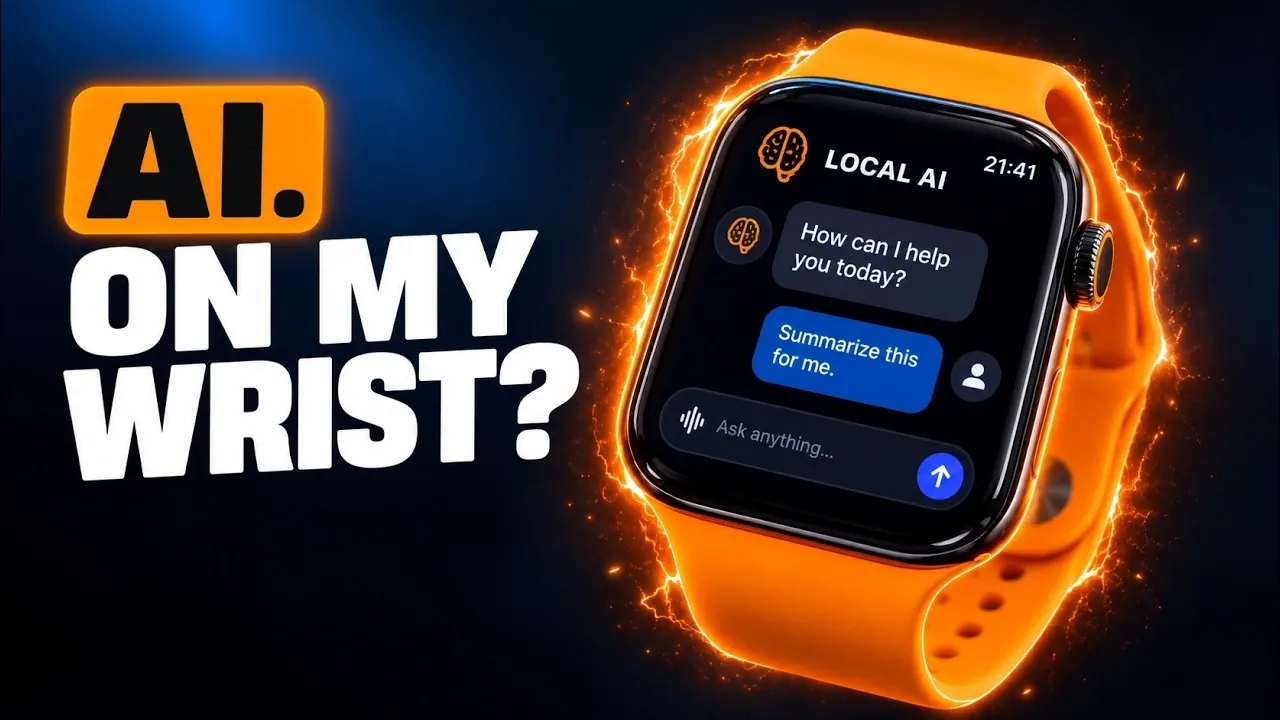
Running a large language model (LLM) on a six-year-old Apple Watch might sound improbable, but Better Stack demonstrates how lightweight AI models like Falcon H1, with its 90 million parameters, can operate within the constraints of aging hardware. The experiment utilized the Apple Watch Series 6, originally released in 2020, to achieve a processing speed of 15-24 tokens per second. By adapting the llama.cpp library to overcome compatibility issues with Apple’s Core ML framework and optimizing memory usage for the watch’s 1GB RAM, the project highlights the feasibility of deploying AI on resource-limited devices.
Explore how this experiment sheds light on the practical challenges of running AI locally, from navigating memory constraints to balancing performance with hardware limitations. You’ll also gain insight into the broader implications of edge AI, including its potential to enhance privacy, reduce latency and extend the lifespan of consumer electronics. These findings provide a glimpse into how on-device AI could reshape the role of wearable technology in daily life.
Highlights of the Experiment
TL;DR Key Takeaways :
- A six-year-old Apple Watch Series 6 successfully ran the Falcon H1 large language model (LLM) with 90 million parameters, showcasing the potential of on-device AI on resource-limited hardware.
- Despite hardware constraints, the watch achieved a processing speed of 15-24 tokens per second, emphasizing the importance of optimizing AI models for specific devices.
- Technical challenges, such as Core ML incompatibility and memory constraints, were overcome by adapting the llama.cpp library and optimizing the model for the watch’s 1GB RAM and 32-bit architecture.
- On-device AI offers benefits like improved privacy, reduced latency and extended device lifespan, highlighting the growing importance of edge AI solutions in consumer technology.
- This experiment demonstrates the feasibility of running lightweight AI models on older devices, paving the way for broader adoption of edge AI and reducing reliance on cloud-based systems.
The Apple Watch Series 6, originally released in 2020, served as the platform for this new experiment. Despite its modest hardware specifications, the watch achieved a processing speed of 15-24 tokens per second using the Falcon H1 model. A larger model, with 135 million parameters, was also tested but proved less compatible with the device’s constraints. The smaller Falcon H1 model was better suited to the watch’s limited resources, emphasizing the importance of tailoring AI models to specific hardware capabilities.
This achievement underscores that even older devices can support advanced AI applications when optimized effectively. It also highlights the potential for extending the lifespan of consumer electronics by allowing them to perform tasks previously thought to require more powerful hardware.
Technical Challenges and Solutions
Running an LLM on watchOS presented several significant technical challenges, requiring innovative solutions to overcome the limitations of the Apple Watch’s hardware and software environment. Key hurdles included:
- Core ML Incompatibility: Apple’s Core ML framework was unable to support the Falcon H1 model due to its unique state space model architecture, known as Mamba 2. To address this, the llama.cpp library was adapted for watchOS by modifying build flags and resolving architecture-specific issues, allowing the model to function on the device.
- Memory Constraints: The Apple Watch’s arm64_32 architecture, with its 1GB RAM and 32-bit memory addressing, posed significant challenges. Careful optimization of the model was required to manage memory usage efficiently and prevent performance bottlenecks.
Through these adjustments, the Falcon H1 model was successfully deployed on the Apple Watch without exceeding its hardware limitations. This achievement demonstrates the potential for adapting AI models to operate within the constraints of older or less powerful devices.

Advance your skills in local AI by reading more of our detailed content.
- Ollama Runs 32B Local AI Models on a $599 Mac via Quantization for Free
- How DeepSeek Fits a 284B Parameter AI Model on a Single Laptop
- Awesome DIY Raspberry Pi 5 Offline AI Companion Inspired by BMO from Adventure Time
- Beelink GTR9 Pro : The AMD Ryzen AI Max Plus 395 Mini PC Outperforming the Big Guys
- $40K Apple Mac Studio RDMA Setup: 1 TFLOP per Node, 3.7 TFLOPS Across Four
- New AMD’s $1,500 Strix Halo PC Runs 120B AI Models Locally
- New DeepSeek Harness Runs AI Workflows on Local Systems
- Apple Silicon AI Performance: Local Al on Apple Silicon Uses 7X Less RAM
- 128GB Ryzen AI Halo Replaces Cloud Servers for Local AI
- AMD’s $3,500 Strix Halo Mini PC Excels in Mixture-of-Experts
Performance Insights: How Did the Watch Perform?
The Apple Watch Series 6 delivered notable performance results, especially considering its hardware limitations. Key insights from the experiment include:
- Token Generation Speed: The watch achieved a token generation speed that was 50 times faster than a first-generation Raspberry Pi, highlighting the efficiency of modern wearable devices in handling computational tasks.
- Memory Efficiency: The Falcon H1 model maintained consistent memory consumption regardless of the number of tokens generated, a critical factor for devices with limited resources. This efficiency ensured stable performance without overloading the device.
Despite these achievements, the experiment also revealed certain limitations. The watch’s 1GB RAM and 32-bit architecture restricted its ability to run larger models, underscoring the need for further advancements in AI model optimization to accommodate resource-constrained environments. These findings emphasize the importance of designing AI systems that balance performance with hardware limitations.
Potential Applications of On-Device AI
This experiment opens up exciting possibilities for integrating AI into wearable technology. The Apple Watch was able to process voice-based prompts and execute tool calls, such as retrieving information from Wikipedia or providing weather updates. These capabilities demonstrate how lightweight AI models can enhance everyday tasks and improve user experiences.
Beyond convenience, running AI locally on devices offers several significant advantages:
- Improved Privacy: On-device processing reduces reliance on cloud-based systems, making sure that sensitive data remains local and secure.
- Reduced Latency: Local AI eliminates the need for internet-dependent processing, allowing faster and more reliable responses to user inputs.
These benefits align with the growing demand for edge AI solutions, where data processing occurs directly on the device rather than relying on external servers. By allowing devices to operate independently of cloud infrastructure, edge AI has the potential to transform how technology is integrated into daily life.
Implications for the Tech Industry
The success of this experiment raises important questions about the future of AI in consumer technology. While the technical feasibility of running LLMs on wearable devices has been demonstrated, manufacturers have yet to fully embrace on-device AI for wearables. Lightweight models like Falcon H1 could drive broader adoption of edge AI, allowing more efficient and versatile applications across a wide range of devices.
This development also underscores the need for continued innovation in AI model design and optimization. By creating models that can operate effectively on resource-constrained devices, the tech industry can expand AI’s reach to older hardware, making advanced capabilities more accessible to a broader audience. This approach not only extends the lifespan of existing devices but also reduces electronic waste by minimizing the need for frequent hardware upgrades.
As the demand for smarter, more efficient devices grows, the integration of on-device AI into wearables and other consumer electronics could redefine the role of technology in everyday life. The ability to process information locally, without relying on cloud-based systems, represents a significant step forward in making technology more secure, responsive and user-friendly.
Media Credit: Better Stack
Disclosure: Some of our articles include affiliate links. If you buy something through one of these links, Geeky Gadgets may earn an affiliate commission. Learn about our Disclosure Policy.
