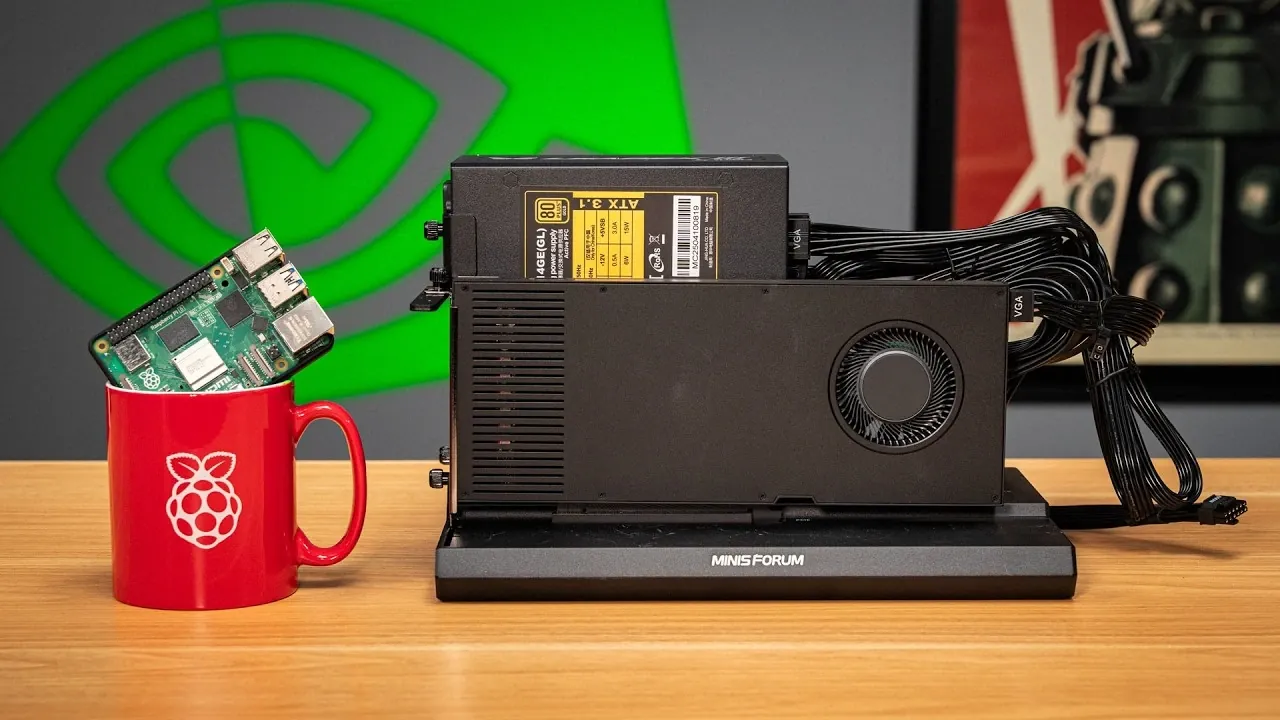
Have you ever imagined running a powerful NVIDIA GPU on a tiny Raspberry Pi? It sounds like a tech enthusiast’s dream, or perhaps a logistical nightmare, but recent breakthroughs have turned this into a stunning reality. By pairing the NVIDIA A4000 GPU with the Raspberry Pi Compute Module 5 (CM5), engineers have achieved full GPU acceleration on an ARM-based platform, a feat that was once thought impossible due to architectural differences. While the setup isn’t perfect yet, display output functionality remains a work in progress, the implications are profound. This milestone signals a shift in what ARM-based systems like the Raspberry Pi can achieve, pushing them into the realm of high-performance computing traditionally dominated by x86 systems.
In this breakdown, Jeff Geerling explains how this new integration works, what it means for developers, and why it could transform the landscape of AI training, machine learning, and data analysis. You’ll discover the technical ingenuity behind this achievement, including the role of open source contributions that made it possible, and learn about the challenges that remain. Whether you’re a hobbyist dreaming of GPU-powered projects or a researcher seeking cost-effective, energy-efficient solutions, this development opens up a world of possibilities. The journey isn’t without its hurdles, but the potential is undeniable, and it’s only just beginning.
NVIDIA GPUs on Raspberry Pi
TL;DR Key Takeaways :
- The NVIDIA A4000 GPU has been successfully integrated with the Raspberry Pi Compute Module 5 (CM5), achieving full GPU acceleration for computational tasks, though display output functionality is still under development.
- This integration enables ARM-based platforms to handle high-performance workloads like AI model benchmarking and machine learning, with benchmarks showing 121 tokens per second for the Llama 3B AI model.
- The setup requires approximately 160 watts of power and relies on open GPU kernel module patches, showcasing the importance of community-driven development in bridging compatibility gaps.
- Tests with other GPUs, including AMD and Intel, highlight the growing versatility of ARM platforms in supporting diverse GPU architectures for cost-effective, energy-efficient high-performance computing.
- Challenges such as the lack of display output functionality remain, but ongoing open source collaboration and testing aim to unlock the full potential of ARM systems for GPU-intensive tasks.
For the first time, the NVIDIA A4000 GPU has been successfully combined with the Raspberry Pi CM5 to deliver GPU acceleration. This breakthrough addresses the long-standing challenge of architectural differences between ARM and x86 systems, which previously limited such integrations. While the current setup does not yet support display output, its computational performance is impressive. Benchmarks indicate that the Llama 3B AI model can process 121 tokens per second using this configuration. This result demonstrates that ARM platforms are increasingly capable of handling demanding applications traditionally dominated by x86 systems.
The pairing of NVIDIA GPUs with Raspberry Pi systems opens up new possibilities for developers and researchers. By allowing GPU acceleration on ARM-based platforms, tasks such as AI training, data analysis, and real-time processing can now be performed more efficiently on cost-effective, low-power hardware.
Power Consumption and Technical Advancements
The integration of the NVIDIA A4000 GPU with the Raspberry Pi CM5 requires approximately 160 watts of power, a reasonable trade-off given the performance gains achieved. This setup relies on open GPU kernel module patches developed by contributors like Mario Balanica and Yanghu, whose work has been instrumental in bridging the compatibility gap between ARM systems and NVIDIA GPUs. These patches enable the seamless operation of NVIDIA GPUs on ARM platforms, showcasing the importance of community-driven development.
In addition to NVIDIA GPUs, AMD GPUs have also been tested and found to work effectively with Raspberry Pi systems. Intel GPUs, while functional, require further optimization to achieve comparable performance levels. These developments highlight the growing versatility of ARM platforms in supporting a wide range of GPU architectures, further expanding their potential applications.
Raspberry Pi and NVIDIA GPU: A4000 Acceleration on CM5
Unlock more potential in NVIDIA GPU on Raspberry Pi by reading previous articles we have written.
- Raspberry Pi 4 Compute module and external graphics cards tested
- Transform Your Raspberry Pi into a 4K Gaming Powerhouse
- How to Install Deepseek R1 on a Raspberry Pi for Free Local AI
- How the NVIDIA DGX Spark Redefines Local AI Computing Power
- NVIDIA CEO Jensen Huang Declares AI a $100 Trillion Opportunity
- Raspberry Pi 5 vs N100 PC performance comparison
- Apple M3 Ultra vs NVIDIA RTX GPUs : Local AI Performance
- RTX 5060 Ti vs RX 960 XT : Best GPU for Local AI Workflows 2025
- Best GPUs for Local AI, VRAM Needs and Price Tiers Explained
- NVIDIA DGX Spark Compact Supercomputer AI Developers Need
Expanding GPU Compatibility Across ARM Platforms
The NVIDIA A4000 GPU represents just the beginning of what is possible with ARM-based systems. Ongoing tests are being conducted with other NVIDIA GPUs and ARM platforms, including the Raspberry Pi 5, Pi 500 Plus, and Rock 5 Model B. These tests aim to evaluate compatibility, performance, and energy efficiency across various hardware configurations. The findings will help determine how ARM systems compare to traditional x86 setups in terms of GPU performance and power consumption.
This expanding compatibility is particularly significant for industries and researchers seeking cost-effective solutions for high-performance computing tasks. By using ARM systems with GPU acceleration, organizations can achieve substantial computational power while maintaining energy efficiency and reducing costs.
The Role of Open source Collaboration
The progress achieved in integrating NVIDIA GPUs with Raspberry Pi systems is largely due to the efforts of the open source community. Developers have contributed kernel patches, resolved compatibility issues, and optimized performance for various GPU setups. This collaborative approach has accelerated development, allowing milestones that would have been challenging for a single organization to achieve independently.
The contributions of the open source community highlight the power of collective innovation in advancing technology. By pooling resources and expertise, developers have created solutions that benefit a wide range of users, from hobbyists to professionals in fields such as AI and machine learning.
Challenges and Future Prospects
Despite the significant progress made, several challenges remain. One of the most pressing issues is the lack of display output functionality for NVIDIA GPUs on Raspberry Pi systems. Resolving this limitation will be crucial for expanding the usability of these setups in applications that require graphical output. Additionally, further testing is needed to assess the practicality and efficiency of using GPUs on ARM systems for a broader range of tasks.
Future efforts will focus on addressing these challenges and exploring new opportunities for ARM platforms in high-performance computing. The continued collaboration between developers, engineers, and the open source community will be essential in overcoming these hurdles and unlocking the full potential of ARM-based systems.
As advancements continue, ARM platforms are poised to become a viable alternative to x86 systems for GPU-intensive tasks. Their combination of energy efficiency, cost-effectiveness, and growing performance capabilities positions them as a promising option for a wide range of applications, from AI research to real-time data processing.
Media Credit: Jeff Geerling
Disclosure: Some of our articles include affiliate links. If you buy something through one of these links, Geeky Gadgets may earn an affiliate commission. Learn about our Disclosure Policy.
