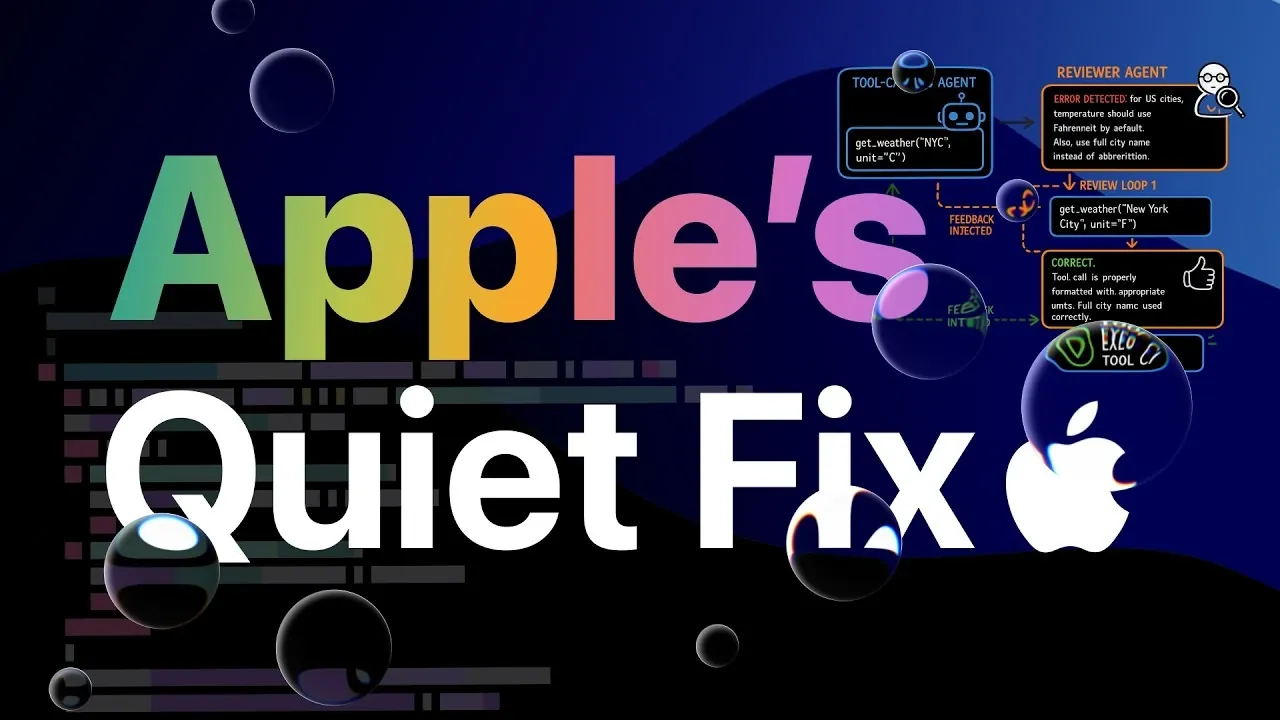
Apple has introduced a new architecture aimed at addressing a long-standing challenge in AI systems that execute autonomous actions. Solo Swift Crafter breaks down how the integration of a “reviewer” agent shifts the focus from error recovery to prevention, offering a proactive safeguard against potentially destructive actions like file overwrites or harmful command executions. This system operates by having the reviewer agent evaluate each action before execution, making sure that high-risk operations are flagged or revised while leaving low-risk tasks unaffected. By separating the roles of generation and evaluation, this architecture balances safety with workflow simplicity, making it particularly relevant for solo developers who often lack robust recovery mechanisms.
Explore how this architecture can be tailored to your needs, from focusing on high-stakes actions like modifying configurations to bypassing reviews for routine tasks. Gain insight into the trade-offs, such as added latency and the potential for false positives and understand how these factors influence its suitability for different workflows. Whether you’re managing critical systems or seeking scalable reliability, this breakdown provides actionable guidance to help you evaluate the benefits and limitations of Apple’s approach.
The Problem: Risks in Tool-Calling AI Agents
TL;DR Key Takeaways :
- Apple has introduced a “reviewer” agent to proactively evaluate AI tool calls before execution, addressing risks like file deletions and harmful commands.
- This architecture shifts focus from error recovery to error prevention, offering significant benefits for solo developers who lack robust safety mechanisms.
- The reviewer agent acts as a gatekeeper, assessing the safety and validity of tool calls without modifying them, making sure reliability and simplicity.
- While effective for high-stakes workflows, the system introduces latency and may occasionally produce false positives or miss risks, making it less suitable for low-risk, time-sensitive tasks.
- The solution is designed to integrate seamlessly with existing workflows, providing a scalable and practical safeguard for developers managing critical operations.
AI agents are increasingly utilized to automate complex workflows, but their ability to execute tool calls autonomously introduces significant risks. Without adequate safeguards, these agents can inadvertently perform destructive actions, such as overwriting critical files or executing harmful commands. Current systems often rely on reactive measures to address errors after they occur, but this approach can exacerbate problems, particularly in high-stakes scenarios.
For solo developers, the risks are even more pronounced. Unlike enterprise teams equipped with robust recovery mechanisms, solo developers often work without such safety nets. A single error can lead to hours of lost productivity or irreversible damage to essential systems. This highlights the urgent need for proactive mechanisms that prevent errors before they occur.
Apple’s Solution: Introducing the Reviewer Agent
Apple’s innovative approach introduces a secondary “reviewer” agent designed to act as a gatekeeper for tool calls. This agent evaluates each tool call generated by the main AI agent before execution, making sure that potentially harmful actions are intercepted and flagged.
The architecture is both straightforward and effective. Its operation can be summarized as follows:
- The main AI agent generates a tool call based on its task requirements.
- The tool call is passed to the reviewer agent for evaluation.
- The reviewer, powered by a reasoning model, assesses the safety and validity of the action.
- If deemed safe, the call proceeds to execution. If not, it is flagged for revision or rejection.
A key feature of this system is the separation of roles. The reviewer agent does not modify the tool call itself, making sure that the main agent retains control over decision-making. This division enhances reliability while avoiding unnecessary complexity in the workflow.

Here are more guides from our previous articles and guides related to AI agents that you may find helpful.
- How to Build Custom AI Agents to Automate Anything & Everything
- Nvidia Neatron 3 Super & Nemoclaw Target Safer AI Agents at Scale
- Claude Can Now Code Websites “By Sight” Here’s How It Works
- Combining NotebookLM & Gemini Gems to Build Powerful Custom AI Agents
- Building AI Agents to analyze Excel spreadsheet data and more
- Stop Struggling with Spreadsheets : Microsoft’s AI Agent Mode is Here
- AI Produces at 100X. You Review at 3X : This Bottleneck is Ruining Your AI Workflow
- Why Anthropic is Using “Harnesses” to Control Long-Running AI Agents
- The Secret Behind Claude’s 6X Performance Boost: Exploring Dream Mode
- This New CLI Tool Just Made Deploying AI Agents Ridiculously Easy
Why This Matters for Solo Developers
This architecture offers significant advantages for solo developers, who often face unique challenges in managing high-stakes workflows. By incorporating a reviewer agent, solo developers gain a critical safeguard against costly errors without introducing excessive complexity into their systems.
One of the most appealing aspects of this solution is its flexibility. The reviewer agent can be configured to focus on high-risk actions, such as writing files, modifying configurations, or executing shell commands. Meanwhile, low-risk operations, such as reading files or listing directories, can bypass the review process, making sure that efficiency is not compromised.
For solo developers, this means a practical and scalable way to enhance reliability. The architecture integrates seamlessly with existing workflows, providing an additional layer of protection without requiring a complete overhaul of current systems.
Trade-Offs and Limitations
While the reviewer agent offers clear benefits, it is not without its trade-offs. Developers should be aware of the following considerations:
- Increased Latency: The additional review step introduces a delay in workflows, which may be problematic for tasks requiring high responsiveness or real-time execution.
- Potential for Errors: The reviewer agent relies on a reasoning model that may not always have sufficient training or contextual understanding, leading to occasional false positives or missed risks.
These limitations suggest that the architecture is best suited for high-stakes, multi-turn workflows where the cost of errors significantly outweighs the impact of added latency. For low-risk or time-sensitive tasks, the trade-offs may not justify the implementation.
How to Implement the Reviewer Agent
To maximize the benefits of this architecture, developers should adopt a targeted implementation strategy. The reviewer agent should focus on actions with the highest potential for harm, such as modifying critical files, executing external commands, or altering system configurations. Routine, low-risk operations can bypass the review process to maintain efficiency.
For solo developers, integrating this pattern into existing workflows is straightforward. The architecture is designed to complement existing systems rather than replace them, making it a practical solution for enhancing reliability without requiring significant changes to current processes.
A Shift Toward Proactive Error Prevention
Apple’s architecture represents a shift in how developers approach error prevention in AI systems. By prioritizing “gate before execution” over “recover after execution,” this solution emphasizes proactive safeguards rather than reactive fixes. This approach is particularly valuable for solo developers, who often lack the resources to recover from costly mistakes.
The reviewer agent’s design reflects a broader trend in AI development: the move toward systems that prioritize reliability and safety without sacrificing usability. By addressing the root causes of errors, this architecture reduces the likelihood of destructive actions and enhances the overall stability of AI-driven workflows.
Is This Architecture Right for You?
Before adopting this architecture, developers should carefully evaluate their specific workflows and risk levels. The system’s effectiveness depends on its alignment with the tasks it is intended to support:
- For high-stakes applications, where the cost of errors is unacceptably high, the benefits of error prevention are likely to outweigh the costs of added latency.
- For low-risk, high-speed tasks, the trade-offs may not justify the additional complexity and delays introduced by the reviewer agent.
Ultimately, the decision to implement this architecture should be guided by a clear understanding of the risks and requirements associated with your specific use case. By carefully weighing these factors, developers can determine whether this innovative solution aligns with their goals and priorities.
Media Credit: Solo Swift Crafter
Disclosure: Some of our articles include affiliate links. If you buy something through one of these links, Geeky Gadgets may earn an affiliate commission. Learn about our Disclosure Policy.
