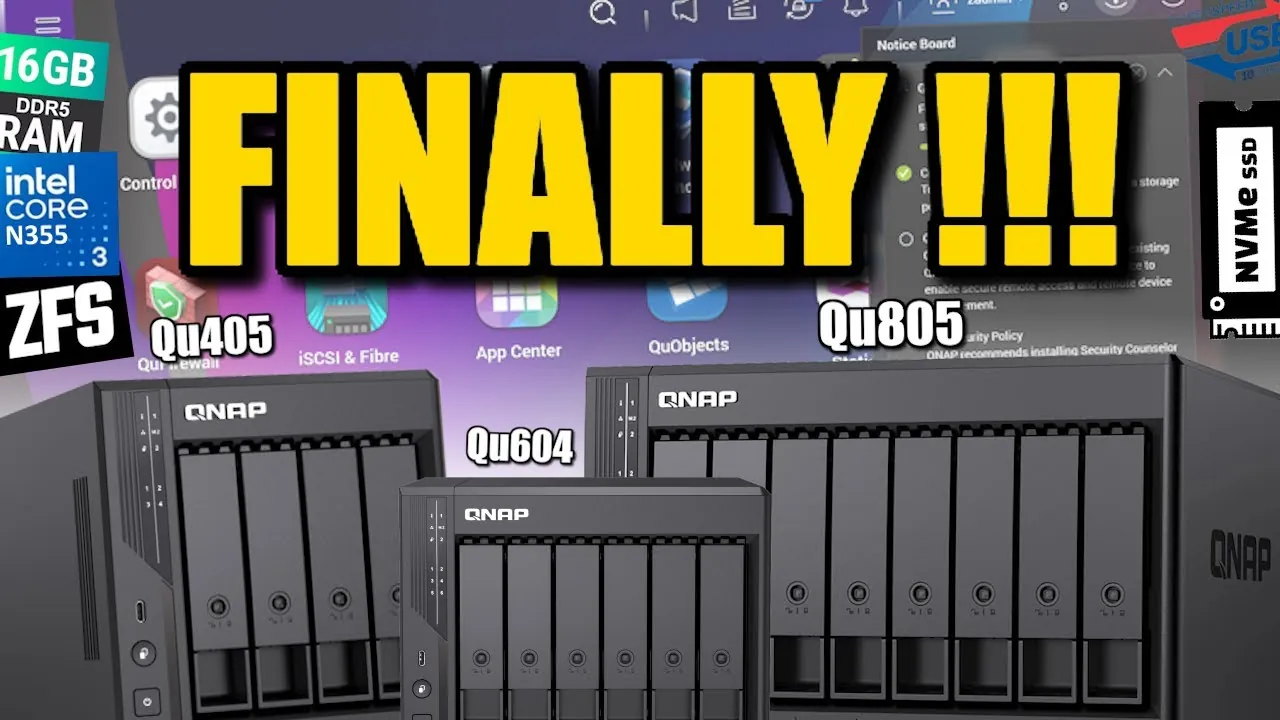
What if your next NAS device could seamlessly blend innovative performance with user-friendly design, catering to both your personal and professional needs? Enter QNAP’s latest reveal: the QU405, QU605, and QU805—a trio of NAS devices designed to redefine how home users, small-to-medium businesses (SMBs), and tech enthusiasts manage their data. With configurations ranging from 4-bay to 8-bay setups, this lineup promises a compelling mix of scalability, advanced data protection, and intuitive management tools. But as with any innovation, these devices come with their own set of trade-offs that could spark debate among tech-savvy users. Are these NAS solutions the perfect fit for your needs, or do they fall short in critical areas?
NAS Compares takes you through the unique strengths and potential limitations of QNAP’s new offerings. From dual operating system support that caters to both casual users and advanced professionals, to features like RAID Z configurations and M.2 NVMe caching, these devices aim to strike a balance between affordability and functionality. But how do they stack up in real-world scenarios, and are their design choices, such as the absence of PCIe slots or limited 2.5GbE ports, a dealbreaker for future-proofing? By the end, you’ll have a clearer picture of whether the QU405, QU605, or QU805 deserves a spot in your home or business setup. After all, the right NAS isn’t just about storage, it’s about empowering your workflow.
QNAP QU405/QU605/QU805 Overview
TL;DR Key Takeaways :
- The QNAP QU405, QU605, and QU805 NAS models are designed for home users, SMBs, and home lab enthusiasts, offering 4-bay, 6-bay, and 8-bay configurations respectively, with a focus on balancing performance, storage capacity, and data management features.
- Dual operating system support (QTS with EXT4 and QuTS with ZFS) provides flexibility for users to choose between simplicity and advanced functionality, catering to diverse technical requirements.
- Advanced features include RAID Z and triple parity RAID for robust data protection, inline deduplication and compression for storage efficiency, and M.2 NVMe slots for caching, though limited by throughput constraints.
- Hardware options include quad-core Intel N150 or 8-core Intel i3 N355 CPUs, up to 16GB DDR5 RAM (unofficially expandable to 32GB), but lack ECC memory, which may concern users prioritizing critical data integrity.
- Connectivity includes dual 2.5GbE ports, a 10Gbps USB-C port, and HDMI 2.1 support, but the absence of 10GbE and PCIe slots limits scalability and future-proofing for high-demand environments.
Target Users and Applications
The QU405, QU605, and QU805 are versatile NAS devices tailored to meet the needs of various users and scenarios:
- Home Users: Ideal for centralized multimedia storage, personal data backups, and seamless access to files across devices.
- Small-to-Medium Businesses (SMBs): Designed for file sharing, data protection, and moderate scalability to support business-critical operations.
- Home Lab Enthusiasts: Suitable for experimenting with virtualization, advanced RAID setups, and handling data-intensive tasks.
These models are particularly appealing if you value ease of use, reliable data protection, and moderate scalability. They provide a practical solution for users seeking a balance between functionality and affordability.
Operating Systems and Management Flexibility
QNAP offers dual operating system support for these models, providing flexibility to adapt to different technical requirements:
- QTS: Built on the EXT4 file system, this operating system delivers a user-friendly interface and traditional storage management capabilities.
- QUTS: Based on the ZFS file system, it introduces advanced features such as self-healing data, superior RAID configurations, and enhanced data integrity.
This dual compatibility enables users to select an operating system that aligns with their technical expertise and storage needs. Whether you prefer simplicity or advanced functionality, these options ensure adaptability for a wide range of use cases.
QNAP QU405, QU605 and QU805 : Home and SMB NAS

Enhance your knowledge on NAS solutions by exploring a selection of articles and guides on the subject.
- TerraMaster F2-223 & F4-223 NAS with TRAID
- How to Set Up a Synology NAS: A Beginner’s Guide 2025
- SSD vs HDD NAS storage compared which is best?
- QNAP NAS storage solutions
- Build a Petabyte NAS: How to Store 1 Million GB at Home
- Synology NAS Home vs Homes folders explained
- Building a NAS using a RISC-V BPI-F3 and OpenMediaVault
- How to soft reset your Synology NAS if you are locked out
- How to Set Up a Synology NAS for Family File & Media
- How to build a NAS from scratch using UnRAID OS
Advanced Features and Technologies
The QU405, QU605, and QU805 incorporate several advanced features to enhance performance and optimize data management:
- RAID Configurations: Support for RAID Z and triple parity RAID ensures robust data protection and redundancy, safeguarding against potential drive failures.
- Data Optimization: Inline deduplication, compression, and compaction reduce storage overhead, improving efficiency and maximizing available capacity.
- M.2 NVMe Slots: Gen 3 x1 slots enable caching and tiered storage, though their throughput is limited to 8-900MB/s, which may constrain performance in certain scenarios.
These features make the devices well-suited for demanding workloads, such as multimedia streaming, virtualization, and data-heavy operations. However, users with extremely high-performance requirements may need to evaluate these limitations carefully.
Hardware Specifications and Performance
The hardware design of the QU405, QU605, and QU805 is tailored to handle a variety of tasks, but there are trade-offs to consider:
- Processors: Two configurations are available:
- A quad-core Intel N150 CPU for standard tasks and general-purpose use.
- An 8-core Intel i3 N355 CPU with integrated graphics for more intensive workloads, such as virtualization and multimedia processing.
- Memory: Options include 8GB or 16GB of DDR5 RAM, with unofficial upgrades up to 32GB. However, the use of non-ECC memory may be a drawback for users requiring error correction for critical data integrity.
While the i3 version offers enhanced performance for demanding applications, the absence of ECC memory could be a concern for users prioritizing data reliability in enterprise or mission-critical environments.
Connectivity and Design Considerations
The connectivity options provided by these NAS devices are modern but come with certain limitations:
- Network Ports: Two 2.5GbE ports deliver faster-than-Gigabit speeds, but the lack of 10GbE support may limit performance in high-demand environments or future scalability.
- USB-C: A front-facing 10Gbps USB-C port with one-touch copy functionality simplifies data transfers and enhances convenience.
- HDMI: HDMI 2.1 (4K 60Hz) support is available on the i3 version, allowing direct multimedia playback for home entertainment or presentations.
The devices feature a plastic chassis with extensive ventilation to ensure effective cooling during operation. However, the absence of PCIe slots restricts the ability to add expansion cards, such as 10GbE adapters or additional storage controllers, which could limit long-term scalability.
Storage Capacity and Scalability
Each SATA bay supports up to 30TB drives, offering substantial storage potential. However, there are notable constraints to consider:
- The 8-bay QU805 provides significant capacity but lacks PCIe slots for future expansion, which may limit its appeal for users with evolving storage needs.
- The M.2 NVMe slots, while useful for caching, are limited in speed, potentially impacting performance in data-intensive scenarios such as large-scale archiving or virtualization.
These limitations may affect scalability and performance for users with long-term or high-demand storage requirements. It is essential to assess whether the available features align with your specific use case and growth expectations.
Market Position and Value Proposition
The QU405, QU605, and QU805 are positioned as successors to QNAP’s TS-64 and TS-x53e series, incorporating modern features such as DDR5 memory and advanced data management capabilities. However, their limitations in network speed, scalability, and PCIe expandability may deter users seeking future-proof solutions. Pricing will play a critical role in determining their competitiveness against other NAS options in the market.
These devices are well-suited for users who prioritize ease of use, moderate scalability, and advanced data management features. If the pricing aligns with your budget and the feature set meets your current needs, the QU405, QU605, and QU805 could serve as practical and reliable storage solutions.
Media Credit: NASCompares
Disclosure: Some of our articles include affiliate links. If you buy something through one of these links, Geeky Gadgets may earn an affiliate commission. Learn about our Disclosure Policy.
