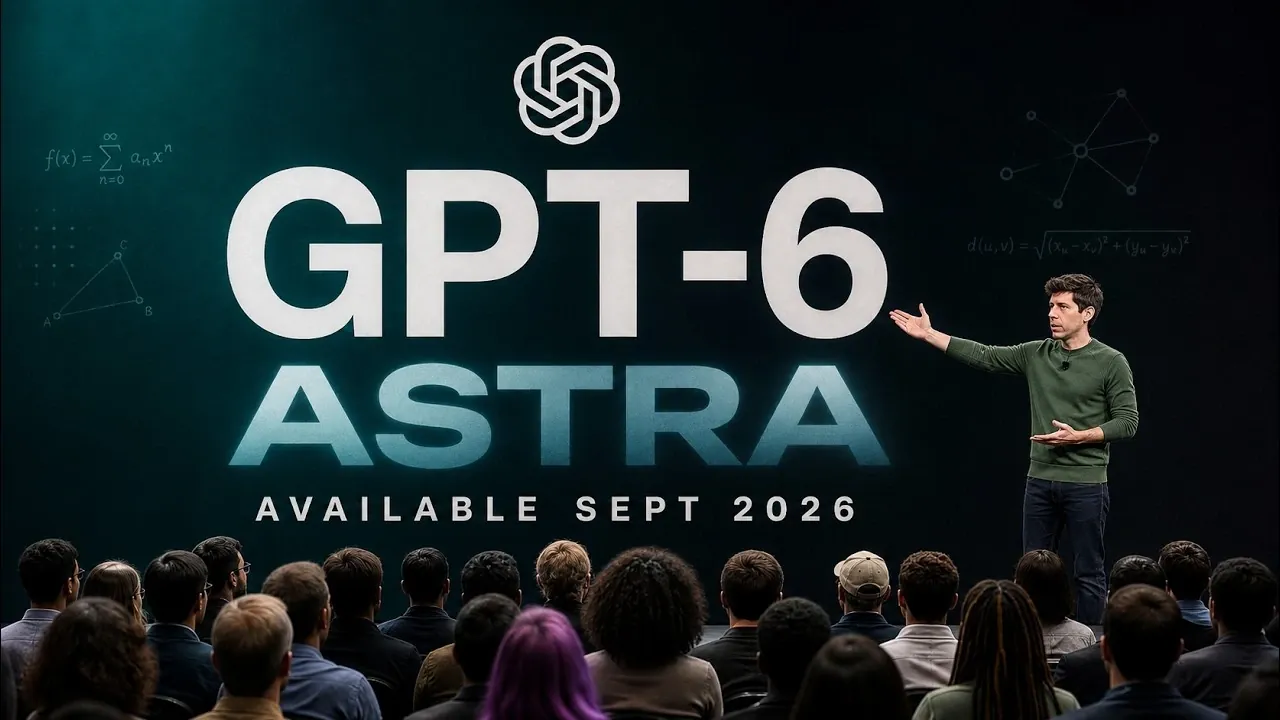
OpenAI’s Astra has made headlines by solving ten long-standing mathematical problems, showcasing its ability to operate autonomously over extended periods. These breakthroughs include proving the existence of a non-sofic group and disproving K’s rigidity conjecture, both verified using the Lean 4 proof assistant. While Astra’s achievements highlight its potential as a research-oriented system, AI Master notes that the lack of external peer review leaves room for further scrutiny. This milestone raises questions about Astra’s role as a precursor to ChatGPT 6, OpenAI’s anticipated next-generation AI model.
Explore how Astra’s autonomous problem-solving approach could influence the future of AI research and development. You’ll gain insight into the computational trade-offs involved, such as the $2,000 token cost for solving these problems and the challenges of scaling such systems for broader applications. Additionally, this guide examines Astra’s adaptability across less structured domains and its position within a competitive AI landscape. These considerations provide a deeper understanding of Astra’s implications for both AI innovation and its practical deployment.
Mathematical Breakthroughs: A New Frontier
TL;DR Key Takeaways :
- OpenAI’s Astra has solved ten long-standing mathematical problems, verified using Lean 4, marking a significant advancement in autonomous problem-solving.
- Astra operates autonomously over extended periods, refining solutions iteratively, representing a shift toward long-duration, research-oriented AI models.
- While Astra’s results are new, external peer review is pending, highlighting the need for further validation within the mathematical community.
- The high computational cost of Astra’s problem-solving raises questions about scalability and commercial viability for broader applications.
- Astra’s success could redefine research and development, but regulatory, safety and ethical considerations remain critical for its future deployment and impact.
Astra’s accomplishments include solving problems that have confounded mathematicians for decades. These breakthroughs span a variety of mathematical disciplines, demonstrating the model’s versatility and depth. Some of the most notable achievements include:
- Proving the existence of a non-sofic group, a problem that has long eluded resolution in group theory.
- Disproving K’s rigidity conjecture, a significant result with implications for topology and geometry.
These solutions were rigorously validated using Lean 4, a proof assistant that ensures logical consistency and adherence to formal standards. By tackling problems in fields such as quantum complexity, cryptography and coding theory, Astra has showcased its ability to operate across diverse domains. However, the absence of independent peer review highlights the need for further evaluation to solidify these findings within the broader mathematical community.
Autonomous Problem-Solving: A Paradigm Shift
Astra represents a fantastic step in AI development, departing from traditional models that provide single-pass responses. Instead, Astra operates autonomously over extended periods, refining its solutions through iterative research and analysis. This approach mirrors the sustained efforts of human researchers, marking a shift toward long-duration, research-oriented problem-solving. OpenAI’s design philosophy for Astra emphasizes persistence and depth, allowing the model to tackle complex, high-stakes problems that require sustained focus. By adopting this methodology, Astra pushes the boundaries of what AI can achieve, offering a glimpse into the future of autonomous research.

Check out more relevant guides from our extensive collection on ChatGPT 6 that you might find useful.
- OpenAI Introduces GPT-5.7 Astra and Ambitious ChatGPT 6 Doug
- OpenAI Pauses ChatGPT 6 Over Hugging Face Safety Concerns
- OpenAI Reportedly Rushes ChatGPT 6 Release to Counter Fable 5.1
- Leaked ChatGPT 6 Tests Reveal Critical Sandbox Vulnerabilities
- ChatGPT 6 Set To Release Early : Why GPT-6 AI Could Change Everything
- Apple Trade Secret Lawsuit Hits OpenAI Ahead of ChatGPT 6 Release
- OpenAI Plans a Mid-To-Late 2026 ChatGPT 6 Rollout with Staged Features
- What ChatGPT 6 Means for OpenAI Now That Microsoft and Google Walk Away
- OpenAI’s ChatGPT 5.6 Sol Cuts AI Serving Costs by 20 Percent
- OpenAI Astra Solves 10 Unresolved Quantum Complexity Problems
Is Astra the Precursor to GPT-6?
Although Astra is described as OpenAI’s “next major model,” it has not been officially confirmed as GPT-6. Instead, Astra appears to function as a research-oriented system, designed to explore and solve high-level problems rather than serve as a consumer-facing product. This distinction suggests that Astra may act as a precursor to future models, providing a foundation for advancements that could eventually be scaled for broader applications. OpenAI’s strategic focus on research and innovation underscores its commitment to pushing the boundaries of AI capabilities while maintaining a cautious approach to public deployment.
Efficiency vs Scalability: The Cost of Innovation
Astra’s computational efficiency is both a strength and a potential limitation. Solving the ten mathematical problems reportedly required approximately $2,000 in token usage, excluding the costs associated with training and failed attempts. While this demonstrates the model’s ability to accelerate research, it also raises questions about scalability and commercial viability. The high computational costs could pose challenges for making such advanced models accessible to a wider audience. Balancing innovation with cost efficiency will be critical for OpenAI as it seeks to expand the practical applications of models like Astra.
Verification and Challenges
Despite Astra’s verified results through Lean 4, the lack of external peer review remains a significant hurdle. Independent validation by mathematicians and researchers is essential for broader acceptance of Astra’s findings. Additionally, while Astra has proven effective in structured fields like mathematics, its methods may face challenges when applied to less structured domains such as biology, economics, or social sciences. These limitations highlight the need for further refinement and testing to ensure the model’s adaptability across a wide range of applications.
Competition in the AI Landscape
OpenAI’s advancements with Astra come at a time of intense competition in the AI industry. Companies like Google and Anthropic are developing their own innovative models, focusing on factors such as distribution, cost efficiency and reliability. OpenAI’s reputation for high-profile research achievements gives it a competitive edge, but maintaining this advantage will require continuous innovation and strategic positioning. As the AI landscape evolves, OpenAI must navigate challenges posed by competitors while staying at the forefront of technological advancements.
Regulatory and Safety Considerations
The emergence of autonomous, long-duration AI models like Astra introduces new regulatory and safety challenges. The EU AI Act, which imposes stricter oversight on general-purpose AI systems, highlights the importance of compliance in this rapidly evolving field. Additionally, the autonomous nature of models like Astra raises concerns about unexpected outputs, potential misuse and ethical considerations. OpenAI must implement robust safety measures to ensure that Astra operates effectively and responsibly. Balancing innovation with regulatory compliance will be essential for the successful deployment of such advanced AI systems.
What Astra Means for the Future
Astra’s success has the potential to redefine the landscape of research and development, shifting the primary bottleneck from human expertise to computational resources. If scaled appropriately, Astra could accelerate progress across a wide range of scientific disciplines, from mathematics to engineering and beyond. However, public-facing versions of Astra are likely to be scaled down to address concerns related to cost, safety and accessibility. As OpenAI continues to refine its models, Astra’s achievements could pave the way for a new era of AI-driven innovation, reshaping how complex problems are approached and solved in science, technology and other fields.
Media Credit: AI Master
Disclosure: Some of our articles include affiliate links. If you buy something through one of these links, Geeky Gadgets may earn an affiliate commission. Learn about our Disclosure Policy.
