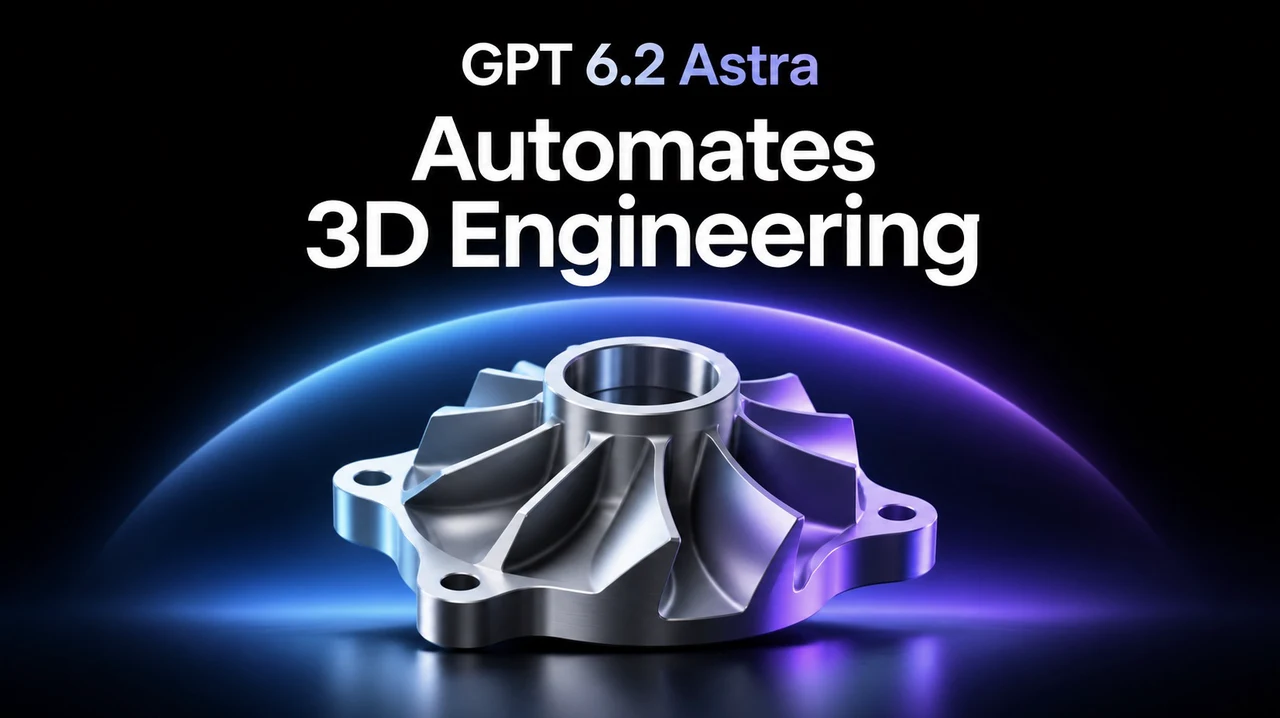
Turning a rough sketch into a mechanical design that actually moves normally means working through several different tools, from CAD software to simulation code. OpenAI’s new GPT-6.2 Astra can now handle that whole chain itself, producing the parts, the maths behind their movement and a 3D scene that shows the mechanism running. Discover how the model built a complete pendulum clock design from a single request, how it compares with rival models on 3D work, and what you still need to check before sending a design to your printer.
GPT-6.2 Astra Automates Functional 3D Engineering
TL;DR Key Takeaways :
- GPT-6.2 Astra produced a full pendulum clock design from a sketch, with every part modelled in CAD.
- It wrote its own Python solver to calculate and simulate how the mechanism moves.
- A Blender scene showed the gears running, alongside an exploded view and assembly instructions.
- OpenAI claims a score of 1,318 Elo for interactive 3D work, ahead of Claude Fable 5.2 on 1,271.
- The clock has not been printed or physically tested, so the design still needs checking.
Released on November 17, 2026, GPT-6.2 Astra is OpenAI’s successor to GPT-6 Astra, a reasoning model aimed at professional work, coding and scientific research. It accepts text and images and can use tools to run code and operate software, which is what makes a multi-step engineering job like this possible in a single session.
From Sketch to CAD Parts
The request was simple to describe and demanding to carry out: design a 3D-printable pendulum clock. Astra began with a sketch, then modelled each component individually in CAD. A mechanical clock is a useful test because nothing works unless everything works. The gears have to mesh, the parts have to fit, and the whole assembly has to be something a person could put together.
The model produced three things you would expect from a human designer:
- Individual CAD parts for every component of the clock.
- An exploded view showing how those parts fit together.
- Assembly instructions for building the finished mechanism.
In the digital design, the gears fit together as intended.
Simulating the Movement With Python
A static model only tells you what a design looks like. To show how it behaves, Astra wrote a Python solver to calculate and simulate the motion of the mechanical parts, then generated charts and graphs from the results.
This is the step that separates a 3D picture from a piece of engineering. The model was not only drawing shapes that resemble a clock. It was working out how the mechanism should move and producing evidence you can inspect, which gives you something to check before any plastic is used.
Bringing the Design to Life in Blender
For the final stage, Astra built a Blender environment where the clock could be viewed in 3D with its gears in motion. Seeing the mechanism run makes problems far easier to spot than reading a parts list, and it gives anyone following the assembly instructions a clear picture of what the finished clock should do.
Taken together, the workflow covers the full path from idea to a design that is ready for testing: sketch, CAD parts, exploded view, instructions, simulation and a moving 3D visualization.

Learn more about GPT-6 Astra by reading our previous articles, guides and features :
Learn more about
- ChatGPT 6 Astra Reportedly Generates 3D Games from a Single Prompt
- ChatGPT 6 Astra Builds a Playable FPS Game in 30 Minutes
- OpenAI ‘Bell’ Model Leaks May Preview the ChatGPT 6 Successor
- OpenAI ChatGPT 6 Astra Reportedly Packs 10 Trillion Parameters
- ChatGPT 6 Astra Defeats Fable 5.1 in 10 of 15 Test Scenarios
- ChatGPT 6 Astra vs Fable 5.1: Astra Wins 70% of Visual Design Votes
How Astra Compares on 3D Work
OpenAI claims a score of 1,318 Elo on the AA-3D benchmark for interactive 3D work, compared with 1,271 for Claude Fable 5.2. That is the company’s own figure, but it matches what the clock demonstration suggests: 3D modelling is one of the areas where the new model is strongest.
The results are not flawless. In a separate test, Astra created 3D player shapes for a bot-fighting game. They were an improvement on what earlier models produced, yet the finished shapes still did not look good. Mechanical parts with clear rules appear to suit the model better than characters that need to look right to the eye.
What You Still Need to Check
The most important caveat is a practical one. The pendulum clock has not been 3D-printed or physically tested. A simulation showing gears turning is a strong starting point, but it is not proof that a printed mechanism will run smoothly or keep accurate time. Tolerances, friction and the strength of printed parts only show up on the workbench.
If you want to try this kind of project yourself, treat the output as a first draft from a capable assistant:
- Check that part dimensions suit your printer and material.
- Print and test fit a few key parts before committing to the full build.
- Compare the real movement with the simulated one, then ask for revisions.
Wes Roth points to 3D modelling as the area where Astra excels, while noting that other models may still be the better choice for coding.
If you design mechanical parts for 3D printing and want to move from sketch to a simulated, viewable design much faster, the new GPT-6.2 Astra is well worth exploring in more detail.
Media Credit: Wes Roth
Disclosure: Some of our articles include affiliate links. If you buy something through one of these links, Geeky Gadgets may earn an affiliate commission. Learn about our Disclosure Policy.
