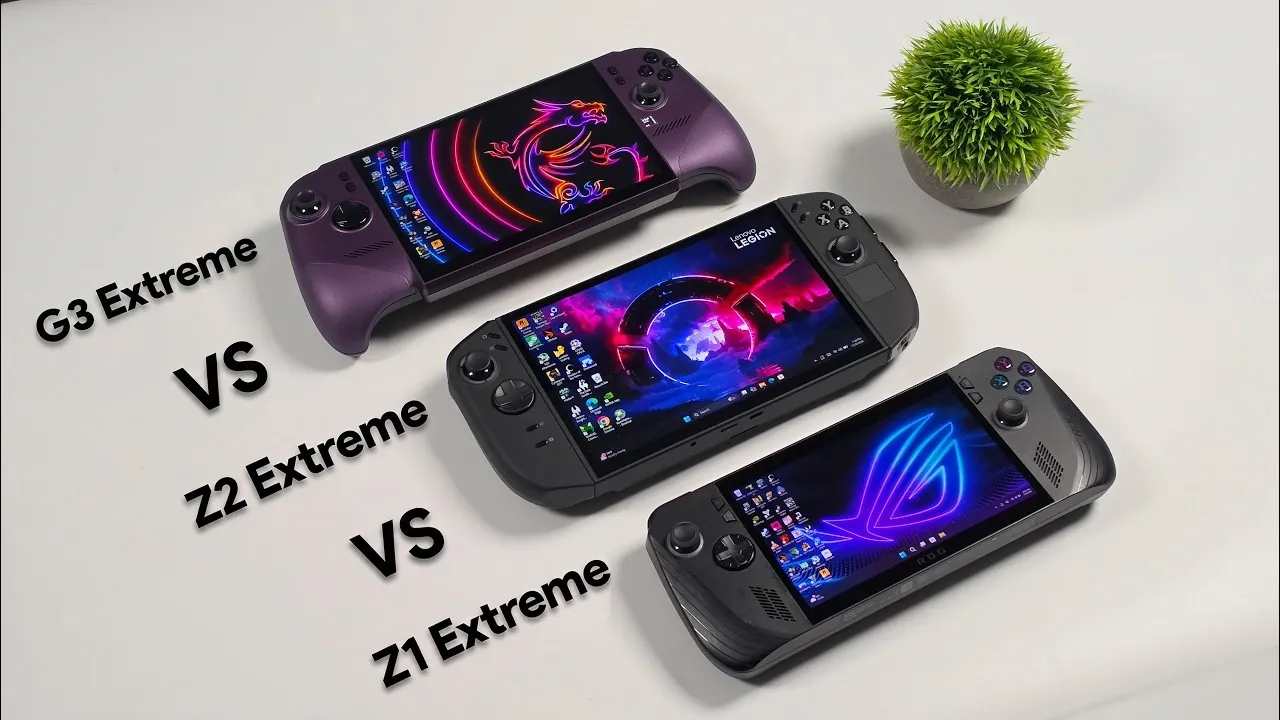
The Intel G3 Extreme, AMD Ryzen Z1 Extreme and AMD Ryzen Z2 Extreme are three processors competing in the handheld gaming space, each offering unique capabilities. According to ETA Prime, the Intel G3 Extreme stands out with its hybrid architecture featuring 14 cores and a B390 iGPU equipped with 12 XE3 cores clocked at 2300 MHz. Combined with 32GB of LPDDR5X RAM running at 8533 MT/s, it achieves notable results, such as 79 FPS in Cyberpunk 2077 at 25W, significantly outperforming its AMD counterparts in similar conditions.
Dive into how the G3 Extreme’s memory bandwidth and thermal efficiency stack up against the Z1 and Z2 Extreme and learn how these processors perform in graphically demanding titles like Horizon Zero Dawn Remastered and Black Myth Wukong. Gain insight into the trade-offs between Intel’s hybrid design and AMD’s Zen-based architectures, including considerations around pricing, performance thresholds and availability.
TL;DR Key Takeaways :
- The Intel G3 Extreme outperforms AMD Ryzen Z1 and Z2 Extreme processors in both synthetic benchmarks and real-world gaming, offering up to 55% higher single-core and 35% higher multi-core performance at 17W TDP.
- The G3 Extreme’s hybrid architecture features 14 cores (2 performance, 8 efficiency, 4 low-power efficiency) and a B390 iGPU with 12 XE3 cores clocked at 2300 MHz, delivering superior graphical and computational capabilities.
- In gaming benchmarks, the G3 Extreme consistently leads, achieving significant FPS improvements in titles like Cyberpunk 2077 (up to 92% better) and Black Myth Wukong (up to 68% better) compared to AMD processors.
- With 32GB LPDDR5X RAM at 8533 MT/s, the G3 Extreme offers unmatched memory bandwidth and power efficiency, making it ideal for handheld gaming devices where battery life is critical.
- While the G3 Extreme sets a new standard for performance, its premium price may limit accessibility, with AMD Ryzen Z1 and Z2 Extreme processors offering more budget-friendly alternatives for gamers.
Intel G3 Extreme: A Closer Look
The Intel G3 Extreme is engineered to redefine portable gaming performance. Its hybrid architecture integrates 14 cores, comprising 2 performance cores, 8 efficiency cores and 4 low-power efficiency cores. This design achieves a balance between computational power and energy efficiency, making it particularly well-suited for handheld devices where battery life is critical.
The processor’s integrated GPU (iGPU), the B390, features 12 XE3 cores clocked at up to 2300 MHz, delivering impressive graphical performance. Paired with 32GB of LPDDR5X RAM running at a remarkable 8533 MT/s, the G3 Extreme is optimized for speed and efficiency. This combination of advanced architecture and high-speed memory positions it as a leader in the handheld gaming market.
AMD Ryzen Z1 Extreme and Z2 Extreme: What They Offer
AMD’s Ryzen Z1 Extreme and Z2 Extreme processors also target the handheld gaming segment, but their approach differs from Intel’s. Both processors use AMD’s expertise in CPU and GPU integration, offering competitive options for gamers.
- Ryzen Z1 Extreme: Based on AMD’s Zen 4 architecture, this processor features 8 cores and 16 threads. Its RDNA 3 iGPU includes 12 Compute Units (CUs) clocked at 2900 MHz. The Z1 supports up to 24GB of RAM at 7500 MT/s, providing a solid foundation for gaming performance.
- Ryzen Z2 Extreme: Building on the Z1, the Z2 incorporates Zen 5 and Zen 5c cores while maintaining the same core and thread count. The iGPU is upgraded to RDNA 3.5 with 16 CUs, offering improved graphical capabilities. RAM support is slightly enhanced, reaching 8000 MT/s, though still falling short of the G3 Extreme’s memory bandwidth.
While the Z2 Extreme introduces architectural refinements and a more powerful iGPU, it remains a modest evolution rather than a innovative leap forward.

Uncover more insights about handheld games consoles in previous articles we have written.
- $99 Android Handheld is a Retro Gaming Steal : Mangmi Air X
- What Happens When Handheld Consoles Rival Gaming Laptops In 2026
- RG56 Pro Max First Look & Performance Guide: What Runs Well & What Struggles
- Valve Finally Solves Long-Standing SteamOS Bugs in New Update
- Why WinEnhanced is the Ultimate Xbox App Alternative for Handheld Gamers
- RG35XX H mini handheld games console
- 2025 GPD Win Mini Review : The Powerful Gaming PC in Your Pocket
- New Sony PS Vita Teardown
- Why Lenovo’s New 8.8-Inch Tablet is Secretly a Portable Gaming Console
- Retroid Pocket 5: Game Emulation Performance and Features Tested
Performance Benchmarks: How They Compare
CPU Performance
In CPU benchmarks such as Geekbench 6, the Intel G3 Extreme consistently outperforms its AMD counterparts. At a 17W TDP (Thermal Design Power), the G3 delivers up to 55% higher single-core performance and 35% higher multi-core performance compared to the Z1 Extreme. Even when operating at 25W, it maintains a 17% lead over the Z1 and edges out the Z2 Extreme. These results highlight the G3’s ability to combine raw computational power with energy efficiency, making it a standout choice for demanding applications.
iGPU Performance
The G3 Extreme’s B390 iGPU excels in synthetic benchmarks such as 3DMark Time Spy and OpenCL. It achieves a 74%-99% performance uplift over the Z1 Extreme and a 51%-68% improvement over the Z2 Extreme. These results underscore the G3’s ability to handle graphically intensive tasks, making it an excellent option for gamers who prioritize visual fidelity and smooth gameplay.
Gaming Performance
Real-world gaming benchmarks further emphasize the G3 Extreme’s dominance. Tested at 1080p resolution across various settings, the G3 consistently outperforms the Z1 and Z2 in popular titles:
- Cyberpunk 2077: The G3 achieves 79 FPS at 25W, an 80%-92% improvement over the AMD processors.
- Horizon Zero Dawn Remastered: The G3 averages 45 FPS at 25W, maintaining a 50%-45% lead over the Z1 and Z2.
- Shadow of the Tomb Raider: At 17W, the G3 leads with 46 FPS, slightly outperforming the Z1 and Z2.
- Black Myth Wukong: The G3 averages 74 FPS at 25W, significantly surpassing the Z1 (44 FPS) and Z2 (50 FPS).
- Forza Horizon 6: The G3 delivers 44 FPS at 25W, outperforming the Z1 (32 FPS) and Z2 (35 FPS).
These results confirm the G3 Extreme’s ability to deliver smooth, immersive gameplay, even in graphically demanding titles.
Power Efficiency and Memory Bandwidth
The G3 Extreme’s power efficiency is another key advantage. At lower TDP levels, it delivers high performance while conserving battery life, a critical factor for handheld gaming devices. Its 32GB LPDDR5X RAM, operating at 8533 MT/s, provides superior memory bandwidth compared to the Z1 and Z2, which are limited to 24GB and slower speeds. This combination of efficiency and speed ensures that the G3 Extreme can handle multitasking and resource-intensive applications with ease.
Pricing and Accessibility
While the Intel G3 Extreme excels in performance, its advanced architecture, high-speed RAM and powerful iGPU come with a premium price tag. This could make it less accessible to budget-conscious consumers. On the other hand, the AMD Ryzen Z1 and Z2 Extreme processors, though less powerful, may appeal to those seeking a more affordable option without entirely sacrificing performance. For gamers prioritizing value over peak performance, AMD’s offerings remain viable alternatives.
Final Thoughts
The Intel G3 Extreme sets a new benchmark for handheld gaming processors, delivering unmatched performance in both CPU and iGPU tasks. Its ability to combine raw power, efficiency and high-speed memory makes it a top choice for portable gaming systems. However, its higher price point may limit its appeal to a niche audience of enthusiasts willing to invest in innovative technology. For those seeking the best possible performance in handheld gaming, the G3 Extreme emerges as the clear leader, leaving the AMD Ryzen Z1 and Z2 Extreme trailing in its wake.
Media Credit: ETA PRIME
Disclosure: Some of our articles include affiliate links. If you buy something through one of these links, Geeky Gadgets may earn an affiliate commission. Learn about our Disclosure Policy.
