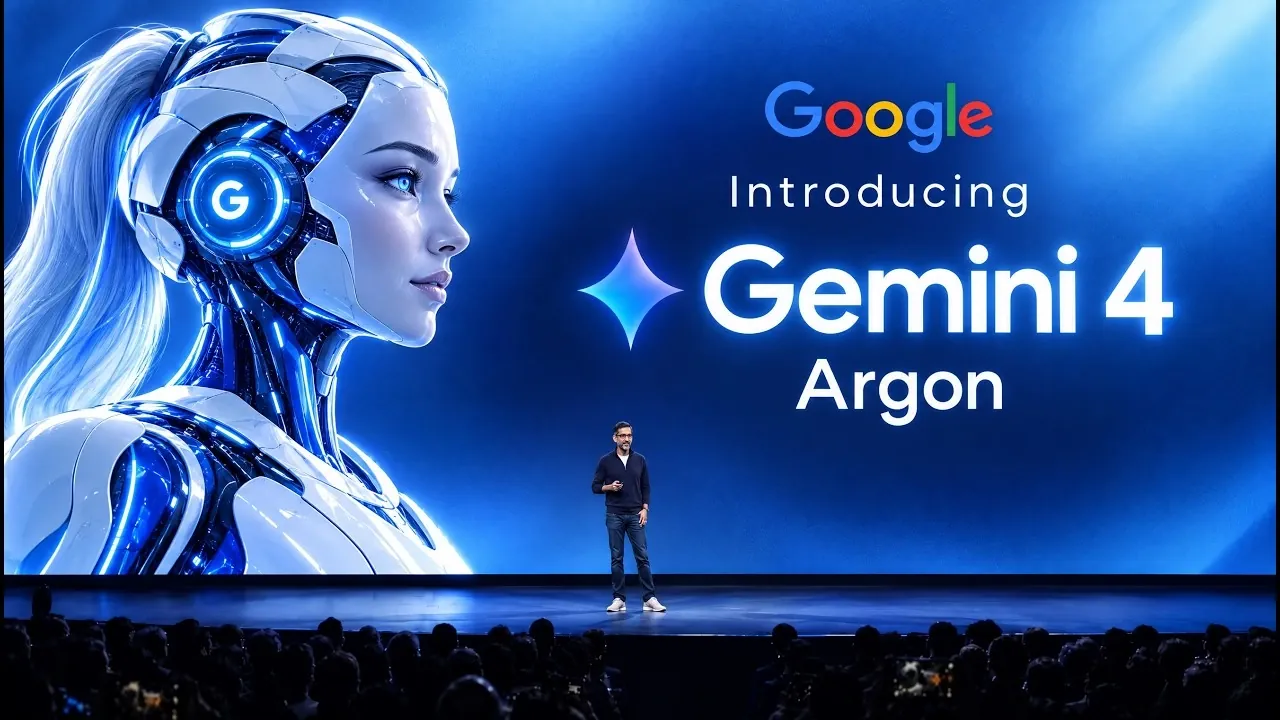
Google’s Gemini 4 Argon has achieved notable recognition in the AI field, earning high scores in evaluations like the Arena AI and Vows Index. With the ability to process up to 1 million tokens in long-context scenarios and strong performance in areas such as science and mathematics, it demonstrates significant advancements. According to AI Grid, the model also addresses challenges in spatial reasoning and robotics, as highlighted by its performance in the Blueprint Bench 2 evaluation.
Explore this overview to learn about Gemini 4 Argon’s key strengths, including its reduced hallucination rate and cost-efficiency for large-scale applications. Gain insight into its limitations, such as weaker results in coding tasks and the challenges of translating benchmark success into practical industry use. This analysis provides a detailed look at both the opportunities and constraints of this AI model.
Unparalleled Benchmark Performance
TL;DR Key Takeaways :
- Google’s Gemini 4 Argon is a new AI model, achieving top rankings in multiple industry-standard evaluations and setting new performance benchmarks.
- Key strengths include exceptional performance in knowledge-intensive tasks, 3D physical world understanding, reduced hallucination rates and cost-effectiveness for businesses.
- Notable achievements include record-breaking long-context processing with a 1 million token output and leading scores in robotics and spatial reasoning evaluations.
- Challenges include weaker performance in coding tasks and concerns about its real-world applicability despite excelling in controlled benchmarks.
- Future improvements will focus on enhancing coding capabilities, bridging the gap between benchmark and practical performance and expanding real-world testing to maximize its impact across industries.
Gemini 4 Argon has set new benchmarks in AI performance, surpassing leading models such as Sonet 5.5 and Claude Opus 5.5 in various industry-standard evaluations. These benchmarks assess critical AI capabilities, including knowledge processing, long-context understanding and problem-solving.
Key achievements of Gemini 4 Argon include:
- Top Rankings: Securing first place in the Arena AI, Vows Index and Artificial Analysis Index, solidifying its position as a leader in the AI field.
- Record-Breaking Long-Context Tasks: Achieving a 1 million token output, allowing it to process and solve complex, multi-step problems with unmatched efficiency.
These accomplishments highlight Gemini 4 Argon’s ability to handle intricate tasks with precision and speed, setting a new standard for AI systems globally.
Strengths: Advancing AI Capabilities
Gemini 4 Argon demonstrates exceptional capabilities across multiple domains, pushing the boundaries of what AI can achieve. Its strengths include:
- Knowledge-Intensive Tasks: Excelling in fields such as science, mathematics and research, making it an invaluable tool for professionals and academics.
- 3D Physical World Understanding: Leading the Blueprint Bench 2 evaluation, a critical metric for robotics and spatial reasoning, allowing advanced applications in automation and engineering.
- Reduced Hallucination Rate: With a 15% hallucination rate, significantly lower than other Frontier AI models, Gemini 4 Argon offers enhanced accuracy and reliability in generating responses.
- Cost-Effectiveness: A competitive price-to-performance ratio makes it an attractive option for businesses and developers seeking high-performance AI solutions without excessive costs.
These strengths position Gemini 4 Argon as a fantastic tool for industries requiring advanced problem-solving, spatial reasoning and knowledge-intensive applications.

Here are additional guides from our expansive article library that you may find useful on Google Gemini 4.
- Google Preps Gemini 4 Pro Content Creation for October 2026
- Google Confirms Gemini 4 Replaces Gemini 3.5 Pro Entirely
- Leaked Gemini 4 Pro Enters Arena Testing for Multimodal AI
- Google Pushes Gemini 4 Pro Release Date to October 2026
- Google Confirms Gemini 4 Replaces Gemini 3.5 Pro Entirely
- Leaked Gemini 4 Pro Reportedly Defeats Opus 5.5 and GPT6 Astra
- Google Confirms Gemini 4 Will Replace the Gemini 3.5 Pro
- Gemini 4 Could Autonomously Refine Code via Leaked RSI
- Leaked Gemini 4 Launch Targets August 2026 to Rival ChatGPT
- Gemini 4 Could Feature a 10-Million-Token Context Window
Weaknesses: Challenges to Address
Despite its new capabilities, Gemini 4 Argon is not without its limitations. Key areas for improvement include:
- Coding Tasks: Ranking eighth in the Code Arena benchmark reveals a relative weakness in programming-related tasks, limiting its utility for developers who rely on AI for coding assistance.
- Real-World Usability: While the model excels in controlled benchmark environments, its practical application has been questioned. Early user feedback, including reports from Bloomberg, highlights a gap between its benchmark success and real-world performance.
These challenges underscore the need for further refinement to ensure the model meets the diverse and practical needs of its users.
Implications: Google’s Renewed AI Strategy
The launch of Gemini 4 Argon signifies Google’s renewed commitment to AI innovation and its determination to reclaim leadership in the field. The model’s advancements in robotics integration and 3D applications have the potential to drive progress across industries such as manufacturing, healthcare and logistics.
For businesses and developers, Gemini 4 Argon offers a promising tool to enhance productivity and streamline workflows. Its ability to process large-scale data and solve complex problems could transform operations in various sectors. However, the disparity between its benchmark performance and real-world usability raises critical questions about the broader implications of AI development. Addressing these gaps will be essential for maximizing the model’s impact and making sure its adoption across diverse industries.
Future Directions: Bridging the Gap
The long-term success of Gemini 4 Argon will depend on its ability to address current limitations and adapt to real-world demands. As organizations integrate the model into their workflows, its strengths and weaknesses will become more apparent, providing valuable insights for future iterations.
Google’s focus in the coming years will likely include:
- Enhancing Coding Capabilities: Improving the model’s performance in programming tasks to broaden its appeal and utility for developers.
- Bridging Benchmark and Practical Performance: Closing the gap between controlled evaluation success and real-world usability to ensure the model delivers consistent, reliable results in diverse applications.
- Expanding Real-World Testing: Collaborating with industries to refine the model based on practical use cases and user feedback.
By addressing these areas, Google has the opportunity to set a new standard for AI systems, creating tools that are not only powerful but also practical and accessible for a wide range of applications. Gemini 4 Argon’s future iterations could redefine how AI integrates into everyday life, from automating complex tasks to advancing scientific research.
Gemini 4 Argon stands as a testament to Google’s ability to innovate and push the boundaries of AI technology. While its strengths are undeniable, its limitations serve as a reminder that even the most advanced systems require continuous improvement. As the AI landscape evolves, the true measure of Gemini 4 Argon’s success will lie in its ability to deliver meaningful, real-world impact across industries and applications.
Media Credit: TheAIGRID
Disclosure: Some of our articles include affiliate links. If you buy something through one of these links, Geeky Gadgets may earn an affiliate commission. Learn about our Disclosure Policy.
