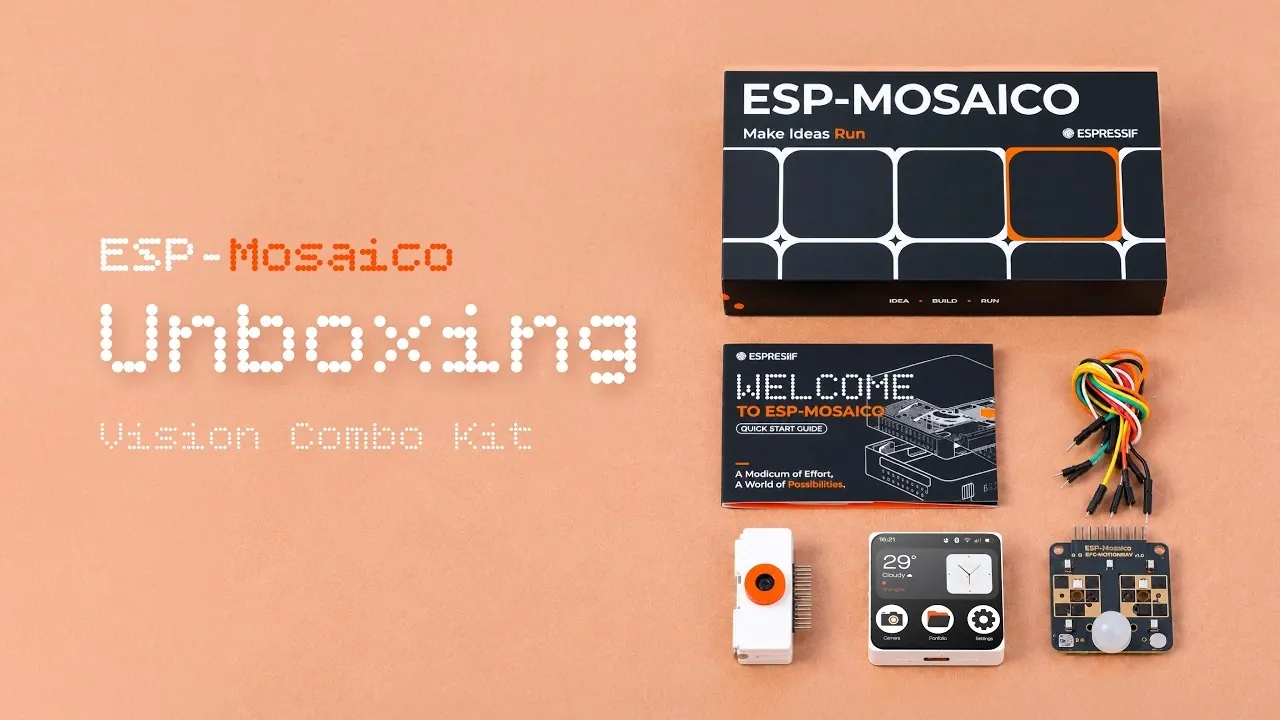
You can now easily add touch, sound and motion sensing to compact devices with the new Espressif ESP-Mosaico Vision Combo Kit, a small electronics development kit. Its units can join magnetically and detect their relative positions while keeping applications synchronized wirelessly. The hardware runs from a customizable enclosure and expansion connections to a folding camera, which must not be disconnected while the unit is powered on. Get to know how the screen, sensors and plug-in modules fit together, as well as the options for powering your own portable build.
ESP-Mosaico Vision Kit: Modular Hardware for Prototyping
TL;DR Key Takeaways :
- The ESP-Mosaico Vision Combo Kit costs $59 and is available for pre-order with an estimated 15-day dispatch lead time.
- The core unit has a 2.16-inch, 480 × 480 AMOLED touchscreen and weighs 33 g.
- Its ESP32-S31NRV16 processor runs at up to 320 MHz and includes 16 MB of PSRAM.
- Two 20-pin expansion headers support modular hardware, including the included camera and interaction modules.
- Wireless connectivity includes 2.4 GHz Wi-Fi 6, Bluetooth 5.4, Thread 1.4 and Zigbee 3.0.
The ESP-Mosaico Vision Combo Kit is part of a modular hardware platform for embedded application development and physical prototyping, announced on October 20, 2026. Its core unit contains a CoreBoard and a BaseBoard. The kit also includes a camera module, an interaction module, DuPont wires and an instruction manual. Espressif Systems makes ESP-Mosaico, so the claims reported here about it are the maker’s own.
A Square AMOLED Touchscreen Fits in a Small Enclosure
The core unit has a 2.16-inch AMOLED touchscreen with a resolution of 480 × 480 pixels. Its colors are more vivid than those of a traditional LCD, with less visible separation between the display and its edges.
Version 1.2 uses a resin 3D-printed enclosure with a smoother finish. The unit measures 45.19 mm wide and 11.48 mm thick, and weighs 33 g, making it light enough to carry comfortably or wear on the go.
Available STL files let you print and customize the open source enclosure. The core unit also has dedicated power, boot and application-function buttons.

Take a look at other insightful guides from our broad collection that might capture your interest in ESP32-S3 projects and uses.
- How to Build a Custom AI Desk Buddy with a ESP32 S3
- Create a Wireless Security Camera with an ESP32 CAM Module
- ESP Control Connects the ESP32 S3 to Home Assistant in Minutes
- 6 ESP32 Projects to Build Including an OLED Pulse Oximeter
- 5 ESP32 Projects Worth Building in 2026: Such as an Apple HomeKit Controller
The CoreBoard Combines a Processor and Motion Sensors
The CoreBoard runs on the ESP32-S31NRV16 system-on-chip, which has a dual-core, 32-bit RISC-V processor. Its onboard memory and storage include space for graphics, multimedia and cached assets:
- Processor: Up to 320 MHz
- SRAM: 512 KB
- In-package PSRAM: 16 MB
- SPI NOR flash: 16 MB
- SPI NAND flash: 1 Gbit
The processor supports hardware JPEG encoding and decoding. The CoreBoard also includes a BMI270 six-axis IMU, which measures motion, and two BMM150 magnetometers.
A microphone, speaker and vibration motor in the BaseBoard provide voice capture, audio output and haptic feedback. The kit’s audio hardware includes an ES8311 codec and an NS4150B Class-D amplifier.
Side Connectors and Magnets Allow Physical Expansion
A 20-pin expansion header sits on each side of the core unit, each with a 2.54 mm pitch compatible with common DuPont wires and pin headers. The connectors provide 3.3 V and 5 V outputs for sensors or custom expansion boards, while contact points and pins support expansion through pogo pins.
Four magnets beneath a sticker on the back of the enclosure let you attach the unit to metal surfaces or join it magnetically to another unit; you can also place it flat. Connected ESP-Mosaico devices can detect their relative positions and orientations and synchronize application states wirelessly.
The circuit board has an ENIG surface finish, a nickel-and-gold finish applied to its contacts. The core unit also has a USB Type-C port supporting High-Speed USB 2.0 On-The-Go.
Wireless Connections Cover Wi-Fi and Bluetooth
ESP-Mosaico supports 2.4 GHz Wi-Fi 6 and Bluetooth 5.4, including Bluetooth Low Energy and Bluetooth Classic. It also supports Thread 1.4 and Zigbee 3.0.
The system identifies compatible expansion modules automatically when they are attached to the expansion headers.
The Camera Module Folds Between Two Positions
The camera module connects to the left expansion connector only. The system recognizes it automatically, and its camera application displays a live feed. A folding mechanism switches the camera between front-facing and rear-facing positions, while two LEDs provide supplemental illumination.
Two camera hardware revisions are documented. V1.2 uses a 3.2-megapixel OV3640 sensor and supports 1024 × 768 output at 30 frames per second. Its fixed-focus lens has a 4.15 mm focal length, an f/2.4 aperture and a 68-degree field of view.
V1.4 uses a 1-megapixel SC101IOT sensor and supports 1280 × 720 output at a maximum specified transfer rate of 30 frames per second. It has three manually adjustable lens versions: one has a 4.3 mm focal length and 52-degree diagonal field of view, while the other two have a 3.1 mm focal length and 79-degree diagonal field of view. Rotate the focus ring to adjust focus distance and keep close-range images clear.
Both revisions support automatic exposure, gain and white balance. You can connect the camera while the core unit is powered on, but it must not be disconnected while powered on.
The Interaction Module Adds Touch, Light and Motion Inputs
You can install the Multi-function Interaction Module on either side of the core unit, which recognizes it automatically. Its application provides touch input, human-presence detection, ambient-light sensing, RGB effects and infrared control.
Its hardware combines a GL5506 photoresistor for light sensing, an AS312 passive infrared motion sensor, mechanical-button and capacitive-touch inputs, and six individually addressable RGB LEDs. The infrared transmitter uses the NEC protocol at 38 kHz by default.
The module supports hot swapping and has reverse-polarity protection to help protect the device if you connect it the wrong way.
A Small Battery Supplies Short Power Peaks
The BaseBoard contains a rechargeable 3.7 V, 65 mAh lithium-ion battery. It supports a 15C discharge rate and can briefly deliver close to 1 amp for peak power demands. The battery’s rated charging current is 65 mA.
The core unit can also receive power through USB Type-C or its rear expansion pads, and its USB-C port can supply a connected USB device with up to 5 V and 500 mA. Espressif says its own tests found standby current of around 0.2 mA, keeping consumption low during extended idle periods.
The Vision Combo Kit is listed at $59 through the official store. As of November 25, 2026, it is available there for pre-order with an estimated dispatch lead time of 15 days. A portable charger designed for the unit is sold separately, and a separate battery module is also available for longer portable operating time.
For us, the modular design is the standout feature of the ESP-Mosaico Vision Combo Kit. Automatic recognition of the camera and interaction modules means the system identifies those additions without manual selection. The standard 2.54 mm headers on both sides are just as important to that appeal: they let you build on the kit with ordinary DuPont wires and pin headers rather than special parts.
You could use the customizable enclosure to take a sensor experiment beyond the workbench in a form you can carry or wear. For anyone building compact interactive devices, the ESP-Mosaico Vision Combo Kit is worth exploring in more detail as a starting point for physical prototypes.
Media Credit: Espressif Systems
Disclosure: Some of our articles include affiliate links. If you buy something through one of these links, Geeky Gadgets may earn an affiliate commission. Learn about our Disclosure Policy.
