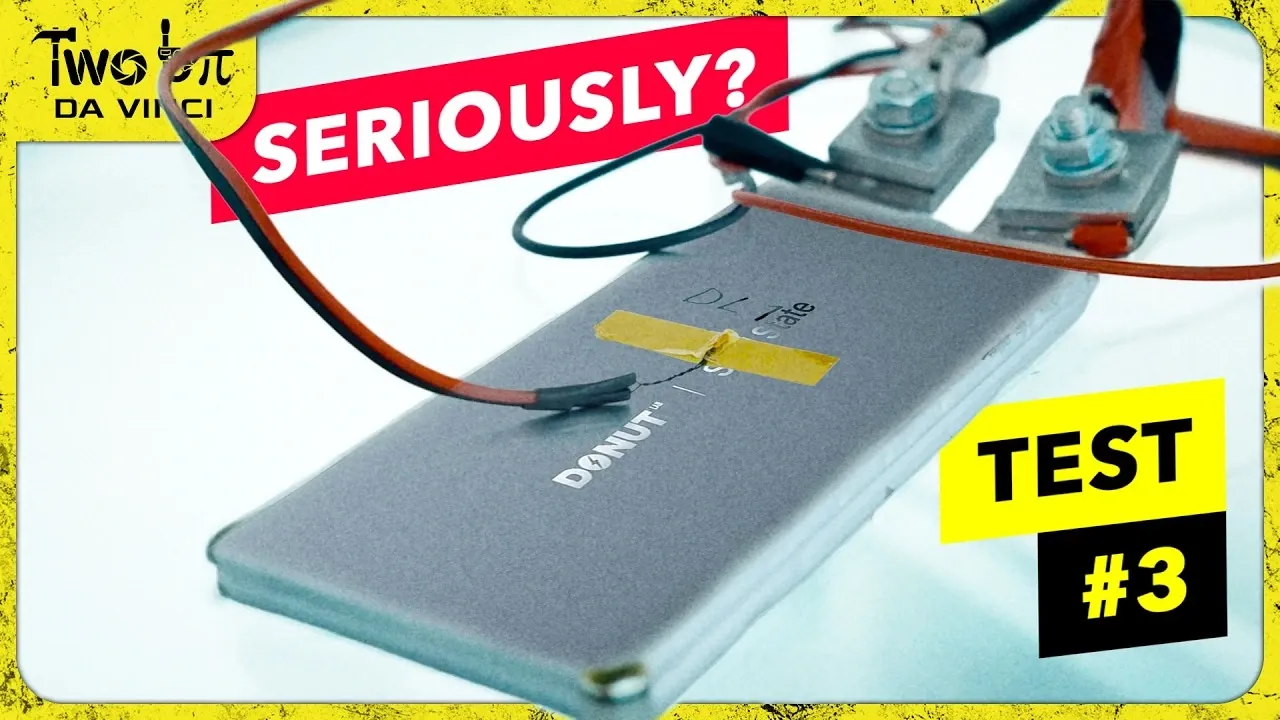
Donut Lab’s latest solid-state battery prototype has undergone its third round of testing and the results have sparked a mix of optimism and concern. In this evaluation, the battery demonstrated 97.7% charge retention over a 10-day period, highlighting its potential for stable energy storage. However, this performance falls short when compared to established technologies like Nickel Manganese Cobalt (NMC) and Lithium Iron Phosphate (LFP) batteries, which typically exhibit lower self-discharge rates. As Two Bit da Vinci explores the implications of these findings, the discussion shifts toward the broader challenges of bridging the gap between experimental designs and real-world applications.
In this guide, you’ll gain insight into how Donut Lab’s prototype measures up against commercial alternatives and why self-discharge performance is only one piece of the puzzle. Expect a closer look at the consistency of the battery’s chemistry across multiple tests, as well as the critical gaps in data that leave questions about its energy density, durability and cold-weather performance. This breakdown will also examine how competing advancements, such as BYD’s Blade 2 battery, are shaping the landscape and influencing the expectations for emerging technologies.
Donut Lab Battery Test Results
TL;DR Key Takeaways :
- The Donut Lab solid-state battery prototype demonstrated a 97.7% charge retention over 10 days, showing promise but falling short compared to established commercial batteries like NMC, LFP and sodium-ion chemistries.
- While the prototype displayed consistent electrochemical performance across tests, it lacks critical data on energy density, weight, durability and cold-temperature performance, raising concerns about its real-world viability.
- Test results suggest similarities to existing NMC or sodium-ion chemistries, casting doubt on the prototype’s level of innovation and differentiation from current technologies.
- Critics have expressed skepticism over the limited scope of testing and perceived lack of transparency, with calls for more comprehensive third-party validation to build credibility.
- Donut Lab faces increasing competitive pressure from advancements like BYD’s Blade 2 battery and commercial sodium-ion batteries, emphasizing the need for improved performance metrics and transparency to remain relevant in the market.
Key Findings: Self-Discharge Performance
The primary objective of the test was to evaluate the battery’s self-discharge performance, a critical metric for energy storage technologies. Over a 10-day period at room temperature, the prototype retained 97.7% of its charge. While this result demonstrates a degree of promise, it lags behind the performance of widely used battery chemistries, including:
- Nickel Manganese Cobalt (NMC)
- Lithium Iron Phosphate (LFP)
- Sodium-ion batteries
This shortfall can be attributed to the prototype’s experimental nature, but it also underscores the significant gap between early-stage development and the performance benchmarks set by commercial products. For a technology aiming to disrupt the market, this level of performance suggests that further refinement is necessary to meet industry standards.
How It Compares to Existing Technologies
The test results also provided insights into the battery’s underlying chemistry. Voltage data from the prototype closely aligns with characteristics of conventional NMC or high-voltage sodium-ion chemistries, effectively dispelling earlier speculation that the battery might operate as a supercapacitor. However, this similarity to existing technologies raises questions about the prototype’s level of innovation.
Competing advancements, such as BYD’s Blade 2 battery and commercial sodium-ion batteries, already offer proven performance and are gaining traction in the market. In this context, Donut Lab’s prototype struggles to differentiate itself, leaving observers to question whether it can deliver a meaningful advantage over established solutions.

Here is a selection of other guides from our extensive library of content you may find of interest on Solid-State Battery.
- Donut Lab Solid-State Battery Test Results from VTT Explained
- Donut Lab Solid State Battery or Pseudo-Capacitor, Experts Weigh In
- Solid-State Battery or Capacitor? Donut Lab’s 100,000-cycle Claim
- Solid-State Battery CES 2026 : Donut Verge TS Pro Plans & Doubts
- Donut Lab Solid-State Battery Test: VTT Finds 110% Capacity at 80C
- Donut Lab Solid State Battery Claims, 400 Wh/kg and Fast Charge
- New Donut Lab Solid-State Battery Made with Abundant, Non-Rare Materials
- CATL Sodium-Ion Battery Uses Water-Based Lines for Cheaper Cells
Consistency: A Positive Takeaway
One encouraging aspect of the test series is the consistency demonstrated by the prototype. Across all three tests conducted by Donut Lab, the electrochemical fingerprint has remained stable, suggesting that the same chemistry has been used throughout. This consistency reinforces the reliability of the design and indicates that the prototype is not prone to significant variability.
However, while consistency is a positive attribute, it does not address broader concerns about the battery’s practicality. For the prototype to gain traction, it must demonstrate not only reliability but also superior performance across a range of critical metrics.
Critical Gaps in Testing
Despite the focus on self-discharge performance, several critical aspects of the battery remain untested. Donut Lab has yet to provide data on key metrics that are essential for evaluating the real-world viability of the technology, including:
- Energy density
- Weight
- Durability over 100,000 charge cycles
- Cold-temperature performance
The absence of this data leaves significant gaps in understanding how the battery would perform in practical applications. Observers have expressed frustration at the slow release of limited information, viewing it as a potential red flag. Without addressing these critical areas, the prototype’s ability to compete with existing technologies remains uncertain.
Growing Skepticism and Criticism
The limited scope of the tests has fueled growing skepticism about Donut Lab’s intentions. Critics argue that the tests appear to prioritize marketing over genuine technical validation. The lack of independent testing has further undermined confidence in the company’s claims, with many calling for third-party verification to ensure transparency and credibility.
This skepticism is compounded by the perception that Donut Lab is withholding critical data, which has led some to question whether the prototype is being positioned as a concept rather than a viable product. Without greater transparency and more robust testing, the company risks losing the trust of both industry stakeholders and potential investors.
Competitive Pressure
Donut Lab’s challenges are amplified by the rapid progress of competing technologies. For example:
- BYD’s Blade 2 battery is already in production, offering proven safety, reliability and performance.
- Commercial sodium-ion batteries are emerging as a viable alternative to traditional lithium-ion chemistries, with advantages in cost and resource availability.
These advancements place additional pressure on Donut Lab to demonstrate not only the viability of their prototype but also its ability to outperform existing solutions. To remain competitive, the company must address critical performance metrics such as energy density, cycle life, and safety, areas where competitors are already excelling.
What’s Next for Donut Lab?
To move forward, Donut Lab must expand their testing efforts to address the gaps highlighted by the current results. Comprehensive evaluations should include:
- Safety testing to assess the risk of thermal runaway and other hazards.
- Performance in extreme temperatures, particularly in cold climates where battery efficiency often declines.
- Long-term durability to determine how the battery performs over thousands of charge and discharge cycles.
However, continued delays and limited disclosures could erode trust and interest in the project. To maintain credibility, Donut Lab must prioritize transparency and provide substantive data that addresses the concerns raised by the current test series. Without these steps, the company risks falling behind in an increasingly competitive market.
Broader Implications
The results of Donut Lab’s third-party validation test serve as a reminder of the challenges inherent in developing new battery technologies. While the prototype shows promise, its performance falls short of the benchmarks set by established solutions. As competitors continue to advance, Donut Lab faces mounting pressure to prove that their technology can deliver meaningful improvements and stand out in an increasingly crowded field.
Media Credit: Two Bit da Vinci
Disclosure: Some of our articles include affiliate links. If you buy something through one of these links, Geeky Gadgets may earn an affiliate commission. Learn about our Disclosure Policy.
