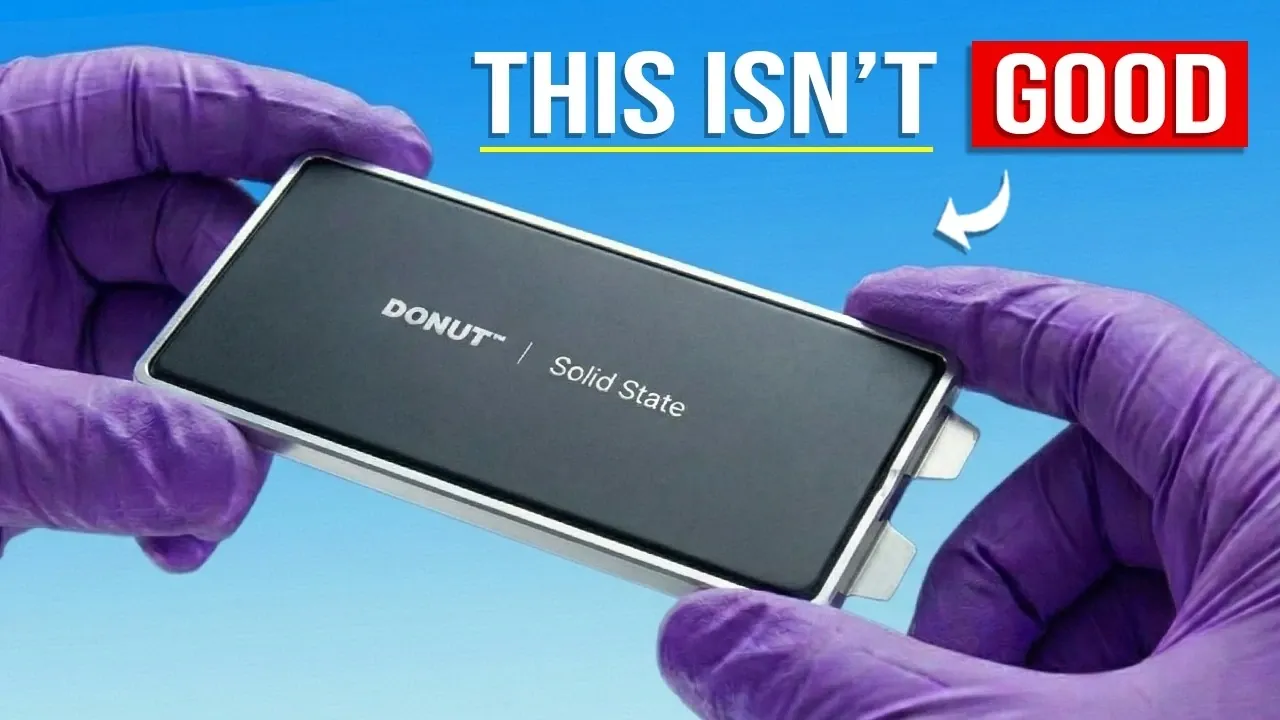
The world’s first solid-state battery, announced by Donut Lab, has sparked interest for its potential advancements over traditional lithium-ion technology. While marketed as a breakthrough in energy density, safety, and charging speed, independent testing by Finland’s VTT Research Institute, and as analyzed by Ziroth below, suggests otherwise. VTT’s findings reveal a 298 Wh/kg energy density, significantly lower than the claimed 400 Wh/kg and indicate that the battery may align more closely with enhanced lithium-ion designs rather than representing a fully solid-state system.
You’ll learn how VTT’s analysis identified gaps in the battery’s performance, including its charging limitations and safety characteristics. The discussion also examines how the battery’s design mirrors existing lithium-ion technology, from its material dependencies to its voltage behavior. This deep dive will provide clarity on the battery’s actual performance and the technical hurdles in achieving a true solid-state design.
Solid-State Battery Claims
TL;DR Key Takeaways :
- Donut Lab’s “solid-state battery” claims significant advancements in energy density, safety and charging speed, but independent testing by VTT suggests it may be an enhanced lithium-ion battery rather than a true solid-state design.
- VTT’s analysis revealed discrepancies, including a lower energy density (298 Wh/kg vs. the claimed 400 Wh/kg), slower charging times and a safety threshold of 90°C instead of the advertised 100°C.
- The battery contains lithium, contradicting Donut Lab’s claim of being lithium-free and its voltage curves resemble those of conventional lithium-ion batteries.
- Overheating issues during fast charging and unverified claims of a 100,000 charge cycle lifespan raise concerns about the battery’s long-term reliability and safety.
- While the battery demonstrates incremental improvements within lithium-ion technology, it falls short of delivering the fantastic potential expected from true solid-state batteries.
Independent Testing Unveils Key Findings
VTT, a globally respected research institute, carried out a detailed evaluation of the Donut Lab battery. Their findings revealed inconsistencies between the company’s promotional claims and the actual performance of the battery. The analysis indicated that the battery’s design and functionality align more closely with lithium-ion principles than with the characteristics of a genuine solid-state battery. Key findings from VTT’s testing include:
- The presence of lithium, contradicting Donut Lab’s assertion that the battery is lithium-free.
- An energy density of 298 Wh/kg, which is significantly lower than the advertised 400 Wh/kg.
- Charging times that did not meet the promised rapid performance.
- A safety threshold of 90°C, falling short of the claimed safe operation at 100°C.
These results suggest that while the battery demonstrates advanced capabilities, it does not represent a fundamental departure from the principles of lithium-ion technology.
Performance Under Scrutiny
Further testing by VTT highlighted additional concerns regarding the battery’s performance. The voltage curves recorded during testing closely resembled those of conventional lithium-ion batteries, casting doubt on the claim that this is a solid-state design. Fast charging tests revealed overheating issues, necessitating operational adjustments to maintain safe conditions. Moreover, the claimed lifespan of 100,000 charge cycles remains unverified, as long-term testing is required to substantiate such durability.
These findings underscore the importance of rigorous, independent validation when evaluating new technologies. While the Donut Lab battery showcases certain advancements, its performance metrics suggest it is not the innovative leap forward that solid-state technology promises.
World’s First Solid-State Battery?

Unlock more potential in battery technology by reading previous articles we have written.
- Donut Lab Solid State Battery or Pseudo-Capacitor, Experts Weigh In
- Solid-State Battery or Capacitor? Donut Lab’s 100,000-cycle Claim
- Solid-State Battery CES 2026 : Donut Verge TS Pro Plans & Doubts
- Donut Lab Solid State Battery Claims, 400 Wh/kg and Fast Charge
- Samsung Galaxy Ring 2: The Next Big Thing in Wearables
- Solid-State Electric Motorcycle from Verge Adds 300 Km in 10 Minutes
- Galaxy Watch 9 Ultra: Smartwatch with Solid-State Batteries
- New Donut Lab Solid-State Battery Made with Abundant, Non-Rare Materials
- Solid-State Batteries for EVs, 2027 Commercialization Timeline
- CATL Sodium-Ion Battery Uses Water-Based Lines for Cheaper Cells
Notable Advancements, But Not Innovative
Despite its limitations, the Donut Lab battery does introduce some noteworthy improvements. Its relatively high energy density and faster charging capabilities represent progress within the framework of lithium-ion technology. These features push the boundaries of what is currently achievable, offering potential benefits for applications requiring compact, high-performance energy storage.
However, these advancements are not without caveats. The battery’s operation near the edge of safe conditions raises concerns about its long-term reliability and suitability for widespread use. Additionally, the lack of a clear departure from lithium-ion principles limits its potential to redefine the energy storage landscape. While the battery is a step forward, it does not yet fulfill the fantastic promise of solid-state technology.
Unanswered Questions
The discrepancies identified by VTT’s testing leave several critical questions unresolved. These questions highlight the need for further investigation to fully understand the battery’s capabilities and limitations:
- Why do the voltage curves so closely resemble those of lithium-ion batteries?
- What accounts for the lower energy density compared to the claimed 400 Wh/kg?
- Why are the charging times slower than advertised?
- Why is the safety limit set at 90°C when 100°C operation was claimed?
These unanswered questions emphasize the importance of transparency and independent verification in the development of new energy storage technologies. Without clear answers, the true potential of the Donut Lab battery remains uncertain.
Progress in Perspective
The Donut Lab battery represents a meaningful step forward in energy storage technology, showcasing advancements in energy density and charging speed. However, the inconsistencies highlighted by independent testing suggest that this innovation remains firmly rooted in the principles of lithium-ion technology. While it offers incremental progress, it does not yet achieve the fantastic potential associated with true solid-state batteries.
For the energy storage industry, the development of a genuine solid-state battery remains a critical goal. Such a breakthrough would deliver significant improvements in safety, performance and efficiency, reshaping the possibilities for renewable energy, electric vehicles and portable electronics. Until then, the Donut Lab battery serves as a reminder of the challenges and complexities involved in pushing the boundaries of existing technology.
Media Credit: Ziroth
Disclosure: Some of our articles include affiliate links. If you buy something through one of these links, Geeky Gadgets may earn an affiliate commission. Learn about our Disclosure Policy.
