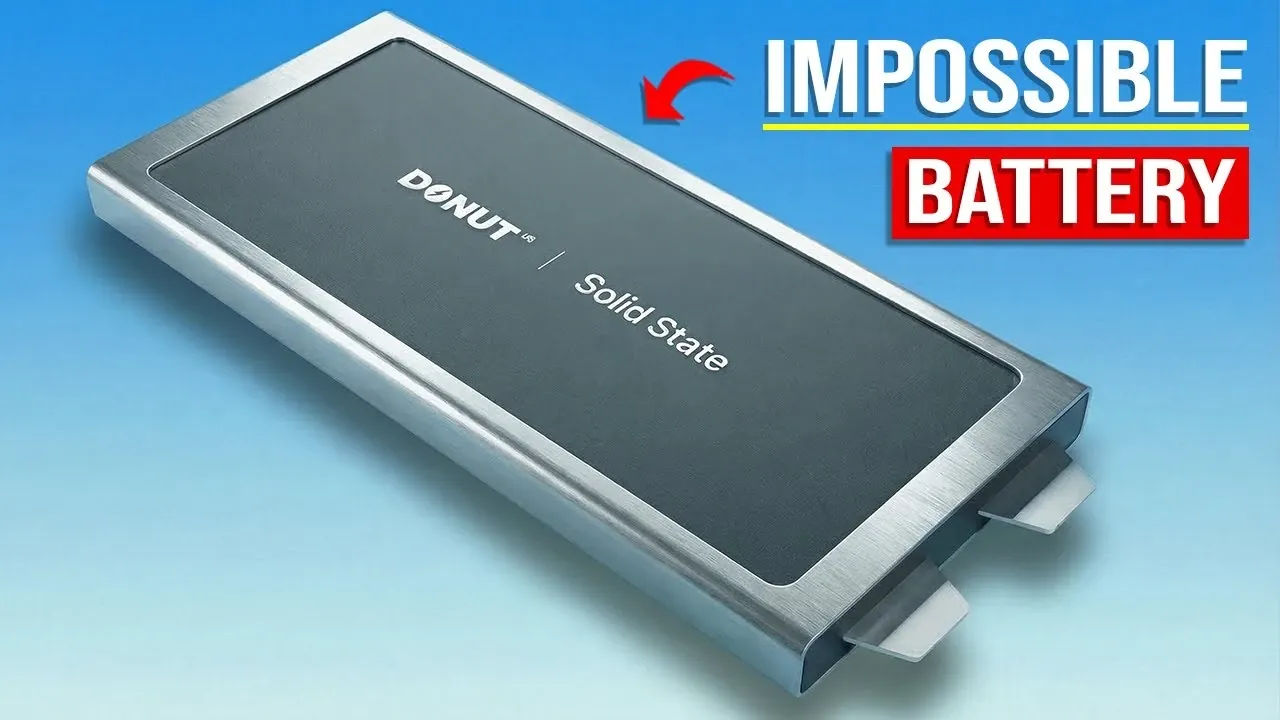
What if the future of energy storage wasn’t just an incremental improvement but a complete reimagining? Solid-state batteries, long considered the holy grail of energy technology, could be the key to unlocking safer, faster, and more sustainable power solutions. In this guide, Ziroth explores how Donut Lab’s bold claim of creating the world’s first solid-state battery could transform industries like electric vehicles (EVs) and renewable energy. But with skepticism swirling around untested prototypes and ambitious performance metrics, the question remains: is this breakthrough the real deal or just another overhyped promise?
This investigation dives into the fascinating claims surrounding Donut Lab’s innovation, from its five-minute charging time to a staggering 100,000-cycle lifespan. You’ll explore the science behind solid-state batteries, the potential environmental benefits of ditching lithium, and the controversies that have experts questioning the technology’s readiness. Whether you’re intrigued by the promise of EVs that charge as quickly as a coffee break or curious about the challenges of scaling such a fantastic idea, this breakdown will leave you pondering the future of energy storage, and the fine line between ambition and reality.
Donut Lab’s Bold Battery Claims
TL;DR Key Takeaways :
- Donut Lab claims to have developed the world’s first solid-state battery with new features, including 400 Wh/kg energy density, 5-minute full charging, 100,000-cycle lifespan, and operational reliability in extreme temperatures.
- The battery uses non-toxic, abundant materials and a customizable design, with a stack-and-press manufacturing method aimed at simplifying production and reducing costs.
- Solid-state batteries replace liquid electrolytes with solid materials, offering enhanced safety, higher energy density, and extended lifespan, while avoiding the environmental and ethical issues associated with lithium.
- Skepticism persists due to the lack of functional prototypes, detailed technical data, and independent validation, with concerns that the technology may function more like an advanced capacitor rather than a true battery.
- Donut Lab plans to scale production through a modular manufacturing plant in Finland, targeting 1 GWh capacity by 2026, but the feasibility of these goals depends on proving the technology’s viability and performance claims.
Donut Lab has made bold assertions about its solid-state battery, highlighting several key performance features:
- Energy density of 400 Wh/kg, which significantly exceeds the capabilities of current lithium-ion batteries.
- Full charging in just five minutes, addressing one of the most significant challenges in EV adoption.
- A lifespan of 100,000 cycles, promising durability far beyond existing battery technologies.
- Operational reliability in extreme temperatures, ranging from -30°C to 100°C.
- Use of non-toxic, abundant materials, emphasizing sustainability and environmental responsibility.
One of the most intriguing aspects of the battery is its customizable design. Donut Lab claims that the battery can be manufactured in irregular shapes, allowing integration into unconventional spaces, such as within the structural components of EVs. Additionally, the company has introduced a stack-and-press manufacturing method, which it claims simplifies production processes and reduces costs. This method could potentially make the technology more accessible for large-scale applications.
How Solid-State Batteries Work
Solid-state batteries differ from traditional lithium-ion batteries by replacing liquid electrolytes with solid materials. This fundamental shift in design offers several advantages:
- Enhanced safety by eliminating the risk of leaks and fires associated with liquid electrolytes.
- Higher energy density, allowing longer-lasting power and improved performance.
- Extended lifespan, reducing the need for frequent replacements and lowering long-term costs.
Donut Lab’s approach reportedly avoids the use of lithium, a material often criticized for its environmental and ethical implications. Instead, the company has partnered with Nordic Nano, a Finnish nanotechnology firm, to develop innovative materials and manufacturing techniques. Central to their production process is the stack-and-press method, which involves layering components and applying pressure to create a compact and efficient energy storage system. This method is described as scalable, supporting modular manufacturing plants that can adapt to varying production demands.
Investigating The World’s First Solid State Battery

Browse through more resources below from our in-depth content covering more areas on Solid-State Batteries.
- New Donut Lab Solid-State Battery Made with Abundant, Non-Rare
- Galaxy Watch 9 Ultra: Smartwatch with Solid-State Batteries
- Solid-State Batteries for EVs, 2027 Commercialization Timeline
- Solid-State Battery Commercialization : How Close Are We?
- Are Solid-State Batteries the Key to Safer, Longer-Lasting EVs
- Solid-State Electric Motorcycle from Verge Adds 300 Km in 10
- Samsung Galaxy Ring 2: The Next Big Thing in Wearables
- Record Broken: Mercedes EQS Solid-State Battery Covers 1205 km
- Samsung Galaxy Ring 2: Features, Release Date, and More
- Samsung Galaxy Watch Ultra 2 Release Date, Features, and More
Why Skepticism Persists
Despite the ambitious claims, several factors have raised doubts about the feasibility and readiness of Donut Lab’s technology:
- The battery modules showcased during the announcement were 3D-printed mock-ups, not functional prototypes, leaving questions about the technology’s current development stage.
- Observed charging behavior and voltage specifications suggest the technology may function more like an advanced capacitor rather than a true battery. Capacitors, while capable of rapid charging and discharging, lack the energy density required for long-term storage, limiting their practical applications in EVs and other energy-intensive systems.
- The company has not provided detailed technical data to substantiate its claims, making it difficult for experts to assess the validity of the technology.
These concerns highlight the need for independent testing and transparency. Without clear evidence to support its assertions, Donut Lab risks being perceived as overpromising on a concept that may not yet be ready for real-world applications.
Plans for Manufacturing and Scaling
Donut Lab has outlined ambitious plans to scale production through a modular manufacturing plant in Finland. The facility is expected to achieve an initial production capacity of 1 GWh by 2026, with a target of 10 GWh in subsequent years. Modular manufacturing offers several advantages, including scalability and flexibility, which could allow the company to adapt quickly to market demands.
The company has emphasized its commitment to using non-toxic materials and sustainable processes, aligning with global efforts to reduce the environmental impact of battery production. However, the success of these plans hinges on the validity of the technology and its ability to meet the promised performance metrics. Without independent validation, the feasibility of achieving these production goals remains uncertain.
Potential Impact and Industry Concerns
If Donut Lab’s claims are validated, the implications for the energy storage industry could be significant:
- Addressing key challenges in EV adoption, such as range anxiety, lengthy charging times, and battery longevity.
- Setting new benchmarks for environmental responsibility by using sustainable materials and processes.
- Allowing innovative applications, such as integrating batteries into the structural components of vehicles, potentially reducing weight and improving efficiency.
However, extraordinary claims require rigorous scrutiny. The lack of transparency and independent testing raises concerns about the potential for misleading the industry and investors. Unverified claims could divert resources and attention from established technologies that are already making incremental but meaningful progress in energy storage. This could disrupt the broader energy ecosystem and delay advancements in sustainable energy solutions.
Looking Ahead
Donut Lab’s announcement has captured the attention of the energy storage community, offering a vision of safer, more efficient, and environmentally friendly batteries. However, the extraordinary nature of the claims, combined with the absence of independent validation, warrants a cautious approach. Until further testing and transparency confirm the technology’s viability, the promise of the world’s first solid-state battery remains an intriguing but unproven possibility. The coming years will be critical in determining whether Donut Lab’s innovation can deliver on its ambitious promises or if it will remain a concept awaiting realization.
Media Credit: Ziroth
Disclosure: Some of our articles include affiliate links. If you buy something through one of these links, Geeky Gadgets may earn an affiliate commission. Learn about our Disclosure Policy.
