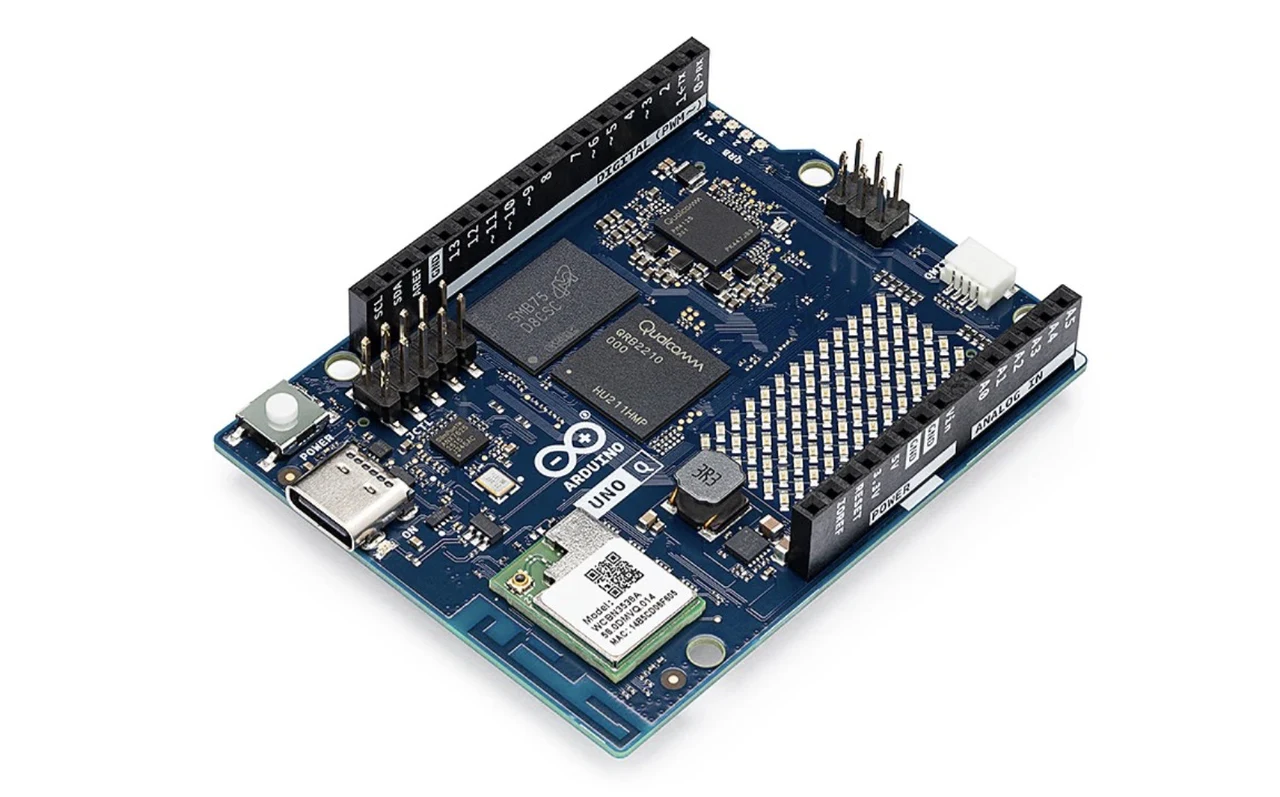
What if a single board could bridge the gap between beginner-friendly simplicity and professional-grade power? Enter the Arduino Uno Q, a new evolution in the world of development boards. With its unique dual-processor architecture, this device doesn’t just promise versatility, it delivers a seamless blend of high-level computing and real-time control. Imagine prototyping an IoT device that not only gathers and processes data but also responds to its environment with split-second precision. Whether you’re an aspiring maker or a seasoned developer, the Uno Q is poised to redefine what’s possible in robotics, edge AI, and beyond.
In this unboxing exploration, DigiKey uncovers the features that make the Arduino Uno Q a standout in its class. From its powerful Qualcomm ARM Cortex A53 processor to its integration of Linux and Zephyr OS environments, this board is designed to handle everything from AI inference to sensor management with ease. You’ll discover how its USB-C connectivity and robust GPIO options simplify hardware integration, and why its support for Python scripting opens doors to limitless innovation. But the real magic lies in how these elements come together to streamline complex workflows. By the end, you might just find yourself rethinking what a development board can do.
Arduino Uno Q Overview
TL;DR Key Takeaways :
- The Arduino Uno Q combines a microcontroller (MCU) and a microprocessor (MPU) in a dual-processor architecture, allowing seamless collaboration between high-level computing and real-time control for advanced applications like edge AI, robotics, IoT, and vision systems.
- Powered by a Qualcomm ARM Cortex A53 CPU (Linux OS) and an STM32 U585 ARM Cortex M33 MCU (Zephyr OS), the board delivers computational power for tasks like AI inference and real-time precision for hardware interactions.
- Key hardware features include USB-C connectivity for faster data transfer, robust GPIO options for easy integration with sensors and actuators, and support for peripherals like displays and keyboards.
- The software ecosystem supports Linux, Arduino IDE, Arduino AppLab, Python scripting, and AI modules, offering flexibility for both beginners and experienced developers to create diverse applications.
- Applications span edge AI, robotics, IoT, vision-based systems, and interactive displays, showcasing the board’s versatility in handling complex workflows and allowing innovation across industries.
- Priced at €47,60 Available to preorder wit delivery in 3-4 weeks : SKU ABX00162 – Barcode 7630049205673
Hardware Features: Power and Precision Combined
At the heart of the Arduino Uno Q is a Qualcomm ARM Cortex A53 CPU, operating within a full Linux OS environment. This MPU provides the computational power necessary for advanced tasks, including running Python scripts, managing AI models, and executing vision-based applications. Complementing this is the STM32 U585 ARM Cortex M33 MCU, which operates on the Zephyr OS. The MCU is optimized for real-time control and low-power operations, making sure precise and efficient task execution.
The dual-processor architecture enables seamless collaboration between high-level computing and real-time control. For instance, the MPU can handle complex data processing, such as AI inference or image recognition, while the MCU manages precise hardware interactions like sensor data acquisition or motor control. This synergy is particularly advantageous for applications requiring both computational intensity and real-time responsiveness.
Additional hardware features include USB-C connectivity, which supports a wide range of peripherals such as displays, keyboards, and mice. This modern interface ensures faster data transfer and simplifies integration with external devices. The board also includes robust GPIO options, allowing developers to connect sensors, actuators, and other components effortlessly. Whether you are prototyping an IoT solution, building a robotics system, or experimenting with AI, the Uno Q’s hardware is designed to meet diverse project requirements.
Software and Programming: Flexibility for Every Developer
The Arduino Uno Q offers a comprehensive software ecosystem, starting with its pre-installed Linux OS. This familiar environment allows developers to access powerful tools for application development. The board supports Arduino AppLab, an intuitive platform for creating applications, as well as the Arduino IDE for traditional sketch-based programming. For those who prefer standalone MCU programming, the board provides full support, making sure flexibility for a wide range of development approaches.
Python scripting is fully supported, opening the door to its extensive libraries for tasks such as data analysis, machine learning, and automation. The board’s compatibility with AI modules further enhances its capabilities, allowing developers to experiment with edge AI applications directly on the device. This flexibility makes the Uno Q equally suitable for beginners exploring new technologies and seasoned developers tackling complex challenges.
The integration of Linux and Zephyr environments allows developers to use the strengths of both systems. For example, the Linux-based MPU can handle high-level tasks like data retrieval or AI processing, while the Zephyr-based MCU manages real-time operations. This dual-environment approach simplifies the development of applications that require both computational power and precise control.
Arduino Uno Q Unboxing

Here are more detailed guides and articles that you may find helpful on Arduino.
- BreadBro Wave Arduino Development Board Helps Create Music
- Arduino Zero Pro 32 bit Cortex M0 Arduino Now Available From
- Arduino GIGA R1 WiFi dual core 32-bits microcontroller
- Arduino omni-wheel robot and pen plotter
- DIY Arduino Wind Speed Meter Anemometer Project
- Adafruit Trinket M0 For CircuitPython And Arduino Launched By
- Arduino Uno UNO R4 officially launches
- New Arduino Robot Kit Unveiled To Help You Learn As You Go
- Arduino Nano 33 BLE and BLE Sense now available
- Raspberry Pi Arduino Shield
Real-World Demonstration: Weather Data Integration
A practical demonstration of the Arduino Uno Q’s capabilities involves integrating its Linux and Zephyr environments to create a weather data visualization system. In this example, the Linux-based MPU retrieves real-time weather data from an online API. The data is then passed to the Zephyr-based MCU, which processes it to generate a visual representation on an LED matrix display. This seamless interaction between the MPU and MCU highlights the board’s potential for IoT applications, where data collection, processing, and real-time visualization are essential.
This example underscores the board’s ability to handle complex workflows efficiently. By combining high-level data processing with precise hardware control, the Uno Q enables developers to create sophisticated systems with minimal effort. Whether you are building a smart home device or an industrial monitoring system, the board’s capabilities can simplify your development process.
Advanced Features
- Microprocessor: Qualcomm® Dragonwing™ QRB2210
- Microcontroller: Real-time, low-power STM32U585 MCU
- RAM: 2GB LPDDR4
- Storage: 16 GB eMMC built-in (no SD card required)
- Connectivity: Dual-band Wi-Fi® 5 (2.4/5 GHz), Bluetooth® 5.1
- High-speed headers: Power advanced peripherals – vision, audio, display
- Classic UNO headers: Mount shields to add capabilities
- LED matrix: 8 x 13 LED matrix for visual creation and feedback
- USB-C connector: Power delivery, video output, or connect keyboard, mouse, USB microphones or USB cameras via dongle
- Qwiic connector: Expand easily with Modulino® nodes – no soldering required
Applications: Unlocking New Possibilities
The Arduino Uno Q’s dual-processor architecture and versatile software support make it a powerful platform for a wide range of applications. Its ability to handle both high-level computations and real-time operations opens up new possibilities for innovation. Key application areas include:
- Edge AI: Execute AI models locally for tasks such as image recognition, predictive analytics, and anomaly detection, reducing reliance on cloud-based processing.
- Robotics: Control motors, sensors, and actuators with precision while managing complex computations for navigation, object detection, and decision-making.
- IoT: Develop connected devices that efficiently gather, process, and transmit data, allowing smart systems for homes, industries, and cities.
- Vision Applications: Implement computer vision tasks, including object detection, tracking, and image processing, for use in security systems, autonomous vehicles, and more.
- Interactive Displays: Create dynamic and engaging user interfaces using the onboard LED matrix display, ideal for educational tools, kiosks, and artistic installations.
The versatility of the Uno Q ensures that it can adapt to the needs of various industries and projects. Its robust hardware and software ecosystem provide the tools necessary to bring innovative ideas to life, whether in research, education, or commercial development.
Media Credit: DigiKey
Disclosure: Some of our articles include affiliate links. If you buy something through one of these links, Geeky Gadgets may earn an affiliate commission. Learn about our Disclosure Policy.
