
What does it take to build a machine that can handle everything you throw at it, without breaking a sweat? Imagine a PC so powerful it can render complex 3D models in minutes, process massive datasets without hesitation, and tackle advanced AI workflows like it’s child’s play. Enter the 2000W PC, a high-performance beast engineered for professionals and enthusiasts who refuse to compromise on speed, efficiency, or capability. But with great power comes great complexity: managing heat, making sure compatibility, and taming its immense energy demands are challenges that only the most determined builders dare to face.
In this project, optimum takes you through what makes this 2,000-watt powerhouse a fantastic option for demanding workflows. From its innovative AMD Threadripper CPU and dual NVIDIA RTX 5090 GPUs to the intricate cooling systems that keep it from overheating, every component is designed to push the boundaries of modern computing. But is such a machine practical for everyday use? And what sacrifices must be made to achieve this level of performance? Whether you’re a creative professional, a tech enthusiast, or just curious about what’s possible at the bleeding edge of PC technology, this deep dive will challenge your understanding of what a computer can do.
Building a 2000W PC
TL;DR Key Takeaways :
- The 2000W PC is a high-performance system designed for demanding tasks like 3D rendering, video editing, and advanced gaming, featuring innovative components for unmatched productivity.
- Core components include the AMD Threadripper 9980X CPU, dual NVIDIA RTX 5090 GPUs, 128GB DDR5 RAM, and 8TB Samsung 990 Pro SSDs, all housed on a Gigabyte TRX50 Arrow motherboard.
- Thermal management is critical, with a Silverstone 360mm liquid cooler for the CPU and plans to upgrade the GPUs from air cooling to liquid cooling for better performance and stability.
- The system excels in professional applications like Blender and Da Vinci Resolve, significantly reducing rendering times and improving workflow efficiency, but gaming performance is limited due to lack of SLI support and CPU optimization challenges.
- Power consumption exceeds 2,000W under full load, requiring a robust power supply and potential electrical upgrades, with future plans for improved cooling and case designs to enhance performance and reliability.
Core Components: Powering Unmatched Performance
At the heart of this build lies the AMD Threadripper 9980X CPU, a 64-core, 128-thread processor built on the advanced Zen 5 architecture. This processor is specifically designed for multi-threaded workloads, making it an ideal choice for software like Blender, Fusion 360, and other professional applications. Its ability to handle simultaneous tasks with ease ensures smooth performance even under heavy computational loads.
Complementing the CPU are dual NVIDIA RTX 5090 GPUs, connected via PCIe 5.0 x16 slots. These GPUs deliver exceptional computational power, making them indispensable for rendering, AI-driven workflows, and other GPU-intensive tasks. Their advanced architecture ensures high efficiency and performance, even when tackling the most complex projects.
The system also features 128GB of DDR5 RAM clocked at 6400 MHz, providing ample memory for seamless multitasking and rapid data access. For storage, the build incorporates 8TB of Samsung 990 Pro SSDs, offering high-speed read and write capabilities essential for managing large project files and making sure quick load times. All these components are housed on the Gigabyte TRX50 Arrow motherboard, an EATX board designed to support the latest technologies and high-performance hardware configurations.
Cooling and Thermal Management: A Critical Challenge
Effective cooling is a cornerstone of any high-performance PC, and with a system drawing over 2,000W, thermal management becomes even more critical. The AMD Threadripper CPU is cooled by a Silverstone 360mm liquid cooler, which efficiently dissipates heat during intensive workloads. This cooling solution ensures that the processor maintains optimal performance without thermal throttling.
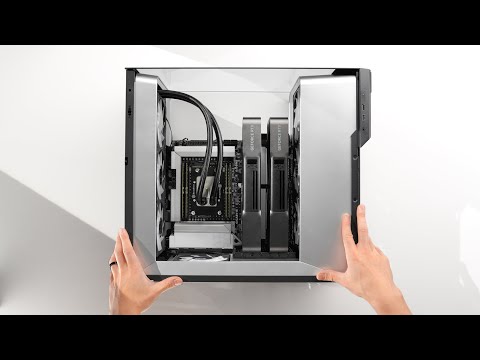
The dual NVIDIA RTX 5090 GPUs, however, present a more complex challenge. Their stacked configuration generates significant heat, particularly during extended rendering or AI training sessions. Currently, air cooling is used for the GPUs, but this setup struggles to maintain ideal temperatures under sustained loads. Plans are in place to implement a liquid cooling solution for the GPUs, which would significantly improve thermal performance and overall system stability.
Inside the 2000W PC Built By Optimum
Here are additional guides from our expansive article library that you may find useful on gaming PC systems.
- How to Build a Budget 4K Gaming PC for Smooth Gameplay
- MEGAMINI G1 the world’s smallest water-cooled gaming PC from
- Revolt small form factor ITX gaming PC systems
- Mini MSI Vortex Gaming PC Equipped With Dual NVIDIA Graphics
- iBUYPOWER Paladin XLC Gaming PC
- Digital Storm Eclipse Mini Gaming PC Systems Unveiled From $699
- COLORFUL iGame M600 Mirage gaming PC with magnetic power
- Giada D2308U Mini Gaming PC Now Available For $1,099
- Periphio Red Gaming PC, Intel Quad Core i7 3.3GHz, 16GB RAM
- AYA Neo handheld gaming PC preorders open
Overcoming Build Challenges
Building a 2000W PC is not without its hurdles, and careful planning is essential to address potential issues. One of the initial challenges was fitting the EATX Gigabyte TRX50 Arrow motherboard into the Phanteks Evolve S2 case. The case required modifications to accommodate the larger board, highlighting the importance of verifying component compatibility during the planning phase.
Another significant challenge was managing the thermal performance of the GPUs. High temperatures during sustained workloads affected system stability and performance. This issue underscores the need for robust cooling solutions and adaptability when working with high-performance components. Additionally, the system’s power requirements necessitated a high-capacity power supply and careful consideration of electrical infrastructure to ensure safe and reliable operation.
Performance Across Applications
This system excels in professional workflows, delivering exceptional performance in applications such as 3D rendering, video editing, and modeling. In Blender and Fusion 360, rendering times were reduced by more than half compared to previous setups, significantly enhancing productivity. The system’s ability to handle complex scenes and large datasets with ease makes it a valuable tool for professionals in creative and technical fields.
In video editing software like Da Vinci Resolve, the system demonstrated smoother playback during tasks such as heavy denoising and color grading. While export times showed only marginal improvements, the overall workflow was noticeably more efficient, allowing for faster project turnaround.
Gaming performance, however, was less impressive. The lack of SLI support meant that the dual GPUs provided no advantage in most gaming scenarios. Additionally, the AMD Threadripper CPU required core disabling to optimize gaming performance, as its multi-threaded design is not fully used by most games. This highlights the system’s focus on professional applications rather than gaming.
Power Consumption and Future Upgrades
Operating a 2000W PC requires careful consideration of power consumption and electrical infrastructure. Under full load, the system draws over 2,000W, pushing the limits of standard electrical circuits. A robust power supply is essential to ensure stable and reliable operation, and users may need to upgrade their electrical setup to accommodate the system’s demands.
Future upgrades aim to address some of the system’s current limitations. Implementing a liquid cooling solution for the GPUs is a priority, as it would improve thermal efficiency and ensure long-term reliability during demanding workloads. Additionally, exploring new case designs or custom enclosures could provide better airflow and cable management, further enhancing the system’s performance and usability.
Media Credit: optimum
Disclosure: Some of our articles include affiliate links. If you buy something through one of these links, Geeky Gadgets may earn an affiliate commission. Learn about our Disclosure Policy.
