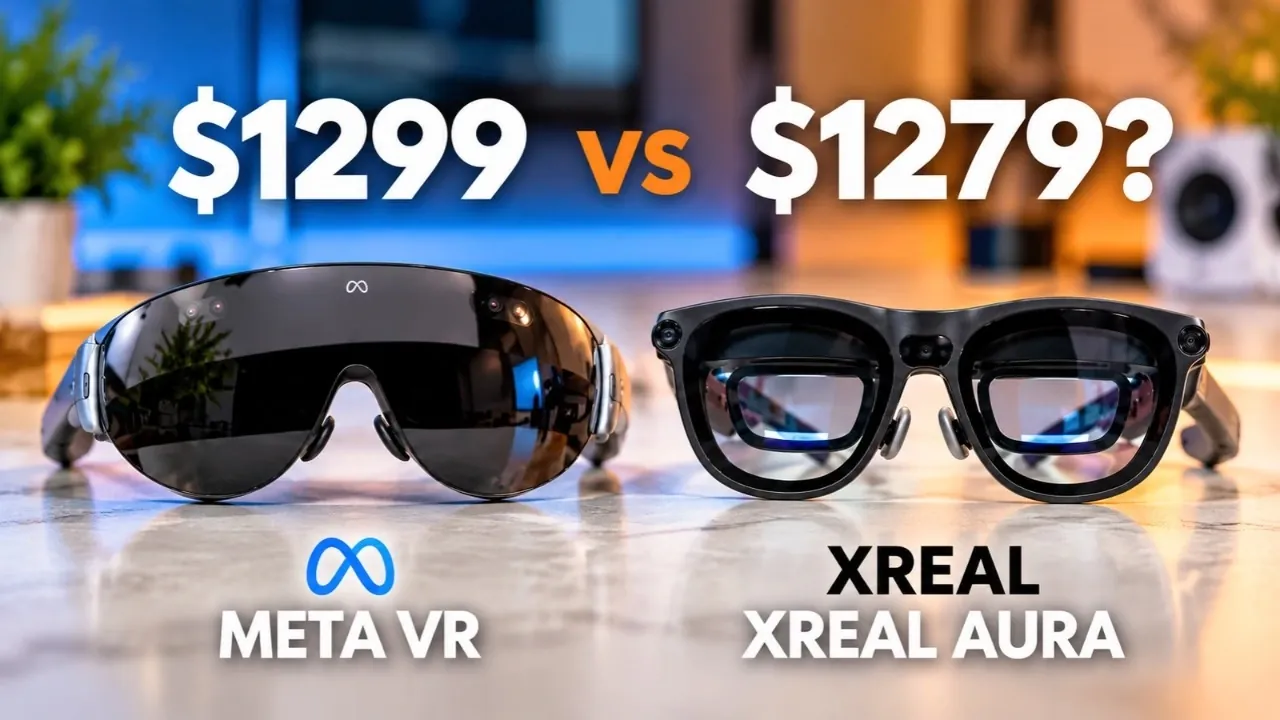
The XREAL Aura and Meta VR headset, both priced at $1,300, cater to distinct user needs through their contrasting approaches to immersive technology. As highlighted by Tech Court, the XREAL Aura focuses on augmented reality (AR) with its see-through lenses, allowing users to overlay digital content onto their surroundings while maintaining awareness of the physical world. This makes it particularly appealing for multitasking and productivity in real-world environments. Meanwhile, the Meta VR headset emphasizes virtual reality (VR), offering a fully immersive experience through its 5K micro OLED display and pass-through screens, making it a strong contender for gaming and entertainment enthusiasts.
Explore how these devices differ in key areas such as design philosophy, display technology and productivity features. You’ll gain insight into the XREAL Aura’s lightweight, portable design and its integration with Gemini AI for enhanced multitasking, as well as the Meta VR headset’s focus on immersive gaming through the Quest ecosystem. This breakdown will help you determine which device aligns better with your priorities, whether it’s blending digital content into your daily life or diving into fully immersive virtual environments.
Differences in Design Philosophy
TL;DR Key Takeaways :
- The XREAL Aura focuses on augmented reality (AR) with see-through lenses for blending digital content with the physical world, while the Meta VR headset emphasizes virtual reality (VR) for fully immersive experiences.
- The XREAL Aura offers a lightweight, glasses-like design for portability and real-world integration, whereas the Meta VR headset features a visor-like design suited for stationary, immersive use.
- For productivity, the XREAL Aura supports up to five virtual screens, runs on Android XR and integrates Gemini AI, while the Meta VR headset supports three virtual screens and focuses more on entertainment.
- The Meta VR headset excels in immersive gaming with access to the Quest ecosystem, while the XREAL Aura provides AR gaming flexibility with compatibility for external devices like the Steam Deck.
- The XREAL Aura is expected to launch by the end of 2026, while the Meta VR headset is slated for release in spring 2027, catering to different user priorities and timelines.
The design philosophies of the XREAL Aura and Meta VR headset reflect their intended use cases. The XREAL Aura is tailored for users who want to seamlessly merge the digital and physical worlds. Its optical see-through lenses allow you to overlay digital elements onto your environment without losing awareness of your surroundings. This makes it ideal for multitasking in real-world settings.
On the other hand, the Meta VR headset is built for complete immersion in virtual environments. Its design isolates you from the physical world, creating an all-encompassing digital space. This makes it particularly appealing for gaming enthusiasts and entertainment seekers who want to fully engage with virtual experiences. The contrasting design philosophies highlight the devices’ focus on either enhancing reality or replacing it entirely.
Display Technology: Clarity vs Adaptability
The display technology of these devices underscores their different strengths. The Meta VR headset features a 5K micro OLED display, delivering exceptional clarity and vibrant colors. This makes it a standout choice for high-definition gaming and entertainment, where visual sharpness is paramount.
In comparison, the XREAL Aura is equipped with a 2K see-through OLED display that incorporates electrochromic dimming technology. This feature allows you to adjust the transparency of the lenses, making sure usability in a variety of lighting conditions. While the Meta VR headset excels in delivering crisp visuals, the XREAL Aura prioritizes adaptability, making it more versatile for everyday environments.

Here are additional guides from our expansive article library that you may find useful on XREAL Aura.
- $20 Price Gap Pits XREAL Aura Against Meta VR Glasses
- XREAL Aura Secures 10,000 Deposits for Fall 2026 Launch
- How XREAL Aura $1,500 Spatial Computing Glasses Could Challenge Apple Vision
- Immersive Meta VR Glasses Challenge XREAL Aura AR Vision
- XREAL Aura Brings Android XR and Gemini AI to Smart Glasses
- URXR One vs XREAL Aura: AR Glasses Specs and Features Compared
- Best $1300 Smart Glasses: XREAL Aura vs Meta VR Headset
- VITURE Pro 2 Beats XREAL XBX in New $299 XR Glasses Test
- XREAL vs URXR vs VITURE Compared as Best AR Monitor Replacements
- Xreal Aura vs Galaxy XR : 6 Degrees of Freedom and a Wider FOV Define the Xreal Aura
Portability and Design
Portability and design are key factors to consider when choosing between these devices. The XREAL Aura’s lightweight, glasses-like design makes it highly portable and suitable for use in public spaces such as offices, coffee shops, or while commuting. Its discreet appearance ensures that it blends seamlessly into your daily routine.
In contrast, the Meta VR headset adopts a visor-like design that, while sleek, is less subtle. It is better suited for home use or dedicated VR sessions where portability is less of a concern. The difference in design reflects the devices’ intended purposes, with the XREAL Aura catering to on-the-go users and the Meta VR headset focusing on immersive, stationary experiences.
Productivity Features: AR vs VR
When it comes to productivity, the XREAL Aura takes the lead. It supports up to five virtual screens and runs on the Android XR platform, granting access to the Google Play Store for a wide range of apps. Its integration with Gemini AI enhances multitasking by providing real-world assistance, making it a powerful tool for professionals.
The Meta VR headset, while slightly less versatile in productivity, supports up to three virtual screens and includes tools such as a virtual keyboard, trackpad and remote desktop functionality. These features make it a viable option for work-related tasks, though its primary focus remains on entertainment and immersive experiences. Both devices cater to productivity needs, but the XREAL Aura’s AR capabilities and AI integration give it an edge for users who prioritize efficiency.
Gaming: Immersion or Flexibility?
For gaming enthusiasts, the Meta VR headset offers a clear advantage. Built on the Quest ecosystem, it provides access to an extensive library of VR games, delivering a deeply immersive gaming experience. However, it’s worth noting that the controllers are sold separately, which could increase the overall cost.
The XREAL Aura, while not specifically designed for gaming, offers compatibility with external devices like the Steam Deck. This allows you to enjoy games on a floating screen, providing a unique but less immersive experience compared to the Meta VR headset. The choice here depends on whether you prioritize the flexibility of AR gaming or the full immersion of VR.
Software and AI Integration
The software ecosystems of these devices further differentiate them. The XREAL Aura uses Android apps and integrates Gemini AI for real-world assistance, making it a practical choice for productivity and AR applications. Its AI capabilities enhance user interaction, offering features like voice commands and contextual assistance.
In contrast, the Meta VR headset excels in its VR app ecosystem, offering features such as holographic avatars for virtual meetings and social interactions. This makes it an appealing option for users interested in collaborative experiences within virtual spaces. The software and AI integration of each device reflect their respective focuses on AR and VR, catering to different user needs.
Availability and Release Timeline
The release timelines of these devices may influence your decision. The XREAL Aura is expected to launch by the end of 2026, making it the sooner option for early adopters. The Meta VR headset, on the other hand, is slated for release in spring 2027. While the later release date for the Meta VR headset may allow for additional refinements, it also means a longer wait for those eager to experience its features.
Who Should Choose What?
– XREAL Aura: Best suited for users who prioritize productivity, portability and real-world integration. Its lightweight design and AR capabilities make it ideal for professionals and individuals looking for a device that enhances their daily routines.
– Meta VR Headset: Perfect for those seeking immersive entertainment, gaming and virtual experiences. Its focus on VR makes it a strong choice for users who want to fully engage with digital environments and reduce reliance on traditional devices.
Making the Right Choice
Choosing between the XREAL Aura and Meta VR headset ultimately depends on your priorities and how you plan to use the device. If you value immersive gaming and entertainment, the Meta VR headset offers a superior experience with its advanced VR capabilities. However, if productivity, real-world integration and immediate availability are more important to you, the XREAL Aura is the better fit. Both devices represent significant advancements in immersive technology, but their distinct approaches ensure they cater to different audiences and use cases.
Media Credit: Tech Court
Disclosure: Some of our articles include affiliate links. If you buy something through one of these links, Geeky Gadgets may earn an affiliate commission. Learn about our Disclosure Policy.
