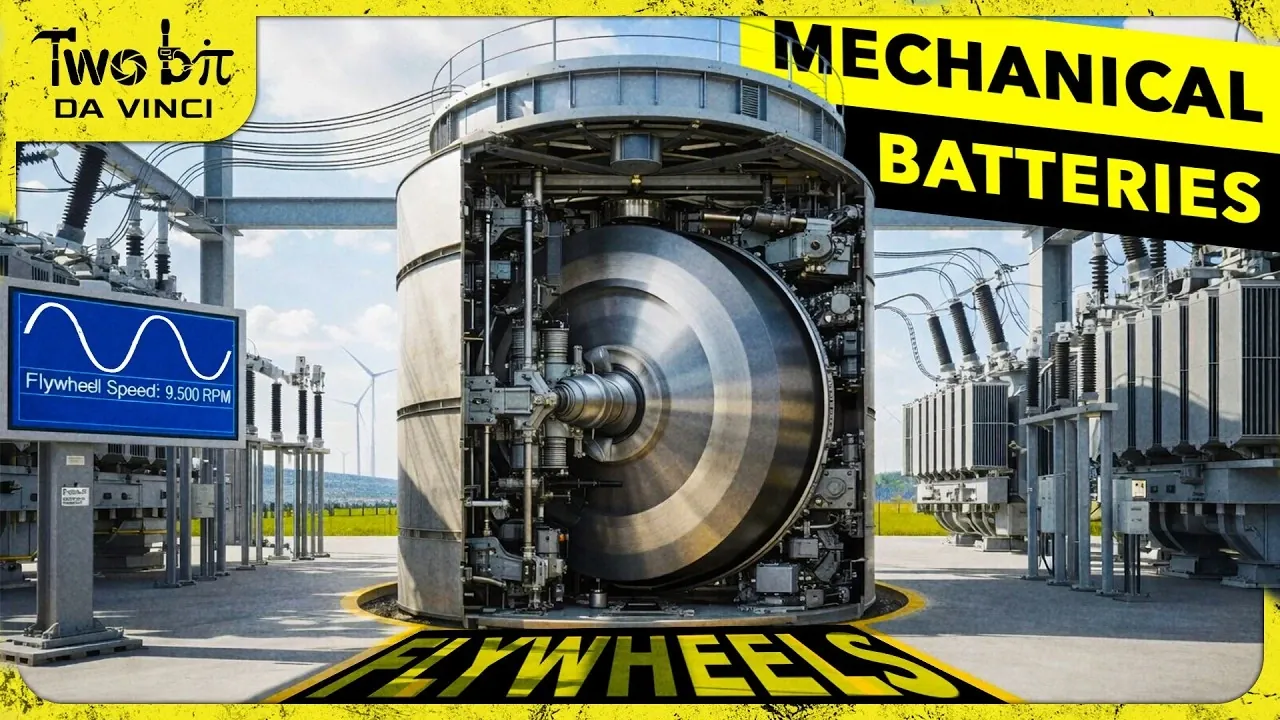
The transition to renewable energy has introduced a critical challenge: maintaining grid stability in the absence of traditional inertia provided by fossil fuel-based power plants. Without the rotational motion of turbines that historically buffered grids against sudden fluctuations, renewable energy systems face heightened risks of blackouts and voltage instability. Flywheel energy storage systems offer a compelling solution to this issue. By rapidly storing and releasing energy, flywheels act as stabilizers, countering the unpredictable nature of solar and wind power. As Two Bit da Vinci explains, these systems not only address the technical gaps left by renewables but also offer practical advantages like durability and minimal maintenance.
In this feature, you’ll explore how flywheels function as a bridge between renewable energy generation and grid reliability. Learn about their ability to provide instantaneous power delivery during demand spikes, their role in hybrid systems alongside batteries and the economic considerations that make them increasingly viable. Whether you’re interested in the mechanics of energy storage or the broader implications for clean energy adoption, this guide offers a detailed look at the growing importance of flywheels in modern energy systems.
Flywheels Stabilizing Renewable Grids
TL;DR Key Takeaways :
- Renewable energy grids face stability challenges due to the loss of grid inertia, previously provided by traditional fossil fuel-based power plants, leading to increased risks of blackouts and voltage instability.
- Flywheel energy storage systems offer a solution by rapidly storing and releasing energy, acting as “shock absorbers” to stabilize grids and counteract fluctuations in supply and demand.
- Flywheels operate by converting electrical energy into kinetic energy, using advanced materials and technologies like electromagnetic bearings to enhance efficiency and reduce costs.
- Applications of flywheels include industrial energy stabilization, hybrid energy systems and grid stabilization, providing rapid energy delivery and reducing strain on renewable energy grids.
- Flywheel technology is gaining global adoption due to its scalability, low operational costs and ability to complement other energy storage systems, playing a critical role in the clean energy transition.
Flywheel energy storage systems have emerged as a promising solution to this issue. By offering rapid energy storage and release capabilities, flywheels stabilize grids and ensure reliable power delivery, making them a critical component in the clean energy transition.
Understanding Grid Inertia and Renewable Energy Challenges
Grid inertia is a fundamental property of traditional power systems, where the rotational motion of turbines in coal, gas and nuclear plants provides a stabilizing effect. This inertia helps maintain a consistent frequency on the grid, preventing sudden fluctuations that could lead to power outages or equipment damage. However, renewable energy sources like solar panels and wind turbines do not inherently provide this rotational inertia, creating a significant gap in grid stability.
The absence of grid inertia poses several challenges:
- Increased Risk of Blackouts: Without inertia, grids are more susceptible to sudden disruptions, especially during periods of fluctuating energy demand.
- Voltage Instability: Renewable energy systems can struggle to maintain consistent voltage levels, leading to potential damage to infrastructure and appliances.
- Unpredictable Energy Supply: Solar and wind energy generation is inherently intermittent, making it difficult to match supply with demand in real time.
Flywheels address these challenges by acting as “shock absorbers” for the grid. They quickly store and release energy to counteract sudden changes in supply or demand, making sure that the grid remains stable even during unpredictable fluctuations.
How Flywheel Technology Works
Flywheel energy storage systems operate on a simple yet effective principle: converting electrical energy into kinetic energy and storing it as rotational motion. When energy is needed, the system releases it almost instantaneously, making flywheels ideal for handling short-duration, high-power demands. The process can be broken down into three key steps:
- Energy Storage: Electricity is used to spin a rotor at high speeds, storing energy as rotational motion. Advanced materials like carbon fiber are often used for the rotor to enhance durability and efficiency.
- Minimizing Energy Loss: The rotor spins in a vacuum chamber to reduce air resistance, while electromagnetic bearings are used to minimize friction and energy loss.
- Energy Release: When the grid requires additional power, the rotational motion is converted back into electricity and delivered to the system almost instantly.
Modern flywheels, such as those developed by Quint, have evolved significantly in terms of efficiency and cost-effectiveness. Early designs relied on superconducting bearings for ultra-efficient rotation, but these were expensive and complex. Quint’s transition to electromagnetic bearings has reduced costs while maintaining high performance, making flywheels more accessible for widespread use.
Advance your skills in energy by reading more of our detailed content.
- The Nuclear Fusion Breakthrough Once Dismissed as Impossible
- Z Pinch Fusion Costs Drop, Compact Reactor Skips Magnets & Lasers
- Kesterite Solar Cells vs Perovskite: Efficiency and Stability
- Solar Energy S 40,000 mAh retractable solar panel and power bank
- EnergyLink’s Magnetic Wireless Charger Apple Watch Band
- NASA’s Mechanical Battery: A Breakthrough in Sustainable Energy
- Donut Lab Solid State Battery Claims, 400 Wh/kg and Fast Charge
- Samsung Galaxy Watch 7: Must-Know Tips & Tricks
- Donut Lab Solid State Battery or Pseudo-Capacitor, Experts Weigh In
- CATL Sodium-Ion Battery Uses Water-Based Lines for Cheaper Cells
Applications and Advantages of Flywheels
Flywheels are versatile energy storage systems that excel in scenarios requiring rapid energy delivery and stabilization. Their unique capabilities make them valuable across various industries and applications:
- Industrial Use: Flywheels are used to stabilize voltage and reduce peak power demands in energy-intensive industries such as manufacturing, construction and port operations. They also capture and reuse regenerative energy from activities like crane movements, improving overall efficiency.
- Hybrid Energy Systems: Flywheels pair effectively with other energy storage technologies, such as sodium-ion or lithium-ion batteries. While batteries handle long-term energy storage, flywheels manage short-term energy spikes, reducing strain on the grid and enhancing system reliability.
- Grid Stabilization: Flywheels provide the burst power delivery needed to stabilize renewable energy grids. This capability is particularly important for addressing the intermittent nature of solar and wind energy generation, making sure consistent power delivery to consumers.
In addition to their technical advantages, flywheels offer several practical benefits. They have a long operational lifespan, require minimal maintenance and can be deployed in a variety of settings, from urban centers to remote locations.
Economic and Practical Considerations
For flywheel technology to achieve widespread adoption, it must balance performance with economic feasibility. Quint’s decision to replace superconducting bearings with electromagnetic ones exemplifies this focus on cost reduction without compromising reliability. By simplifying the design and lowering production costs, flywheels have become more accessible to industries and utilities, paving the way for broader implementation.
The economic advantages of flywheels include:
- Reduced Operational Costs: Flywheels have low maintenance requirements and long lifespans, making them a cost-effective solution over time.
- Scalability: Flywheel systems can be scaled to meet the needs of different applications, from small industrial facilities to large utility grids.
- Energy Efficiency: By minimizing energy losses during storage and release, flywheels improve overall system efficiency, reducing waste and lowering costs.
These factors make flywheels a practical and economically viable solution for stabilizing renewable energy grids, particularly in regions where grid stability is a pressing concern.
Global Adoption and Market Growth
Flywheel technology is gaining traction worldwide as industries and governments prioritize renewable energy integration and grid stability. Quint’s systems are currently operational in several countries, including:
- The Netherlands
- Denmark
- Spain
- Italy
- The United States
- Ukraine
Other companies, such as Taurus and Amber Kinetics, are also advancing flywheel solutions for niche applications, further driving innovation in the field. As the demand for reliable energy storage continues to grow, the global market for flywheels is expected to expand significantly. This growth reflects the increasing recognition of flywheels as a critical component of modern energy systems.
The Role of Flywheels in the Clean Energy Transition
Flywheels are playing an essential role in the clean energy transition by addressing challenges that other energy storage technologies cannot fully solve. While batteries are effective for long-term energy storage, they are less suited for providing the rapid, high-power responses needed to stabilize renewable energy grids. Flywheels fill this gap, offering a complementary solution that enhances the resilience and reliability of clean energy systems.
As the world moves away from fossil fuels and embraces electrification, flywheels will become increasingly important. They provide the stability and flexibility needed to integrate renewable energy sources into existing grids, making sure that the transition to a sustainable energy future is both reliable and efficient.
Media Credit: Two Bit da Vinci
Disclosure: Some of our articles include affiliate links. If you buy something through one of these links, Geeky Gadgets may earn an affiliate commission. Learn about our Disclosure Policy.
