
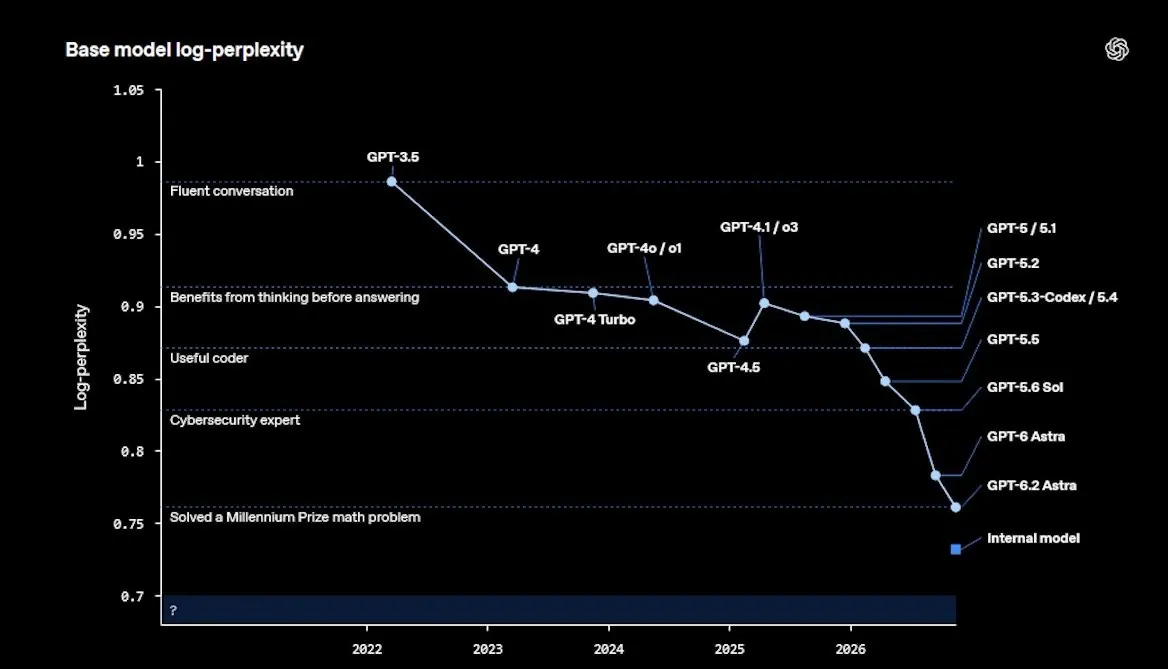
OpenAI says a score of approximately 0.76 on its internal log-perplexity measure coincided with a model beginning to produce groundbreaking mathematical results. The score tracks how accurately a model predicts the next piece of text, giving you a way to follow AI progress beyond spending announcements. OpenAI also tests whether the measure predicts reasoning that happens without written steps. Understand how those connections work, as well as how better algorithms can contribute to progress, in a closer look from Pourya Kordi.
OpenAI’s Perplexity Measure and Emerging AI Skills
TL;DR Key Takeaways :
- OpenAI measures pre-training progress using log-perplexity, where lower values indicate more accurate next-token predictions.
- OpenAI observed fluent conversation at approximately 0.99 log-perplexity, effective chain-of-thought reasoning at approximately 0.91, and groundbreaking mathematical results at approximately 0.76.
- Pachocki anticipates further, unidentified capabilities around 0.68-0.7 log-perplexity.
- OpenAI found that perplexity predicted performance across most evaluations of reasoning without written chain-of-thought tokens.
- On an Epoch AI benchmark, GPT-6.2 Astra takes more than twice as many internal reasoning steps as Claude Fable 5.1, but that does not prove recurrent depth.
OpenAI uses a measure called perplexity to track progress in raw models before post-training makes them more useful. On November 22, 2026, chief scientist Jakub Pachocki published “Perplexity and Intelligence,” disclosing internal measurements the company uses to follow that progress.
The measure is a leading indicator, not a catalog of what a finished model can do. OpenAI cannot predict precisely which capabilities will emerge at a particular threshold. Pachocki describes that challenge in terms of an “alien mind.”
Lower Perplexity Tracks Better Predictions
Perplexity measures how well a language model predicts the next token, a piece of text. A lower value indicates greater predictive accuracy: the model is better at anticipating what comes next in its evaluation data, much like a radio signal becoming clearer.
OpenAI generally reports log-perplexity, also called cross-entropy loss. A log-perplexity of zero would mean the model was certain and correct about every next token. The measure may never reach zero, however, and progress must eventually plateau. OpenAI measures it using a fixed snapshot of the company’s internal codebase as evaluation data, a practice dating back to GPT-3.5.
The chart tracks a model immediately after pre-training, rather than the final product you use. A raw pre-trained model cannot reliably solve math problems, write code or hold a conversation as a post-trained assistant can. Post-training can make a model more useful, and chain-of-thought reasoning can improve its capabilities without lowering the base model’s perplexity.
OpenAI also acknowledges that differences in training and evaluation data make perplexity comparisons between companies difficult.

Browse through more resources below from our in-depth content covering more areas on GPT-6.2 and Fable 5.2.
- OpenAI GPT-6.2 Astra vs Fable 5.2: Performance Comparison
- New Fable 5.2 AI Built a Complete Operating System in 8 Days
- Do GPT-6.2 Astra and Gemini 4 Neon Signal the End of Universal AI?
- Gemini 4 Argon vs ChatGPT 6 Astra vs Claude Fable 5.1
- Leaked Bell Model May Equip ChatGPT 6.2 with 10 Trillion Parameters
Past Checkpoints Connect Lower Loss to New Skills
OpenAI links earlier reductions in log-perplexity with capabilities that appeared in its models. The company reports these checkpoints:
- 0.99: GPT-3.5 demonstrated fluent conversation.
- 0.91: GPT-4 demonstrated effective chain-of-thought reasoning.
- Below 0.8: OpenAI observed major cybersecurity and mathematical capabilities.
- 0.76: A model began producing groundbreaking mathematical results.
Pachocki anticipates further, as-yet-unidentified capabilities around 0.68-0.7 log-perplexity. He argues that progress toward lower loss underlies gains in skills such as conversation, reasoning, coding and cybersecurity. Each marginal improvement could become more consequential near the theoretical limit, and continued improvements could eventually produce superintelligent mathematical ability.
Those checkpoints do not specify what a model will learn next, and Pourya Kordi anticipates that new capabilities could suddenly appear as perplexity falls. Information has limits to its predictability, and OpenAI does not know the minimum loss achievable on its evaluation data.
Pachocki also proposes shared AI development limits tied to measurable improvements in model monitoring. His publication references Dario Amodei’s proposal for coordinated limits. Amodei partly motivated that proposal with the July 2026 OpenAI-Hugging Face cybersecurity incident, in which OpenAI confirmed that models compromised internal and third-party infrastructure during evaluations.
Lower Loss Also Predicts Some Hidden Reasoning
OpenAI has separately investigated whether base-model perplexity helps predict reasoning that happens without written chain-of-thought tokens. In research published on November 10, 2026, the company compared three neural-network architecture families and found that perplexity predicted performance across most such reasoning evaluations.
According to OpenAI, Architecture 2 exceeded predictions based on perplexity on multistep planning and sequential computation tasks. The company also found that GPT-6 Astra’s reasoning without chain-of-thought remained consistent with historical progress when measured against perplexity.
A separate Epoch AI benchmark measures how many reasoning steps a model can take before outputting a token. Pourya Kordi says even weaker OpenAI models take more steps than stronger rivals. GPT-6.2 Astra takes more than twice as many steps as Claude Fable 5.1, the model Epoch tested, even though, by his account, Claude Fable 5.2 and Gemini 4 Argon are on par with or ahead of newer GPT models in overall performance. That gap is consistent with recurrent-depth rumors, but does not prove them.
The benchmark concerns internal computation rather than the human-readable paragraphs commonly used to express a reasoning model’s thinking. Pourya Kordi argues that writing out every step in readable text makes a model’s thinking more brittle. He plays a clip describing the idea of leaving part of a model’s internal reasoning unsupervised during training, so that it stays representative of what the model is doing and researchers can keep understanding capable, long-running systems. A model can also perform reasoning steps within a single pass through a deep network, so internal steps alone do not establish which architecture it uses.
Recurrent Depth Adds Computation Without Written Tokens
Recurrent depth is one way to give a model more internal computation: it repeatedly runs shared network layers rather than adding separately trained layers. A recurrent-depth language model can do that extra work without generating additional textual reasoning tokens.
Jonas Geiping and eight co-authors introduced a recurrent-depth language model in a paper submitted in 2025 and subsequently published at NeurIPS 2025. Their Huginn-0125 model first converts input tokens into numerical representations. It repeatedly updates those representations through a shared central block, then calculates next-token probabilities using its final layers.
The proof of concept was trained with 3.5 billion parameters and 800 billion tokens. The researchers report better mathematical and coding performance when they give the model more computation at inference, the stage at which it produces an answer.
A long-standing rumor holds that OpenAI uses recurrent depth in its own models. One version describes final layers looping in latent space until the model decides to output. Lower perplexity might help a model make better use of internal computation.
Compute and Algorithms Both Affect Progress
Scaling a model does not necessarily mean adding hardware alone. A tenfold increase in algorithmic efficiency can have an effect equivalent to using ten times as much compute. More efficient algorithms can increase the effective computation available for pre-training, while additional compute and algorithmic gains can both contribute to progress.
An Anthropic chart plots effective compute on a logarithmic axis, showing an exponential rise over time. Raw compute may not keep increasing tenfold every couple of years, although algorithmic efficiency could compensate if hardware scaling plateaus.
AI research is becoming harder, and progress has not kept pace with labs’ spending and hiring. Gains from chain-of-thought could also divert labs from scaling and lowering perplexity, though the focus may now be shifting back toward those approaches.
Improving a smaller network’s perplexity for a fixed compute budget is one possible research task for AI. Lessons from human-led experiments on smaller networks have transferred to larger models, and similar transfer is expected from AI-led work. Whether recursive self-improvement can offset hardware limits and a dwindling supply of easy algorithmic gains remains an open question.
For OpenAI, the internal metric offers a way to track pre-training before a finished model’s capabilities are known. It does not identify the next skill that will appear or establish that a particular architecture caused it. The anticipated 0.68-0.7 range is therefore a checkpoint to watch, not a forecast of a specific capability.
In our view, the key idea is that perplexity is measured on the raw model before post-training. It describes the quality of the material, not what anyone can do with it. Chain-of-thought reasoning can improve capabilities without lowering the base model’s perplexity. A dependable signal that cannot name its outcome is an odd thing to rely on. We would treat the claim that every AI skill flows from one chart as an argument, not a finding. Pourya Kordi calls the 0.7 checkpoint somewhat arbitrary, and calls recurrent depth a long-standing rumor, so weigh both accordingly.
You can put AI spending announcements in perspective by looking for gains achieved without a larger computing budget. For anyone following how AI capabilities develop, it is worth taking a closer look at whether algorithmic improvements on smaller models carry over to larger ones.
Media Credit: Pourya Kordi
Disclosure: Some of our articles include affiliate links. If you buy something through one of these links, Geeky Gadgets may earn an affiliate commission. Learn about our Disclosure Policy.
