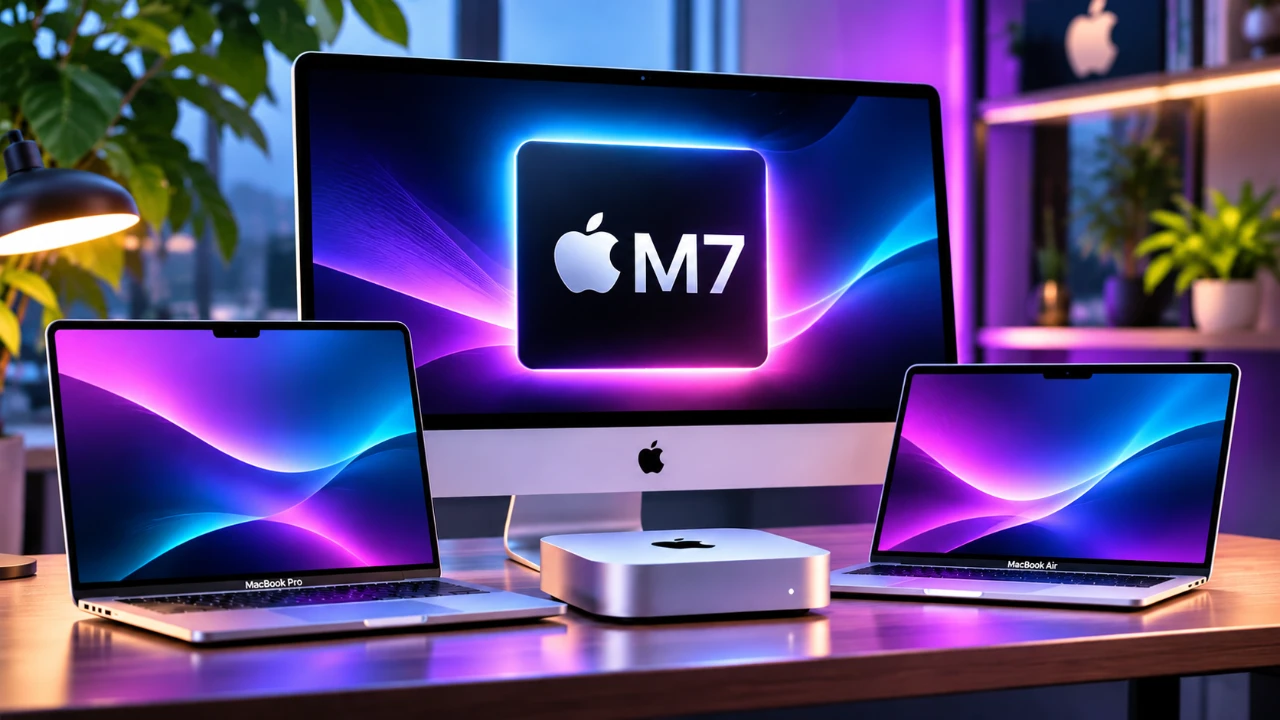
Upgrading graphics throughput and on-device AI muscle is a central theme around Apple’s M7 Mac lineup, a rumoured generation of laptops and desktops that Apple has not yet announced or confirmed. Reports point to a potential 96-core GPU on an M7 Ultra Mac Studio and a thinner 14-inch M7 MacBook Pro, while other models like the Mac mini and MacBook Air are tipped for 2028. Because Apple has not unveiled the M7 chip or any M7 Macs, all reported specifications, designs, pricing, and release windows remain unconfirmed and subject to change.
TL;DR Key Takeaways :
- Base MacBook Pro: A 14-inch M7 model is rumoured to adopt a thinner chassis and could gain a PROLED display.
- Pro and Max MacBook Pros: Higher-tier models are expected to keep their PROLED design, with GPUs potentially climbing to 48 cores.
- Mac mini: M7 and M7 Pro desktops are tipped for spring 2028 without a chassis redesign or port changes.
- Mac Studio: An M7 Ultra configuration is rumoured for 2028 with up to a 96-core GPU and ~40% higher graphics performance.
- MacBook Air: An M7 MacBook Air is tipped for spring or summer 2028 as a silicon-focused refresh rather than a redesign.
The entry-level MacBook Pro could see the clearest physical shift across Apple’s rumoured M7 generation, potentially moving toward the slimmer body style and PROLED XDR display technology used on redesigned MacBook Pro tiers.
Apple’s current MacBook Pro lineup pairs a 14-inch M6 model with redesigned 14-inch and 16-inch M5 Pro and M5 Max configurations equipped with PROLED XDR panels. Keep in mind that every release date, design detail, and chip specification outlined below for the M7 MacBook Pro, Mac mini, and Mac Studio comes from early reporting and predictions rather than official announcements.
1. Base M7 MacBook Pro Could Get a Redesign
Reports point to a 14-inch M7 MacBook Pro adopting the thinner, lighter enclosure of redesigned PROLED models, with Mark Gurman suggesting a possible arrival window in spring or summer 2027—roughly six to nine months after the M6 model.
Alongside slimmer display bezels and a rumoured Dynamic Island cutout, projections put the laptop’s weight around 3.0 pounds and point toward a tandem OLED PROLED XDR panel reaching up to 2,000 nits of peak brightness.
Under the hood, the base M7 chip is tipped to retain a 12-core CPU and 12-core GPU layout while stepping up efficiency and throughput—with estimates pointing to roughly 20% faster multi-core CPU performance and around 25% faster graphics over the M6.
| Rumoured M7 Mac | Expected Window | Reported Chip / GPU Focus | Design & Display Outlook |
|---|---|---|---|
| 14-inch MacBook Pro (M7) | Spring / Summer 2027 (unconfirmed) | M7 (12-core CPU/GPU); ~20% CPU, ~25% GPU lift | Thinner chassis, ~3.0 lbs, slimmer bezels, possible PROLED XDR |
| MacBook Pro (M7 Pro / M7 Max) | Late 2027 / Early 2028 (unconfirmed) | Up to 20-core CPU (8 super + 12 perf), up to 48-core GPU | Keeps PROLED design; possible N2 wireless and 5G options |
| Mac mini (M7 / M7 Pro) | Spring 2028 (unconfirmed) | M7 and M7 Pro silicon upgrade | Unchanged enclosure and port selection |
| Mac Studio (M7 Max / M7 Ultra) | 2028 (unconfirmed) | M7 Ultra up to 40-core CPU, 96-core GPU (~40% GPU gain) | Retains existing Studio form factor |
| MacBook Air (M7) | Spring / Summer 2028 (unconfirmed) | M7 chip refresh | No redesign or OLED panel expected (OLED eyed 2029–2030) |
2. M7 Pro and M7 Max MacBook Pros Could Focus on Chips
Higher-tier M7 Pro and M7 Max MacBook Pro models are expected to build on the PROLED design rather than undergo another full chassis overhaul. Reports also note that these M7 chips are tied to PROLED models rather than older mini-LED MacBook Pros.
Potential connectivity additions include an N2 wireless chip with upgraded Wi-Fi and Bluetooth performance, as well as optional 5G cellular support for staying online away from Wi-Fi or personal hotspots.
On the silicon side, an upper-tier M7 Pro and M7 Max are tipped to scale up to a 20-core CPU—combining eight super cores and twelve performance cores—for roughly 30% higher multi-core throughput alongside single-core speeds near the base M7. Graphics is another major focal point, with GPU core counts rumoured to climb from 40 to 48 cores for an estimated 40% graphics performance gain alongside AI acceleration priorities.

3. M7 Mac mini Could Keep Its Current Design
Desktop shoppers looking at the M7 and M7 Pro Mac mini may be waiting until around spring 2028. Current rumours indicate Apple plans to keep the existing enclosure and port layout intact, making the next-generation M7 and M7 Pro processors the main draw rather than a hardware redesign.
That projected timeline also places the M7 Mac mini well behind the rumoured 2027 arrival of the entry-level M7 MacBook Pro.
4. M7 Mac Studio Could Add a 96-Core GPU
For workstation buyers, M7 Max and M7 Ultra Mac Studio models are rumoured around the 2028 timeframe while retaining the current Studio desktop chassis. The flagship M7 Ultra is forecast to utilize second-generation 2-nanometer manufacturing with up to a 40-core CPU.
Graphics scaling is the headline projection here, with GPU cores rumoured to step up from 80 to 96 cores and deliver roughly 40% stronger graphics performance—complementing broader reports around higher memory bandwidth and large unified-memory options for demanding creative and local AI tasks.
5. M7 MacBook Air May Change Only Its Chip
The M7 MacBook Air is tipped for spring or summer 2028, with no physical redesign expected—meaning the M7 processor itself could be the primary upgrade if the rest of the chassis carries over.
An OLED display is not expected on an M7 MacBook Air, with OLED MacBook Air rumours pointing further out to 2029 or 2030, and an M6 MacBook Air anticipated in 2027 ahead of the M7 refresh. Max Tech also suggests Apple could skip an M7 iMac in favour of waiting for an M8 generation, leaving the base MacBook Pro’s move toward a thinner PROLED chassis as the clearest design change in the M7 rumours.
For most buyers, a meaningful chassis and display change like a thinner ~3.0-pound body and 2,000-nit PROLED XDR screen carries more everyday appeal than a chip-only update in a familiar shell. By contrast, a MacBook Air or Mac mini that mainly swaps in newer silicon without altering the exterior offers less reason to hold off if you need a machine today.
Rather than waiting on the M7 label alone, base your timing on what actually slows down your workflow today—weighing graphics and local AI gains against how soon you need hardware. Remember that Apple has not announced the M7 chip or any M7 Macs, so all reported specs, designs, pricing, and release dates remain unconfirmed and subject to change.
Explore further guides and articles from our vast library that you may find relevant to your interests in MacBook.
- The First M7 Beast: Why Apple’s Rumored MacBook Ultra Changes Everything
- Apple’s MacBook Air M6 May Receive a Major Hardware Upgrade
Source: Max Tech
Disclosure: Some of our articles include affiliate links. If you buy something through one of these links, Geeky Gadgets may earn an affiliate commission. Learn about our Disclosure Policy.
