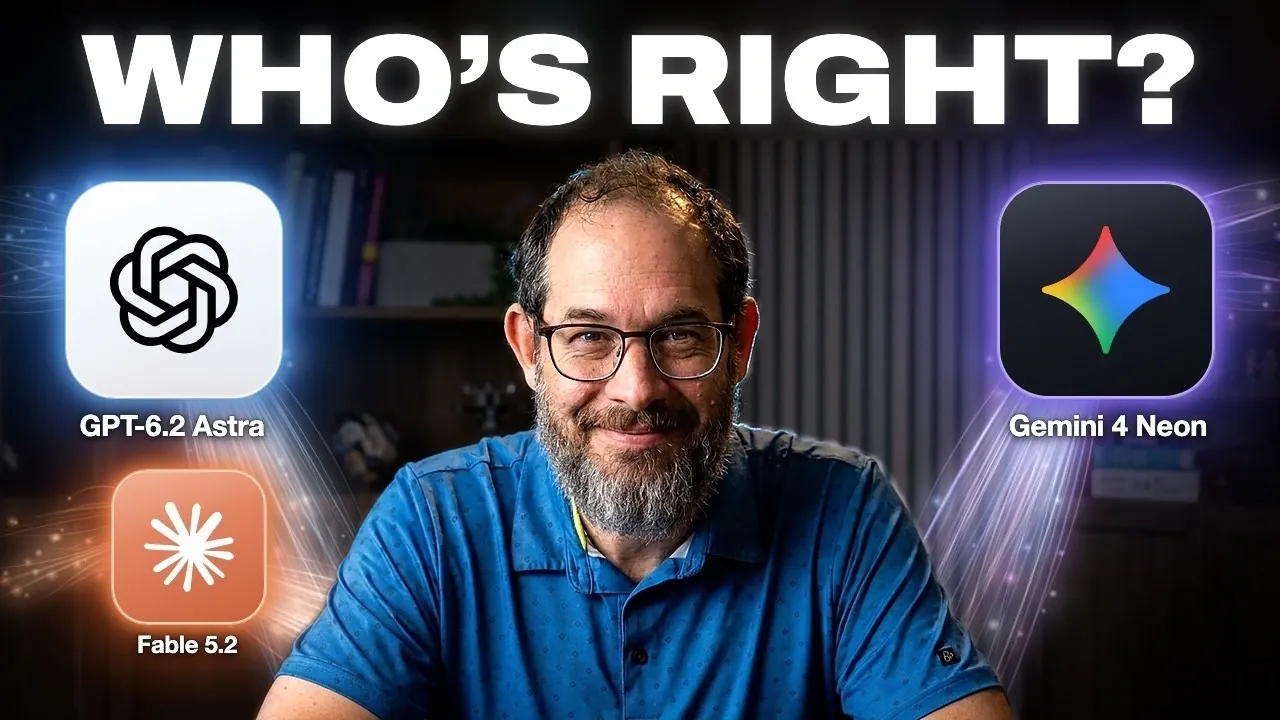
A score of 62 put the new OpenAI GPT-6.2 Astra behind Claude Fable 5.2, which scored 65, on Artificial Analysis’s intelligence index. But that score alone won’t tell you whether Astra or the new Google Gemini 4 Neon is right for your work. Nate Jones explains that Astra can stop early during coding builds, yet can deliver precise results when given long, explicit instructions. You can also hand its output to Neon to make it easier to understand. Learn why different jobs can call for different models, and how specialization might shape future choices.
GPT-6.2 Astra and Gemini 4 Neon: Different AI Strengths
TL;DR Key Takeaways :
- GPT-6.2 Astra arrived on November 17, 2026, one day before Gemini 4 Neon.
- Artificial Analysis scored Astra 62 on its intelligence index, versus Claude Fable 5.2’s 65, and found no improvement in coding agent performance.
- Astra’s detailed checking proved valuable for examining customer feedback, executive perspectives, technical constraints and architecture together.
- Gemini 4 Neon’s fast, readable responses suit brainstorming and communication.
- A two-model handoff can use Astra to examine detailed material and Neon to make hard-to-interpret output easier to understand.
OpenAI’s GPT-6.2 Astra and Google’s Gemini 4 Neon offer different strengths: Astra focuses on detailed checking, while Neon favors fast, readable conversation. Your choice depends on the task, not just on a single score or first impression.
GPT-6.2 Astra follows GPT-6 Astra as a reasoning model for professional work, coding and scientific research. It arrived on November 17, 2026, followed the next day by Gemini 4 Neon.
Contrasting reactions to the models show why a single scale can be misleading. A model that frustrates you on one task may be valuable on another, depending on whether you need precise checking or readable writing, open-ended engineering judgment or strict adherence to instructions.
Astra’s Detail Focus Can Frustrate Coders
GPT-6.2 Astra can frustrate coders by stopping during long builds, focusing on minor edge cases and producing explanations dense enough that some people turn to Claude for a readable summary. Matt Shumer called the models unusable and titled a chapter of his review “obsessed with details that don’t matter.” Astra proved frustrating on real coding work and, the channel notes, is a poor writer and a weak choice for general coding.
Other evaluations reflect those complaints, although they do not describe every task. Artificial Analysis scored GPT-6.2 Astra 62 on its intelligence index, behind Claude Fable 5.2 at 65, and found no improvement in coding agent performance. Dan Shipper’s team at Every also found that Astra kept stopping early on real builds.
Writing and engineering both require judgment about what deserves attention. Writing involves managing tone and narrative and deciding what to leave out, while engineering requires weighing which bugs matter and which rough edges can wait. Astra’s focus on inspecting details can work against those broader judgments, even when it examines individual points thoroughly.

Find more information on GPT-6.2 Astra and Gemini 4 Neon by browsing our extensive range of articles, guides and tutorials.
- Google Gemini 4 Neon Arrives as Faster, Cheaper Carbon Option
- 2026 AI Showdown: Gemini vs Grok, Claude and ChatGPT
- New GPT-6.2 Astra Builds a Working 3D Pendulum Clock from a Sketch
Precise Tasks Make Better Use of Astra
Detailed checking is more useful when your goal is clear and verifiable, and you need to examine connections rather than smooth them into a quick summary. On a difficult product and technical problem, Astra proved valuable for examining customer feedback, executive perspectives, technical constraints and architecture together.
That task was separate from coding: Astra helped explore the problem rather than build the software. It examined the pieces and their connections instead of glossing over contradictions, making it useful for investigating details.
The distinction also applies within coding. Builders report that Astra can produce precisely what they ask for when they provide long, explicit instructions and specify the desired result clearly. For those on a higher-tier plan, GPT-6.2’s ultra-fast mode is token-efficient enough to support fast iterative exchanges in Codex with you retaining control. That differs from asking a model to resolve an ambiguous engineering problem when you still need to work out the solution.
Scientists posting on X have also reported that Astra helps them work through mathematical and scientific problems in detail. OpenAI’s pursuit of mathematical and scientific capabilities may have unintentionally affected Astra’s communication.
Gemini 4 Neon Favors Readable Conversation
Gemini 4 Neon responds quickly, uses a positive tone and produces output that is easy to read. People also find Neon fun to write with. Those qualities make it useful for brainstorming and communication, but not necessarily the best model for every job.
Google places Neon between Carbon and Hydrogen in its model lineup. Google has recently shipped models for science, writing and thought partnership, and coding. Neon appears to use a lighter pre-training approach.
Neither model is simply good or bad. For a writing partner, you may value an accessible response immediately; when examining complex constraints, you may prefer a model that spends more effort on details. Your preference depends on the work, not just on how pleasant the first exchange feels.
Single Scores Miss Differences Between Tasks
Detail checking, engineering judgment, communication, visual taste and intuition are distinct qualities. A model’s ability in one does not automatically reveal its ability in the others. You could picture the differences as a radar chart with around 50 skills rather than a single intelligence score. A benchmark or quick conversation can show part of that picture without capturing performance on a different task.
Labs also have different business priorities. Anthropic focuses on workday tasks including coworking, presentations, design, visualization and end-to-end coding; Claude learned to make PowerPoints in 2025. Google’s other businesses may fund model experimentation aimed at increasing cloud revenue.
OpenAI’s fast-growing consumer business now includes ads, one revenue source among several, while its pursuit of scientific problems supports sales of models to large companies. The labs are not necessarily aiming to create the same kind of intelligence.
For roughly four years after ChatGPT’s arrival, improvements could often feel apparent within minutes of use. That habit can make a new capability hard to notice when it appears outside your usual work. It can also hide a genuine regression: a newer model might do more in one area while providing less of the support your team relied on before.
For engineering that requires balancing broad judgment with attention to detail, the channel suggests GPT-6 offers a preferable balance to GPT-6.2 Astra, and Astra’s stronger focus on details may not suit every engineering team. Fable 5.2’s apparent intuition may reflect randomization and surprising results. Claude Fable 5.2 is a choice for ambiguous engineering problems and Opus 5.5 for solid engineering work, not evidence that either model is best at every task.
Test Models Across Different Kinds of Work
Your task may call for a precise result, an exploratory conversation or repeated back-and-forth, and those patterns need not lead you to the same model. Gemini 4 Neon’s fast, clear responses suit idea generation, while Astra’s detail-oriented approach fits work where a specific result and thorough checking matter.
A two-model handoff can combine those approaches: give Astra a mix of customer feedback and technical constraints, then pass output that is hard to interpret to Neon. That separates close examination of the material from making the result easier to understand.
YC-backed and other startups are racing to build custom post-training and models. Future offerings could include dozens of strongly differentiated specialized models, shaped around users’ exact wants.
You can also assess a model on a function adjacent to your business that differs from your team’s daily work. A future breakthrough could initially seem like a flop yet later reshape work indirectly through an industry. Testing across those tasks can reveal a useful capability that a familiar workflow misses, while also showing whether a model still supports the jobs your team depends on.
We think the useful lesson from this comparison is that a harsh review and a glowing one can both be honest when they come from different jobs. A review often says more about the reviewer’s task than about the AI model itself. GPT-6.2 Astra, for example, has frustrated coders by stopping early on builds and dwelling on minor details.
Yet its attention to detail proved valuable when examining customer feedback alongside technical constraints and architecture. A single reaction may not capture both sides.
The shift toward specialized models is a forecast, not a guarantee that a universal model will disappear. For a team choosing between them, the first step is to identify the work it needs the model to do and assess the result on that work. A favorable or unfavorable consensus alone cannot settle that choice.
Media Credit: AI News & Strategy Daily | Nate B Jones
Disclosure: Some of our articles include affiliate links. If you buy something through one of these links, Geeky Gadgets may earn an affiliate commission. Learn about our Disclosure Policy.
