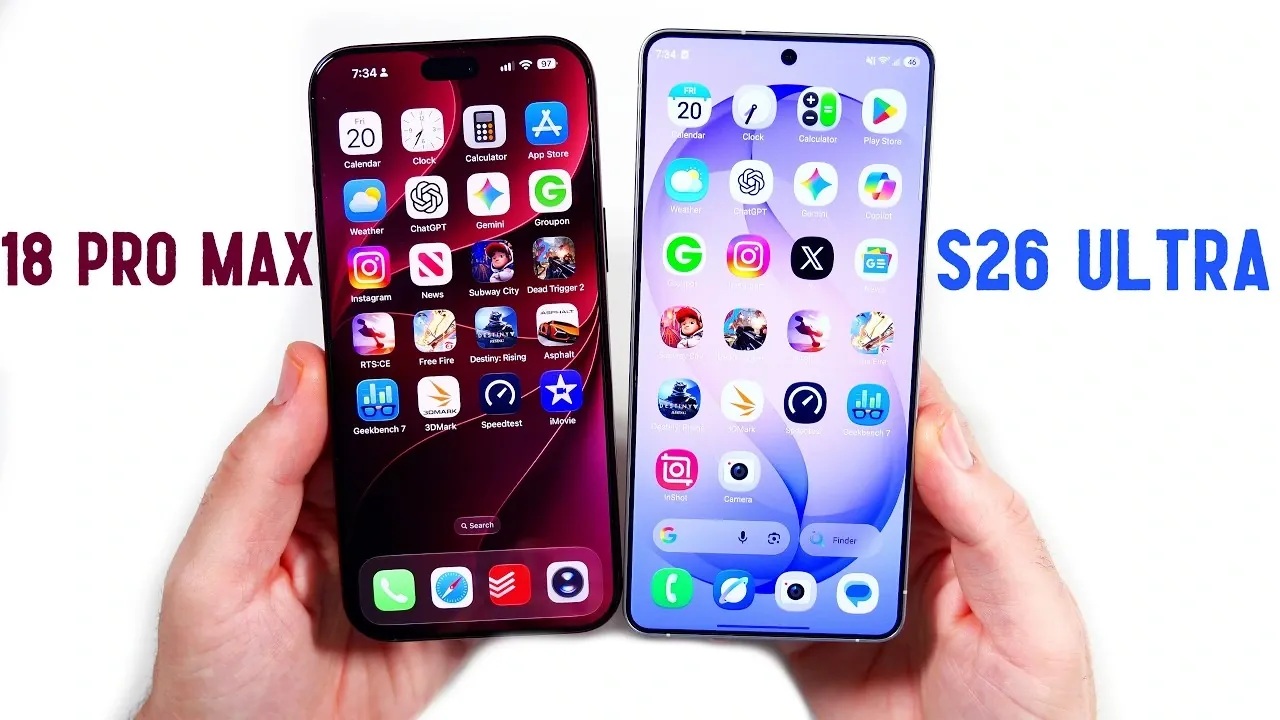
Choosing between the Apple iPhone 18 Pro Max and the Samsung Galaxy S26 Ultra comes down to two distinct flagship philosophies. Both pair 6.9-inch 120Hz OLED displays with flagship silicon and pro-grade cameras, yet they shine in different areas: the iPhone 18 Pro Max leads in battery endurance, sustained thermal headroom, video recording, and mechanical variable-aperture optics, whereas the Galaxy S26 Ultra counters with a noticeably lighter 214g chassis, dual optical zoom lenses up to 100x Space Zoom, built-in S Pen tools, and far deeper retail discounts. The video below from Nick Ackerman breaks down how the two compare in real-world daily use.
TL;DR Key Takeaways :
- Street Price & Trade-In Value: Although both list around $1,299–$1,399 at retail, Samsung’s aggressive trade-in credits and seasonal promos routinely make the Galaxy S26 Ultra significantly cheaper out of pocket.
- Variable Aperture vs. 100x Zoom Reach: The iPhone 18 Pro Max introduces a physical variable-aperture 48MP main camera (f/1.48–f/4.0) alongside class-leading ProRes/Dolby Vision video, while the Galaxy S26 Ultra packs a 200MP quad-camera system with dedicated 3x and 5x optical telephoto lenses.
- Battery Endurance & Thermals vs. Weight: With its 5,567mAh battery (eSIM model) and 3x larger vapor chamber, the 249g iPhone 18 Pro Max lasts longer under heavy loads, while the 214g, 7.9mm Galaxy S26 Ultra feels substantially lighter in the hand.
- Software & Productivity Identity: iOS 27 and Siri AI emphasize tight ecosystem continuity and on-device privacy, while Android 17, One UI, Gemini integration, and the built-in S Pen cater to power multitaskers.
Pricing, Deals, and Real-World Value
On paper, both flagships occupy the top end of the smartphone market—with the iPhone 18 Pro Max starting at $1,299 / £1,299 for 256GB and the Galaxy S26 Ultra sitting at $1,299–$1,399 depending on regional pricing adjustments. In practice, however, street pricing diverges sharply.
Samsung regularly pairs the Galaxy S26 Ultra with enhanced trade-in values, bundle credits, and seasonal sales around events like Black Friday, often shaving hundreds of dollars off the effective purchase price. Apple rarely discounts current-generation Pro iPhones directly, relying mostly on carrier installment promos or modest gift-card events—meaning value-focused buyers almost always get more upfront hardware per dollar on the Galaxy side.

Camera Systems: Variable Aperture and Video vs. Quad-Lens Zoom
Both phones produce flagship-grade stills, yet their camera hardware solves different shooting priorities:
- iPhone 18 Pro Max: Features a triple 48MP Fusion camera system highlighted by Apple’s first mechanical variable-aperture main lens (adjustable across f/1.48, f/1.8, f/2.8, and f/4.0) alongside a 48MP ultrawide and a tetraprism telephoto offering up to 8x optical-quality zoom. Combined with manual shutter/ISO controls, ProRes RAW, and best-in-class stabilization, it remains the stronger tool for video creators and consistent point-and-shoot color.
- Galaxy S26 Ultra: Pairs a 200MP primary sensor and 50MP ultrawide with two dedicated telephoto cameras—a 10MP 3x optical lens and a 50MP 5x periscope lens capable of up to 100x digital zoom. That dual-telephoto setup gives Samsung clear versatility for portraits at 3x and distant subjects well past 10x.
| Feature / Spec | iPhone 18 Pro Max | Samsung Galaxy S26 Ultra |
|---|---|---|
| Display | 6.9″ Super Retina XDR OLED, 1–120Hz, 3,000 nits peak, smaller Dynamic Island | 6.9″ QHD+ Dynamic AMOLED 2X, 1–120Hz, Privacy Display, punch-hole cutout |
| Dimensions & Weight | 163.4 × 78.0 × 8.75 mm / 249g | 163.6 × 78.1 × 7.9 mm / 214g |
| Processor & RAM | 2nm Apple A20 Pro / 12GB LPDDR5X RAM | 3nm Snapdragon 8 Elite Gen 5 / 12GB or 16GB RAM |
| Rear Cameras | 48MP variable-aperture main (f/1.48–f/4.0) + 48MP UW + 48MP telephoto | 200MP main + 50MP UW + 10MP 3x telephoto + 50MP 5x periscope (100x zoom) |
| Battery & Charging | 5,567mAh (eSIM) / 5,391mAh (SIM); 50% in ~15 min (60W PD), 25W MagSafe/Qi2 | 5,000mAh; 60W wired, 25W wireless, 4.5W reverse wireless |
| Signature Extras | Face ID, Camera Control, ProRes RAW & social-app camera integration | Built-in S Pen, DeX desktop mode, anti-reflective Privacy Display |
Design, Ergonomics, and Daily Portability
Despite nearly identical height and width, the two phones feel noticeably different in the hand. At 214 grams and 7.9mm thin, the Galaxy S26 Ultra is 35 grams lighter and nearly a millimeter slimmer than the 249-gram, 8.75mm iPhone 18 Pro Max—making Samsung’s flagship noticeably easier to pocket and hold during long reading or browsing sessions.
Both devices demand a protective case if you want to prevent cosmetic dings or corner scuffs over time, and the iPhone’s smoother frame contours can feel slightly more slippery without a grip case.
Display, Interface, Performance, and Thermals
On the front, the iPhone 18 Pro Max uses a 25% smaller Dynamic Island cutout housing Face ID and an 18MP Center Stage front camera, while the Galaxy S26 Ultra uses a compact single punch-hole cutout paired with anti-reflective glass and built-in Privacy Display angle-limiting tech. In day-to-day navigation, One UI’s brisk animation curves make the Galaxy feel snappy, while iOS 27 favors fluid physics and tight continuity with Mac, iPad, and AirPods.
Under sustained workloads—such as 3D gaming, 4K HDR video exports, or extended camera sessions—the 2nm A20 Pro paired with Apple’s enlarged vapor-chamber cooling gives the iPhone 18 Pro Max strong efficiency and thermal consistency, whereas the Snapdragon 8 Elite Gen 5 in the Galaxy S26 Ultra excels at rapid multitasking, split-screen windows, and desktop-style DeX workflows.
AI Ecosystems, Battery Endurance, and Unique Tools
Software intelligence also reflects different priorities. Apple Intelligence and Siri AI lean heavily on on-device processing and Private Cloud Compute for personal context across Apple apps, while the Galaxy S26 Ultra pairs Galaxy AI and Google Gemini with the built-in S Pen—making quick annotations, photo object edits, and precision note-taking effortless without extra accessories.
In battery life, the iPhone 18 Pro Max holds a clear advantage thanks to its larger cell (5,567mAh on eSIM models, rated up to 43 hours of video playback) and 2nm silicon efficiency, while both phones now reach roughly 60W wired charging speeds for quick top-ups.
Which Flagship Should You Buy?
- Buy the iPhone 18 Pro Max if maximum battery endurance, sustained gaming/editing thermals, class-leading video capture, variable-aperture main camera control, and tight Apple ecosystem integration top your checklist.
- Buy the Galaxy S26 Ultra if you want a significantly lighter 6.9-inch phone, true 3x-to-100x zoom flexibility, built-in S Pen productivity, Privacy Display glass, and much better trade-in or sale pricing.
Explore further guides and articles from our vast library that you may find relevant to your interests in iPhone 18 Pro Max.
- Apple May Keep the iPhone 18’S Best New Feature Exclusive to the Pro Max
- iPhone 18 Pro Max: Final Leaks Drop Hours Before Apple’s Event
- What to Expect from Apple’s iPhone 18 Pro: Design Changes, Specs, and Costs
- iPhone 18 Pro Max Final Leaks: Everything Coming at Apple’s Sept 9 Event
- Apple’s iPhone 18 Event is Set: the Final Leaks You Need to Know
- iPhone 18 Pro Max vs Ultra: is the $800 Price Jump Worth It?
Source & Image Credit: Nick Ackerman
Disclosure: Some of our articles include affiliate links. If you buy something through one of these links, Geeky Gadgets may earn an affiliate commission. Learn about our Disclosure Policy.
