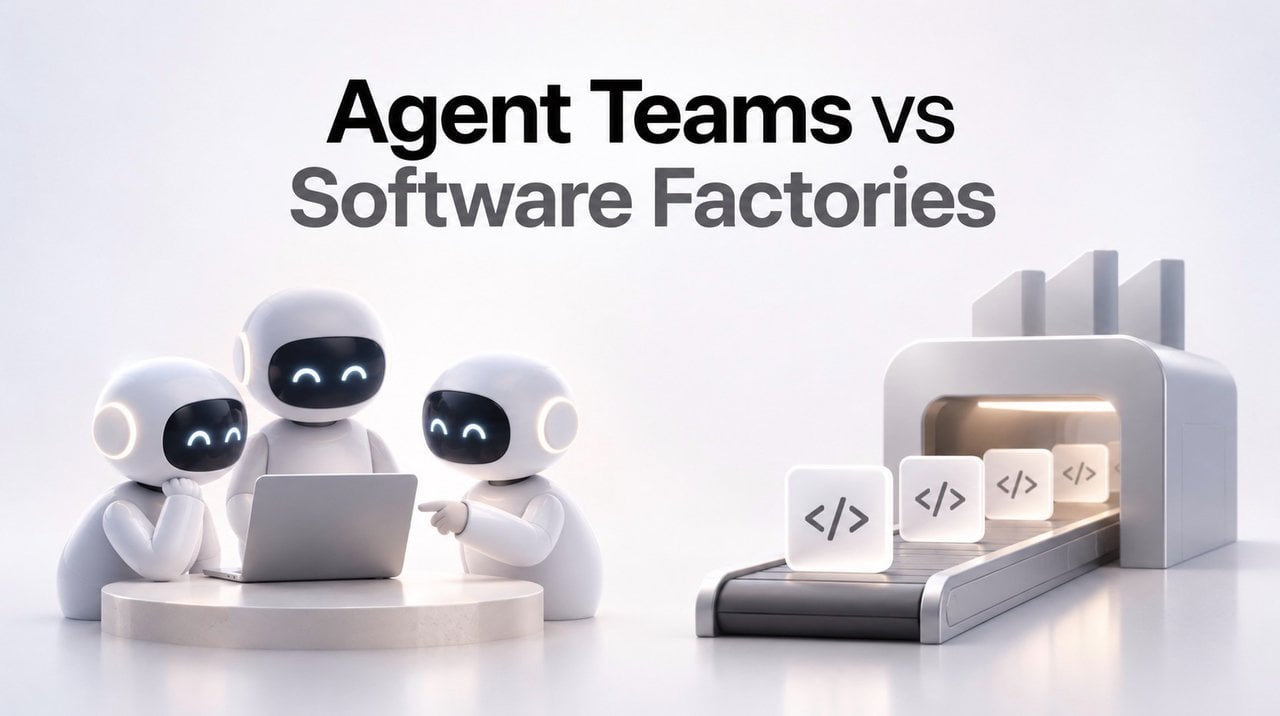
Developers are split on how to run coding agents: as a team you manage, or as a factory you define in code. You can also keep a person involved in new features and replay past work to test how a setup performs. A closer look from Ray Amjad shows how coded workflows and leads with flexible blueprints handle implementation, review and verification. You’ll learn how work moves between agents, as well as why shared budgets complicate decisions about which tasks get done first.
Agent Teams and Software Factories: Two Ways to Organize AI
TL;DR Key Takeaways :
- Agent teams delegate work through roles, while software factories define repeatable stages, handoffs and checks in code.
- In the Devin Bots demonstration, a lead can manage five or 10 workers in separate sandboxes and steer their work.
- In a hybrid approach, an engineering lead gives workers a skill-file blueprint that allows them to adapt their approach during a task.
- OpenAI reports a 500% increase in landed pull requests on some teams after introducing Symphony.
- In Ray Amjad’s own blind replay, removing planners made no measurable difference to quality, while mean cost per pull request fell from $940 to about $630.
Agent teams organize coding agents into roles that can delegate work to one another. Software factories can instead define stages, handoffs and checks in code, making the process repeatable across tasks.
You do not necessarily have to choose between the two: an agent framework can operate inside a software factory. The distinction depends partly on how a developer defines a factory.
Agent Teams Delegate Through Leads and Workers
A team can assign each lead agent a domain, such as documentation, feature development, quality assurance or security. You can talk to a lead directly or route requests through a chief-of-staff agent that coordinates the leads.
In the arrangement demonstrated with Cognition’s Devin Bots, a lead delegates work to worker threads in separate sandboxes, or isolated computing environments. Leads have smaller sandboxes than workers, and you can message worker threads directly. A lead can manage five or 10 workers, exchange messages with them and steer their work; workers report back when they finish.
Leads can persist across projects or exist for a particular job, such as a migration. Both leads and workers can create subagents within their own sandboxes. A worker might use one to review code after implementation or research a missing detail in a separate context window.
Devin Bots provides templates for roles including a software factory, technical writer and chief of staff, as well as products, migration, iOS, Android and compliance engineers and a code reaper. A team can share a lead through Slack, including public channels, control who can use it and choose whether it can message other bots.
Shared bots can have their own identities, and a Slack message returns to the same Devin session. Connections can also give a bot plugins, MCP servers, automations and secrets.
Other tools coordinate coding agents differently. Grok Bot can use leads to spawn subagents that manage a computer or Cursor cloud agents in another sandbox. Steve Yegge’s Gas Town uses a coordinating agent called the Mayor to distribute and track groups of tasks. OpenAI’s Symphony assigns agents to active project-management issues and restarts agents that crash or stall.
Teams carry a cost. Anthropic’s Claude Code agent teams, for example, remain disabled by default and require explicit activation. They consume substantially more tokens than individual sessions because each teammate runs as a separate Claude instance.

Here are more guides from our previous articles and guides related to Devin Bots and MCP integrations that you may find helpful.
- Cognition Labs Devin AI software engineer in detail
- Streamline Your Workflows with Anthropic’s Model Context Protocol (MCP)
- Why Anthropic’s MCP is the Key to Smarter AI Applications
- MCP Explained Without The Hype : The Next Big Thing in AI Automation
- 8 Fantastic MCP Servers To Make Your AI Coding Easier
Factories Put Stages and Checks in Code
A factory-as-code approach defines the process before work starts. A file such as factory.yaml can specify stages, how information passes between them and gates that decide whether work moves on or returns to an earlier stage.
The case for it is that running coding agents is an optimization problem: you want higher quality and more output at a lower cost, and you can only optimize what you can measure. A process fixed in code stays the same between runs, so it can be measured. In the words Ray Amjad quotes, a factory should scale like an engineered system, not like an increasingly large organization.
One coded workflow can send a specification, prompt and output schema to an implementation agent, then fork the agent’s sandbox into parallel jobs for code review and identifying the flows added. Output schemas can act as gates that send work back to a previous sandbox, while further sandboxes verify the flows before a final request.
Factories can also differ in how much human involvement they assume. StrongDM described a development process without human-written code or human code review, while OpenAI uses Symphony to coordinate feature development and infrastructure migrations. OpenAI reports a 500% increase in landed pull requests on some teams after introducing Symphony.
Frameworks can mix fixed operations with agent decisions rather than choosing only one. LangGraph combines predefined software operations with AI-driven decisions, while CrewAI combines collaborating groups of agents with application workflows. Symphony is a reference implementation, not a standalone product OpenAI intends to maintain.
Replay Past Work to Compare Factory Configurations
You can measure a coded process against a simpler version by replaying earlier work. Ray Amjad ran a blind test of this kind on his own factory, replaying past pull requests with a layer of planners and subplanners removed.
The test found no measurable change in quality, and mean cost per pull request fell from $940 to about $630. The planners had been intended to make planning parallel and recursive.
A factory lead could also run a weekly automation that edits a workflow blueprint and compares it against an earlier version using past pull requests. Such a comparison could examine worker runtime, compute and token use, though Ray Amjad cautions that tuning the blueprint risks overfitting it.
A Hybrid Gives a Lead a Flexible Blueprint
In a hybrid approach, an engineering lead receives a skill file as a blueprint, then passes it to workers spawned for individual features. Each worker can contain builder, reviewer and verifier roles that loop through the work, while the lead coordinates them and retains the wider context.
That context could let the lead reuse an existing worker when a new task is mostly similar to work already under way, rather than starting an entirely separate task. The skill file gives the agent room to change its approach during a task, unlike the earlier workflow whose stages were coded up front.
Choose Lead Roles to Limit Handoffs
A hierarchy requires decisions about who talks to whom, how many layers to add and whether roles overlap. A software factory lead and a feature-builder lead might cover much of the same ground, whereas a technical writer has a distinct responsibility.
Ray Amjad recommends splitting leads by domain rather than workflow step, because handoffs between separate planning, implementation and review leads can lose information. Communication frequency can help determine the split: separate implementer, reviewer and verifier leads would communicate almost daily. In the proposed feature-building arrangement, those implementation, review and verification roles sit inside one lead’s workers instead.
A factory can also act as a single consumer of work from a queue such as GitHub issues, which a factory bot could check hourly. A QA agent might discover a bug and send it to the factory. The QA agent could fix the bug faster itself, but might lack the factory bot’s accumulated memory and be more likely to make a mistake.
Other agents could contribute work to the queue, including customer-support or growth leads. For brand-new features, Ray Amjad recommends keeping a person involved because he finds agents’ product taste is not yet good enough.
Shared Budgets Complicate Coordination
When people use separate chief-of-staff agents, those agents may need to coordinate over the same leads and a limited resource. In an Anthropic example, six tasks share an API token budget too small to complete them all: three tasks have high value and three have low value.
With one chief-of-staff agent, the high-value tasks are completed and the low-value tasks canceled. With separate chiefs coordinating peer-to-peer, too much low-value work may be done before the budget runs out, leaving high-value work unfinished. Ray Amjad concludes that a setup with many people and many agents may bring friction that is not worth it yet, though he expects the models to get better at this.
Choosing between a hierarchy and a coded factory therefore also involves how you assign work and how agents share resources. A fixed pipeline puts stages and gates in code; a lead using a skill file can alter its route as work develops. Agent teams can sit inside either approach, but separate leads still need a way to coordinate their work.
In our view, the useful question is not bots versus code but whether you can show that each layer earns its place. Without a way to measure, extra roles and planners are easy to add and hard to justify. We would treat the cost and quality claims as one person’s result on one setup. The reported blind replay found no measurable quality change after removing planners, while mean cost per pull request fell from $940 to about $630. Check against your own past work before cutting roles or copying a hierarchy, since what a team can safely drop depends on its codebase.
Giving each person an agent does not necessarily give your team better control over which work gets done first. If you are organizing coding agents around a shared budget, it is worth looking more closely at how separate leads settle priorities, rather than judging the setup only by the tasks each agent completes.
Media Credit: Ray Amjad
Disclosure: Some of our articles include affiliate links. If you buy something through one of these links, Geeky Gadgets may earn an affiliate commission. Learn about our Disclosure Policy.
