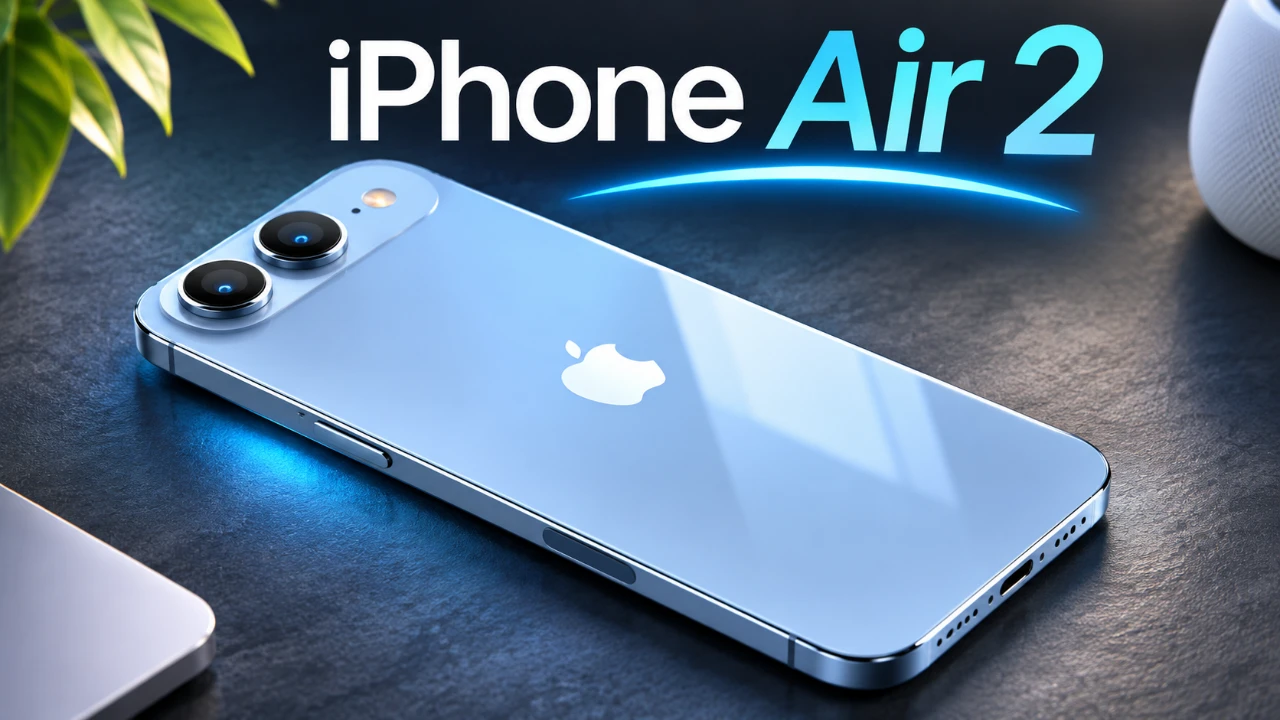
Sustained heat control—rather than raw benchmark speed—is the central engineering challenge facing Apple’s rumoured iPhone Air 2, an upcoming slim smartphone that Apple has not yet officially announced or confirmed. In everyday owner feedback shared by SaranByte, the ultra-thin original iPhone Air can grow warm enough during FaceTime calls and heavy app switching to trigger noticeable stutter, making internal heat dissipation far more important than another incremental processor bump. Because Apple has not unveiled the iPhone Air 2, all reported cooling upgrades, specifications, pricing, and spring 2027 launch timelines remain unverified and subject to change.
TL;DR Key Takeaways :
- Ultra-thin constraints: Measuring just 5.64 mm thick, the original iPhone Air packs its A19 Pro logic board densely inside the top camera plateau, leaving tight margins for heat dissipation.
- Real-world warmth and lag: SaranByte reports noticeable heating and interface lag during FaceTime video calls and rapid app switching.
- Benchmark throttling: In PhoneArena’s 3DMark Wild Life Extreme testing, the iPhone Air scored 2,895—ahead of the Galaxy S25 Edge’s 2,628—yet throttled under sustained GPU load.
- Missing vapor chamber: iFixit’s teardown confirmed the original Air lacks a vapor chamber, unlike the deionized water vapor chamber Apple introduced in the iPhone 17 Pro lineup.
- iPhone Air 2 outlook: Supply-chain reports from The Information suggest Apple is exploring vapor chamber cooling alongside a 2nm A20 Pro chip for spring 2027, though nothing is confirmed.
At just 5.64 mm thick, the original iPhone Air squeezes Apple’s A19 Pro silicon into an exceptionally slender titanium chassis with minimal spare interior volume. As teardown analysis shows, Apple packed the processor, cellular modem, and wireless chips onto a compact stacked logic board tucked inside the upper camera plateau above the battery, while a metal-encased battery occupies roughly two-thirds of the phone’s internal footprint.
Heat and Lag in One Owner’s Use
In SaranByte’s real-world experience, the iPhone Air delivers plenty of speed for routine browsing and messaging, yet grows uncomfortably warm during extended FaceTime calls or frequent app switching—eventually leading to frame drops and sluggish animations as the system dials back clock speeds to manage temperature.
Independent lab testing reflects that split between short bursts and sustained workloads. PhoneArena noted that while the iPhone Air stayed responsive and cool during light everyday tasks, it throttled noticeably during prolonged graphics stress loops—posting 2,895 in 3DMark Wild Life Extreme (ahead of the Samsung Galaxy S25 Edge’s 2,628) before thermal limits trimmed sustained output.
| Thermal & Hardware Factor | iPhone Air (1st Gen) | iPhone 17 Pro / 18 Pro | iPhone Air 2 (Rumoured) |
|---|---|---|---|
| Chassis Thickness | 5.64 mm | ~8.75 mm | ~5.2–5.6 mm (rumoured) |
| Processor & Node | Apple A19 Pro (3nm) | A19 Pro (3nm) / A20 Pro (2nm) | Apple A20 Pro (2nm) + C2 modem |
| Cooling Architecture | Stacked logic board; no vapor chamber | De-ionized water vapor chamber | Vapor chamber cooling reported |
| Sustained Load Behavior | Throttles under prolonged GPU/video load | Spreads heat across rear chassis | Aims to reduce throttling and surface hotspots |
iPhone Air 2 must fix the original model’s overheating issues

The Thin Design Has No Vapor Chamber
A closer look inside explains why heat builds up near the top of the phone. According to iFixit’s teardown, the original iPhone Air contains no vapor chamber—leaving thermal energy concentrated around the dense plateau logic board rather than spreading evenly down the chassis. By contrast, Apple’s iPhone 17 Pro and Pro Max pair the same A19 Pro processor with a sealed, de-ionized water vapor chamber that draws heat away from the chip and distributes it across the rear enclosure.
Reporting from PCMag and supply-chain outlets also notes that Apple engineers identified heat extraction as a growing bottleneck in traditional memory-on-chip stacking—prompting packaging refinements and wider adoption of vapor chamber cooling across newer Pro and folding models. According to reports from The Information, Apple is looking to bring vapor chamber cooling alongside a more efficient 2nm A20 Pro chip to the iPhone Air 2 ahead of its rumoured spring 2027 release.
Warmth Does Not Always Mean Overheating
Apple’s official thermal guidance notes that any iPhone can feel noticeably warmer during initial setup, iCloud backup restores, iOS updates, wireless charging, high-resolution video streaming, or graphics-heavy apps and camera sessions. When internal temperatures climb above normal operating thresholds, iOS automatically steps in to protect hardware—slowing processor performance, pausing or slowing charging, dimming screen brightness, shifting cellular radios into a lower-power state, or temporarily disabling the camera flash.
The core lesson for the iPhone Air 2 is straightforward: the original phone does not suffer from a lack of peak speed, so dropping in a faster processor alone would not resolve the heat-induced stutter SaranByte describes. When a smartphone slows itself down during video calls or multitasking to stay within safe temperature limits, the bottleneck is thermal dissipation rather than raw compute power.
Prioritizing heat spreading—through a vapor chamber, revised chip packaging, and the cooler-running 2nm A20 Pro and C2 modem—matters far more to daily comfort than shaving another fraction of a millimeter off the frame. If thermal throttling held you back from the first iPhone Air, watching how Apple addresses cooling in the rumoured iPhone Air 2 makes sense—while keeping in mind that Apple has not announced the device and all specs, cooling hardware, pricing, and launch dates remain subject to change.
Below are more guides on iPhone Air 2 fixes from our extensive range of articles.
- Fixing the Air: What Apple is Changing for the iPhone Air 2
- iPhone Air 2 Leak Shows Apple May Fix Its Biggest Mistakes
- Leaked iPhone Air 2 Details Show Apple Taking Time to Fix Flaws
- The iPhone Air 2 Leaks: Apple is Finally Fixing the Original’s Biggest Flaws
- iPhone Air 2 Leaks: Why Apple’s Thinnest Phone Is Changing
Source & Image Credit: SaranByte
Disclosure: Some of our articles include affiliate links. If you buy something through one of these links, Geeky Gadgets may earn an affiliate commission. Learn about our Disclosure Policy.
