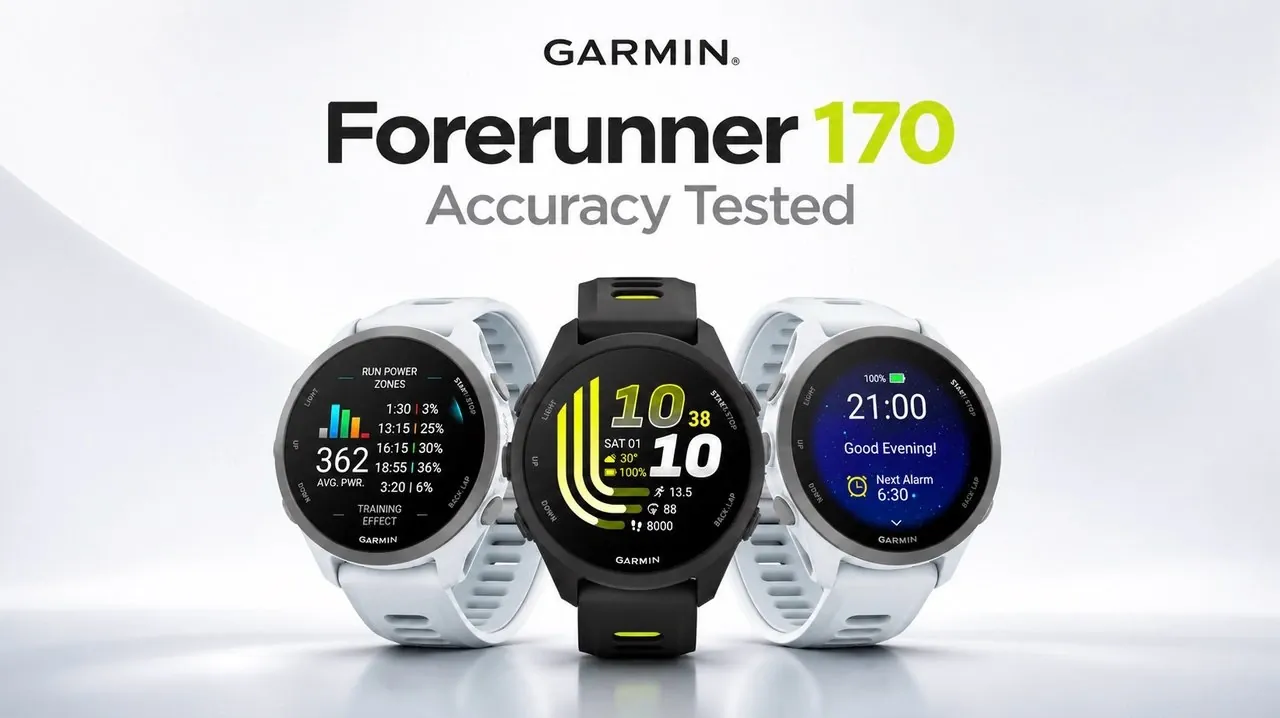
The Garmin Forerunner 170 Music scored 96 for cardio tracking but 72 for sleep stages in accuracy testing. As The Quantified Scientist explains, this GPS running watch gives you different levels of accuracy depending on your activity. Chest-strap comparisons show where exercise readings stay close and where they miss changes, while repeated runs and rides reveal how consistently it records your route. Go deeper into the activity-by-activity results and the sleep comparisons to see what those scores mean for the tracking you use.
Garmin Forerunner 170 Music: Accuracy Under Test
TL;DR Key Takeaways :
- The Forerunner 170 Music costs $349.99 and adds onboard music and Wi-Fi to the standard Forerunner 170’s tracking features.
- It earned a cardio score of 96, with heart-rate correlations of 0.99 for indoor cycling and 0.98 for running against a Polar H10 chest strap.
- During weightlifting, the watch repeatedly missed or understated heart-rate peaks, and 65% of previously tested devices performed better.
- Sleep-stage tracking scored 72, with 58% agreement for REM sleep against the ZMax reference on the person tested.
- GPS tracking scored 90, with closely grouped tracks across repeated runs and rides, though overlap alone does not establish exact position.
The Garmin Forerunner 170 Music is a GPS running watch with wrist-based heart-rate and sleep tracking. Garmin announced it in May 2026 as part of the Forerunner 170 series, which follows the Forerunner 165.
At a suggested US retail price of $349.99, the Music model has essentially the same health and sports tracking as the standard Forerunner 170, but adds onboard music and Wi-Fi, including music downloads from Spotify.
Garmin’s value-focused Forerunner 70 includes core running, training, recovery and sleep features. The Forerunner 170 adds an altimeter, compass, Garmin Pay, open-water swimming and cycling support.
Running and Indoor Cycling Heart Rate Track Closely
The Forerunner 170 Music tracked heart rate closely during runs and indoor cycling when tested against the Polar H10 chest strap. It earned an overall cardio score of 96, rated “great,” although outdoor cycling was less consistent.
Tests compared the watch with the chest strap across four activities. Correlation describes how closely the measurements move together, with 1 the maximum possible value:
- Indoor cycling: 0.99 correlation; better than 64% of devices previously tested.
- Running: 0.98 correlation; better than 72% of devices previously tested.
- Outdoor cycling: 0.90 correlation; better than 50% of devices previously tested.
- Weightlifting: 65% of previously tested devices performed better and 35% performed worse.
During spinning, the watch closely followed the chest strap, with only minor differences across sessions. Spinning is relatively easy for heart-rate tracking, and many devices perform well at it. The watch also detected every running interval, though it occasionally showed a false peak or failed to capture the full depth of a dip.
Running readings sometimes differed by a few beats per minute at higher heart rates, and one run contained two larger deviations. Deviations were larger at high than at medium heart rates, but the review found the differences too small to change the interpretation of the running data.

Outdoor Cycling is Less Consistent, and Weights Are Weaker
For outdoor cycling, the watch sometimes recorded heart rates below the chest strap’s readings or was slow to register increases. Individual rides generally looked good, but the lower correlation and middle-of-the-pack ranking make it a less convincing pick than it is for running.
The review considered the result good enough for personal cycling use, while noting that better devices are available for that activity. The reference briefly lost signal during one longer ride; this was not a watch error.
Weightlifting produced the clearest weakness: the Forerunner 170 Music repeatedly missed or understated heart-rate peaks, particularly at higher rates. Wrist tension during exercise sets prevented the sensor from detecting heart rate in testing, making the watch a less dependable choice if those peaks are important to you.
Nighttime Heart Rate is Close, With an HRV Offset
The watch gave a good indication of nighttime resting heart rate against the Polar H10, although agreement was not perfect. Comparisons used hundreds of heart-rate and HRV measurements, with custom code for both nighttime analyses. Across the tested range of roughly 37 to 55 beats per minute, the watch usually recorded the correct rate.
A few higher peaks appeared, nearly always where the reference data also showed a peak. The comparison required an estimate of how Garmin calculates its averages.
For heart rate variability, or HRV, the variation in time between heartbeats, the watch followed the reference pattern but read slightly lower as HRV increased. The difference was small enough not to change which nights appeared higher or lower when comparing trends over time.
Sleep Stages Improve, but REM Still Lags
The Forerunner 170 Music delivered good sleep-stage results in testing, earning a score of 72. It was compared with the ZMax EEG sleep tracker, which measures brain signals and is designed for scientific sleep studies. The Quantified Scientist describes it as a silver standard: not quite perfect, but good enough to show which devices track sleep stages well.
- Deep sleep: The watch identified 92% of the reference device’s deep sleep as deep sleep.
- Light sleep: Agreement was 66%, with some light sleep classified as deep sleep.
- REM sleep: Agreement was 58%, with most disagreement caused by REM being classified as light sleep.
That deep-sleep figure does not mean every deep-sleep reading was correct: the watch also recorded extra deep sleep. One example night had four main reference deep-sleep segments; the other had a major early segment and a shorter second segment. Across the two nights, the watch found all the main segments recorded by the reference, but added some of its own.
REM was the weakest stage. On one night, the watch found every REM segment but shifted one and shortened two; on another, it missed REM at the beginning and differed in the length of later segments.
Results placed the watch in the review’s second tier for sleep-stage tracking on the person tested, above older Garmin results but below devices including Apple Watches and the Oura Ring 4. The comparison plotted average sensitivity against sensitivity for the worst-performing stage, with the 170 Music near the Garmin Venu 4.
In one comparison, the 170 Music performed slightly better than the Forerunner 70, although the two watches have essentially the same sensors and their results were close on another measure. They were close on Cohen’s kappa, as were the Instinct 3, Venu 4 and Forerunner 570; the difference between the 170 Music and 70 could reflect testing variation.
The Quantified Scientist says the result makes him more curious about the Garmin Cirqa, a screen-free band that he says uses the same sensor platform as the Forerunner 170 and 70. If Garmin can reproduce these numbers over longer-term testing, he thinks the Cirqa could become an interesting alternative to the Oura Ring and the Whoop strap.
GPS Tracks Stay Close on Runs and Rides
The Forerunner 170 Music earned a GPS score of 90, rated “great.” Testing examined how closely the watch’s recorded tracks overlapped across repeated runs and rides. Close overlap makes good tracking more likely, though it does not by itself establish an exact position.
On four runs around the same loop, the tracks stayed close together with some deviation, while the second run deviated more on the left. Tracks also overlapped well near a large wall where devices often struggle, although the final run potentially showed the most variation.
On cycling routes, the watch acquired a signal quickly and recorded closely grouped tracks with minor deviations. The rides were to and from work, with some different routes on the way there and two work locations involved in the return rides. Four return rides also stayed close through a roundabout and beneath a large overhang, with no real signs of smoothing beneath the overhang.
In our view, the real lesson is that watch accuracy depends on the activity, not just the watch. A single headline score can hide the exact situation where a wrist sensor fails you, so check the result for your own sport. Outdoor cycling’s 0.90 correlation, despite an overall cardio score of 96, illustrates that gap. We would be careful before buying on the strength of sleep results or Cirqa hopes. They come from one person’s body, and the Cirqa comparison involves a different device, so wrist fit and your own physiology may change what you see.
The Quantified Scientist recommends the Garmin Forerunner 170 Music for its price-to-performance ratio, while probably favoring the Forerunner 70 for personal use without a need for offline music or a barometer. Sleep-stage tracking reached second tier on the person tested, with the small advantage over the Forerunner 70 potentially reflecting testing variation. Running and indoor cycling produced close heart-rate agreement, making this a better fit for those activities than for weightlifters who need accurate readings of exercise peaks.
Media Credit: The Quantified Scientist
Disclosure: Some of our articles include affiliate links. If you buy something through one of these links, Geeky Gadgets may earn an affiliate commission. Learn about our Disclosure Policy.
