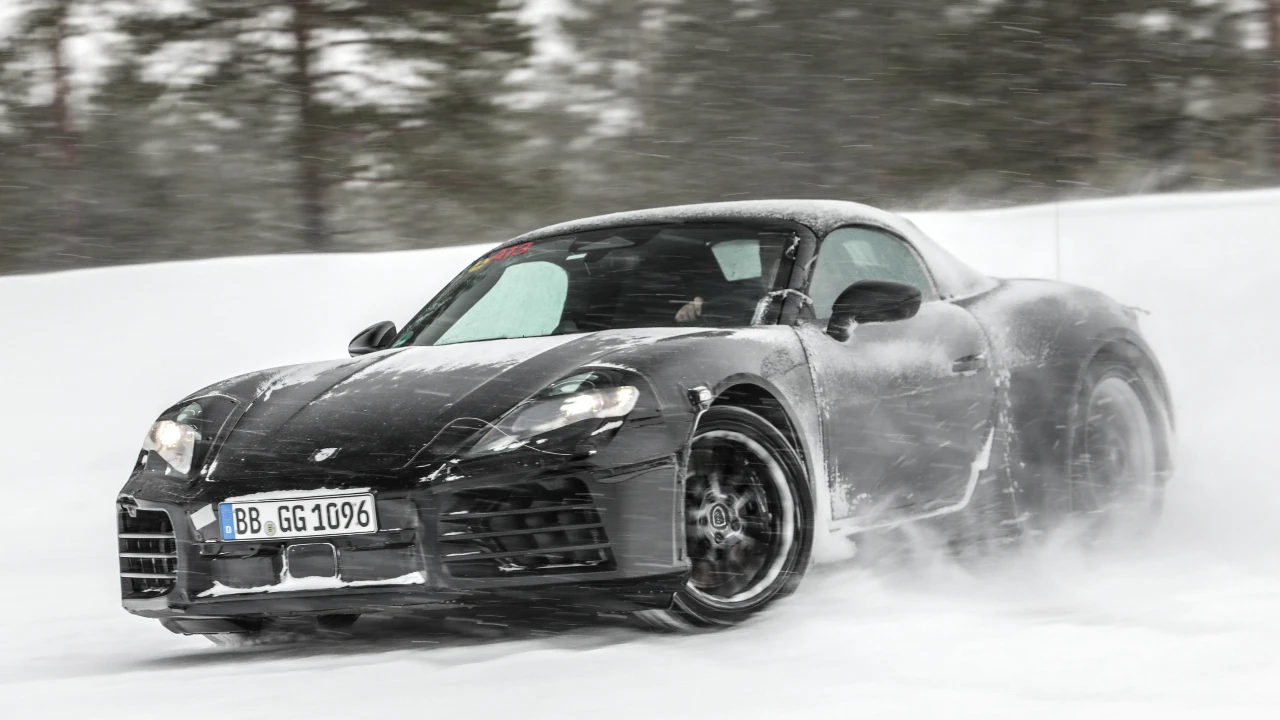
Preserving the mid-engine agility of a petrol roadster on battery power is the central goal behind the electric Porsche 718 Boxster—designated 983—as development enters its final stretch ahead of a planned first-quarter 2027 world premiere. Rather than mounting the pack flat beneath the cabin floor, Porsche places an 800-volt battery directly behind the seats to keep the seating position low and achieve a 40:60 front-to-rear weight distribution across roughly four million prototype test kilometres. Because Porsche has not yet officially unveiled the production electric 718 Boxster, final specifications, power outputs, pricing, and regional launch details remain subject to change.
TL;DR Key Takeaways :
- E-Core battery placement: An 800-volt battery sits behind the seats rather than under the floor, preserving a low seating posture and mid-engine weight balance.
- Weight distribution: Porsche cites a 40% front and 60% rear weight split, with overall mass aligned near current 911 Cabriolet T-Hybrid models.
- Extreme cold testing: Component and vehicle trials in Sweden tested hardware in temperatures down to -30°C alongside -20°C full-vehicle winter runs.
- Global testing scale: Prototypes logged roughly four million kilometres across more than 20 countries and five charging standards.
- Planned debut: Porsche schedules the production car’s presentation for Q1 2027, with final specs and pricing still to be confirmed.
Porsche’s upcoming all-electric 718 Boxster (internally 983) is designed to translate the balanced, open-top handling of the combustion roadster into an electric two-seater built at Zuffenhausen. Traditional Boxster models place the flat engine behind the cabin for sharp turn-in and predictable mid-corner poise, and Porsche’s engineering claims reflect the automaker’s own targets for the electric successor.
Early prototype runs in wind, snow, and temperatures around -20°C—alongside broader development driving—aimed to verify that throttle response, braking, and body control feel natural on winding roads. Porsche also pairs the electric setup with steering-wheel-mounted paddles that either simulate a seven-speed gearbox with synthesized Boxster sound under E-Shift or adjust between three stages of regenerative braking when switched off.
A Central Battery Keeps the Seating Position Low
Instead of placing a flat battery pack beneath the floorpan—which typically raises seat height or legroom constraints in a low-slung sports car—Porsche positions an 800-volt battery directly behind the seats. Under the company’s E-Core architecture, concentrating heavy battery mass near the center of the chassis keeps occupants seated low to the tarmac while preserving compact two-seat proportions.
Porsche states a target weight distribution of 40% at the front and 60% at the rear axle, mirroring classic mid-engined sports car geometry. Lightweight construction is intended to keep total kerb weight comparable to current 911 Cabriolet models equipped with the T-Hybrid powertrain.
| Engineering Area | Electric 718 Boxster (983) Detail | Why It Matters |
|---|---|---|
| Battery Layout | 800-volt E-Core pack mounted behind seats | Keeps seating low and centers mass like a mid-engine car |
| Weight Split | 40% front / 60% rear (target) | Supports agile rear-drive turn-in and traction balance |
| Testing Mileage & Scope | ~4 million km across 20+ countries | Validates durability across extremes from -30°C to 51°C |
| Chassis & Steering | 911 Carrera GTS steering, PTV+, rear-axle steering | Brings 911 hardware and first-time rear-wheel steering to Boxster |
| Planned Reveal | First quarter of 2027 (unannounced final specs) | Sets timeline for official power, range, and pricing disclosures |
Cold Weather Tests Cover the Whole Car
Cold-weather validation included component trials on ice and snow in Sweden—where temperatures dropped to -30°C—as well as storm conditions during whole-vehicle testing. Instrumented prototypes gathered telemetry to help engineers refine thermal management, traction control, and driving dynamics under harsh winter grip.
Stress-testing the battery pack and calibrating charging across five different charging standards formed key engineering hurdles alongside sports-car handling targets. Across the broader development program—spanning more than 20 countries, varying altitudes, and hot-weather and city driving—electric 718 Boxster prototypes accumulated approximately four million kilometres.
Chassis Tuning Aims for Mid-Engine Handling
On twisty mountain roads, Porsche focuses on crisp steering feel, strong braking, and composed corner entry and exit. In early prototype evaluations, stability and chassis control systems were tuned to step in predictably when needed while staying unobtrusive during clean cornering.

To sharpen dynamic response, the electric roadster borrows key chassis elements from the 911—including steering derived from the 911 Carrera GTS, the electronically controlled PTV+ limited-slip differential, and 911-derived wheel, tire, and brake dimensions—while adding rear-axle steering to the 718 Boxster for the first time. Software and drivability calibration continue to be refined ahead of the planned Q1 2027 presentation.
Mounting the battery behind the cabin rather than under the floor is the core engineering choice here—it shapes both seating height and the 40:60 weight balance that define how the car behaves through corners. Cold-weather testing proves resilience in freezing conditions, while real-world road drives once the production car debuts will show how closely it matches petrol roadster feedback.
If you are watching how electric sports cars retain traditional roadster balance and engagement, the electric 718 Boxster is one to track as Porsche moves toward its Q1 2027 reveal. Remember that Porsche has not yet officially announced the production car, so final specifications, performance figures, pricing, and release timing remain subject to change.
Gain further expertise in Porsche 718 models by checking out these recommendations.
Source & Image Credit: Porsche
Disclosure: Some of our articles include affiliate links. If you buy something through one of these links, Geeky Gadgets may earn an affiliate commission. Learn about our Disclosure Policy.
