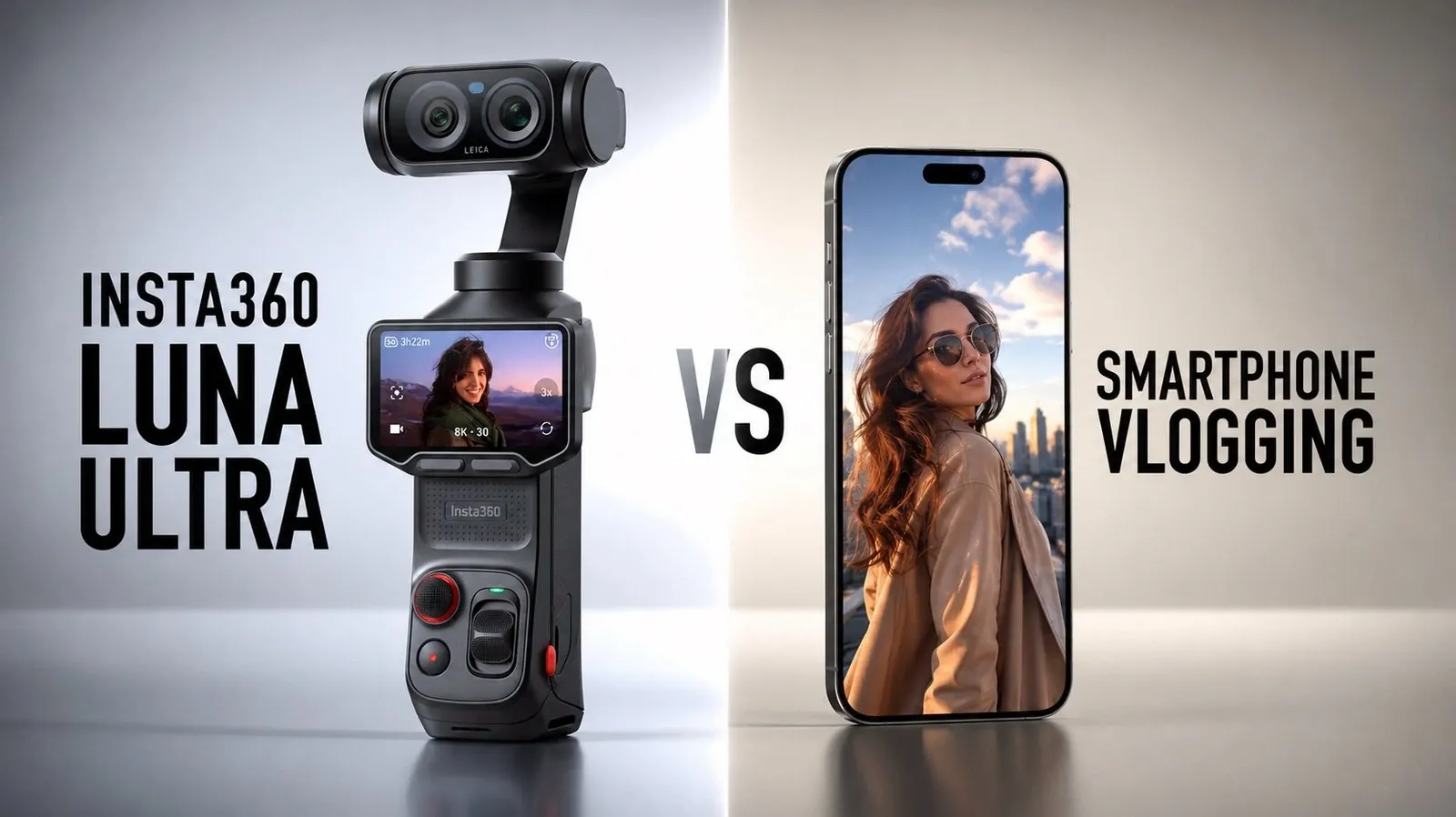
The Insta360 Luna Ultra arrives at a moment when most vloggers already carry a capable camera in their pocket. Modern flagship phones shoot 4K, run night modes and stabilise handheld footage well enough to publish. So the real question is not whether the Luna Ultra is a good camera, but whether it does enough that your phone cannot to justify carrying, charging and paying for a second device. In this latest breakdown, Tech Fowler puts the Luna Ultra’s dual-lens system, featuring a 1-inch main sensor and a 1.3-inch telephoto sensor, against the kind of smartphone setup most creators default to. Paired with a Leica Summicron lens offering 14 stops of dynamic range, the Luna Ultra leans on physics that phone-sized sensors struggle to match, especially in difficult light.
This comparison weighs where a dedicated camera pulls ahead and where your phone still wins outright. You’ll see how the Luna Ultra’s larger sensors, six times lossless zoom and four-microphone array stack up against computational photography, periscope crops and built-in phone mics, and where the phone’s always-in-your-pocket convenience, instant sharing and zero extra cost remain decisive. The aim is a clear buying decision: upgrade from your phone, or keep the device you already own.
Luna Ultra vs Your Phone
TL;DR Key Takeaways :
- The Luna Ultra’s 1-inch main sensor and 1.3-inch telephoto are physically larger than the sensors in flagship phones, giving it a real advantage in dynamic range, low light and depth rendering that computational processing cannot fully replicate.
- Its 6x lossless zoom uses a genuine telephoto lens on a large sensor, whereas phone zoom relies on small periscope sensors or cropping, so the Luna Ultra holds detail at reach where phones degrade.
- Four built-in microphones plus the optional Insta360 Mic Pro give cleaner, more directional audio than phone mics, without the dongles and adapters phones usually need for external sound.
- Your phone still wins on convenience, instant editing and sharing, all-day battery and zero extra cost, since you already own it. The Luna Ultra is a second device to carry and charge.
- Key trade-offs against a phone include heating during extended use, limited battery in 8K, no built-in tripod and a $769 to $969 price on top of the phone in your pocket.
Sensor and Image Quality
The clearest dividing line between the Luna Ultra and smartphone vlogging is sensor size, and it favours the camera. At its core, the Luna Ultra pairs a 1-inch main sensor with a 1.3-inch telephoto sensor. Flagship phones typically top out around a 1/1.3-inch main sensor, and their telephoto units are far smaller still. A larger sensor collects more light per frame, which translates into better dynamic range, cleaner shadows and more natural depth than a phone can produce through software alone. The Leica Summicron lens, with an f/1.8 aperture and 14 stops of dynamic range, delivers sharp, vibrant visuals in lighting where a phone would crush highlights or smear shadow detail with noise reduction.
This is the heart of the case for a dedicated camera: phones lean on computational photography to compensate for small sensors, and that processing can look over-sharpened or artificially lit. The Luna Ultra captures more genuine optical information at the point of exposure, leaving you with footage that needs less rescuing in the grade.
Video Capabilities Where Phones Fall Short
Phones have closed much of the video gap, but the Luna Ultra still reaches places most handsets cannot. For video enthusiasts, the Luna Ultra offers:
- 8K recording at 30fps, providing ultra-high-resolution footage for detailed visuals and aggressive reframing in post.
- 4K recording at 120fps, allowing smooth, cinematic slow-motion that few phones sustain without heavy crops or quality drops.
The bigger separation is the colour pipeline. Dolby Vision HDR, a 10-bit log profile and pre-installed LUTs allow for enhanced colour depth and in-camera colour grading. While recent phones have added log capture, the Luna Ultra’s combination of log, native LUTs and Dolby Vision is a more complete in-camera workflow, significantly reducing the time spent on post-production. For creators who grade their footage, this is the kind of professional pipeline that a phone’s video app only partially imitates.
Portability: The Phone’s Home Turf
This is the section where the phone fights back hardest. The single biggest advantage of smartphone vlogging is that the device is always with you, always charged and never an extra thing to remember. The Luna Ultra is lightweight and compact for a dedicated camera, but it is still a separate device to pack, power and protect.
Where the Luna Ultra earns its place in the bag is in features a phone cannot match:
- Detachable touchscreen, which doubles as a remote control with a range of up to 20 feet, letting you frame solo shots in a way phone selfie setups cannot.
- Six times lossless zoom, allowing you to capture distant subjects without the smeary detail loss of phone digital zoom.
- Five built-in focal lengths, offering versatile shooting perspectives without swapping lenses or relying on software crops.
So the trade is convenience against capability. A phone is the device you already have; the Luna Ultra is the device you choose to carry when the shot matters more than the convenience.
Explore further guides and articles from our vast library that you may find relevant to your interests in Insta360 Luna Ultra.
- What the Insta360 Luna Ultra and Pro Launch Means for Vloggers
- DJI Osmo Pocket 4 vs Insta 360 Luna Ultra : Everything You Need to Know
- The Insta360 Luna Ultra Feature That Could Outsmart the DJI Pocket 4
- Why Insta360’s Unreleased Luna Ultra is Already Beating DJI
- Why the Insta360 Luna Ultra Could Be the Ultimate DJI Rival for Creators
- Why Pro Creators Are Skipping the Insta360 Luna Ultra for DJI
- Why Insta360’s Luna Ultra Might Make You Skip the DJI Pocket 4
- What the New Insta360 Luna Ultra Specs Reveal About Its Launch
- Why You Should Wait for the Luna Ultra Before Buying DJI
- Insta360 Luna Pro and Ultra: Full Specs, Features and Market Analysis
Zoom: Optical Reach vs Computational Crops
Zoom is one of the most visible places the Luna Ultra pulls ahead of a phone. Smartphone zoom beyond the dedicated telephoto lens is mostly cropping and upscaling, and even periscope telephotos sit on tiny sensors that fall apart in anything less than bright daylight. The Luna Ultra’s six times lossless zoom draws on a real telephoto lens mounted to that 1.3-inch sensor, so distant subjects keep their detail and clean tonality instead of dissolving into the soft, processed look that phone zoom produces at range. For travel, wildlife or any subject you cannot walk up to, this is a tangible upgrade over a phone.
Audio: Dedicated Mics vs Phone Pickup
Audio is where smartphone vlogging quietly lets creators down, and the Luna Ultra targets that weakness directly. It comes equipped with four built-in microphones, including one on the detachable touchscreen, making sure clear and consistent audio capture even when the screen is used remotely. Phones generally rely on one or two mics tuned for calls, and getting clean external audio from a phone usually means adapters, dongles or a separate recorder. For creators who want to go further, the optional Insta360 Mic Pro attachment provides professional-grade audio without the cable juggling a phone setup demands. If your videos live or die on voice clarity, this is a meaningful step up from phone audio.
Low Light and Stabilization
In low light, sensor size does what software cannot, and the Luna Ultra’s larger sensors plus AI-powered lighting adjustments deliver bright, detailed footage in dim settings where phone night modes introduce noise, smearing and unnatural brightening. The camera also features an advanced image stabilization system that smooths out shaky footage. It is worth being fair here: modern phones stabilise extremely well, and this is one area where the gap is narrowest. The Luna Ultra matches and often exceeds them, but a recent flagship phone will not embarrass itself. Its autofocus and auto-tracking keep your subject sharp and centred during movement, which is broadly comparable to good phone tracking rather than a clear leap ahead.
Where the Phone Still Wins
For all its advantages over a phone, the Luna Ultra carries compromises that your phone simply does not have:
- Heating Issues: Extended use can lead to noticeable heating, which may affect long recording sessions. A phone manages sustained recording differently, though it has its own thermal limits.
- Battery Life: Recording in 8K significantly drains the battery, with an average runtime of about two hours. The non-removable design needs add-on battery attachments, whereas a phone lasts all day and is trivially topped up from any charger or power bank.
- Lack of Built-In Tripod: Stable shots require external accessories, while phone mounts and grips are cheap and universal.
- Detachable Screen Settings: By default, the detachable screen turns off during recording, which can disrupt workflows until you change the setting.
- No instant editing or sharing: A phone edits and uploads in the same device, while footage from the Luna Ultra has to be transferred before it reaches an app or platform.
None of these are unique failings for a dedicated camera, but they are exactly the frictions phone vloggers avoid by staying on their handset.
Pricing: Paying for a Second Device
The cost comparison is blunt: phone vlogging is effectively free because you already own the phone, whereas the Luna Ultra is a deliberate second purchase. It is available in two main bundles:
- Standard Package: Priced at $769 (approximately $800 after taxes), including the camera and essential accessories.
- Creator Combo: Priced at $969, adding an extra battery attachment and the Insta360 Mic Pro for added versatility.
That is real money on top of a device that already shoots competent video. The justification is not that the Luna Ultra does what a phone does, but that it does several things a phone cannot, larger sensors, true optical zoom and a proper audio array, well enough to be worth the outlay for creators who push image quality.
The Verdict: Should You Upgrade From Your Phone?
The Insta360 Luna Ultra is a genuine upgrade over smartphone vlogging in the areas that separate amateur from polished output: sensor-driven image quality, optical zoom, dynamic range and audio. Its dual-lens system, detachable touchscreen and grading-ready video pipeline give creators tools that computational phone processing only approximates.
The phone, though, keeps the advantages that matter to casual and fast-turnaround creators: it is always with you, it edits and publishes in one place, it lasts all day and it costs nothing extra. If your vlogging is spontaneous, social-first or budget-conscious, your phone is still the right tool. If you are pushing toward higher production value, shoot in challenging light, need real reach from a zoom or care about clean audio, the Luna Ultra earns the upgrade despite its heating, battery and accessory trade-offs. Decide based on which side of that line your content sits, and buy the device that removes your actual bottleneck rather than the one with the longer spec sheet.
Media Credit: Tech Fowler
Disclosure: Some of our articles include affiliate links. If you buy something through one of these links, Geeky Gadgets may earn an affiliate commission. Learn about our Disclosure Policy.
