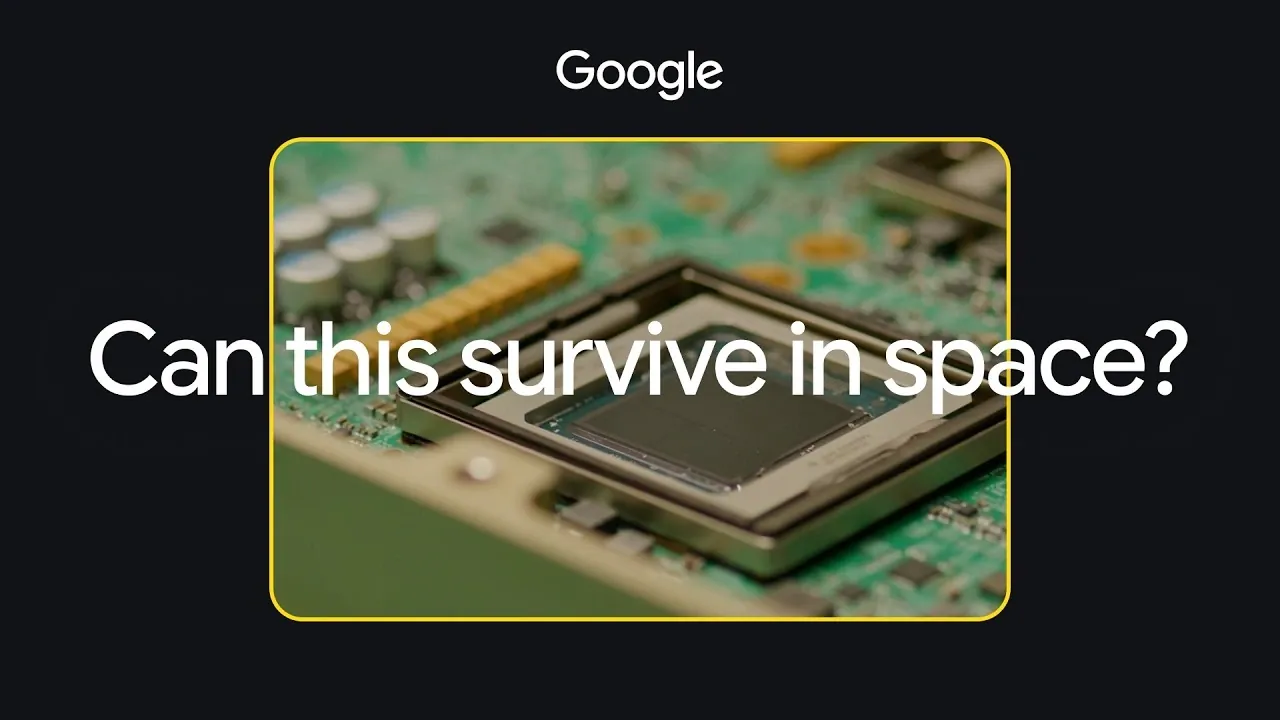
AI chips designed for use on Earth face unique challenges when deployed in space, where extreme conditions can compromise their reliability. Google’s Project Suncatcher tackles these challenges by subjecting AI chips to rigorous testing, such as vibration tests that replicate the intense mechanical forces of rocket launches, which can reach up to 100 g’s. Another critical focus is radiation exposure, as prolonged contact with cosmic rays can degrade hardware performance over time. These tests aim to identify vulnerabilities and ensure the chips can operate effectively in orbital environments.
Explore the methods used to evaluate AI chip resilience, including proton beam simulations to replicate radiation effects and workload testing to assess risks like Silent Data Corruption (SDC). This overview also provide more insights into the performance of Google’s Tensor Processing Units (TPUs) under conditions designed to simulate extended use in space.
Project Suncatcher: AI Beyond Earth
TL;DR Key Takeaways :
- Google’s Project Suncatcher aims to deploy AI-powered data centers in space, using solar energy for sustainable and efficient performance while addressing the challenges of operating in harsh space environments.
- AI chips face significant challenges during rocket launches, including extreme mechanical stresses such as vibrations and acceleration forces, which require rigorous vibration testing to ensure durability.
- In orbit, AI hardware must withstand cosmic rays and solar radiation, which can cause Single Event Upsets (SEUs) and Total Ionization Dose (TID) damage, necessitating innovative strategies to enhance radiation tolerance.
- Comprehensive testing protocols, including vibration testing, radiation testing and AI workload assessments, are critical for identifying vulnerabilities and improving the resilience of AI chips for space applications.
- Google’s Tensor Processing Units (TPUs) have shown promising resilience, with simulated tests indicating their ability to endure five years in orbit, paving the way for advancements in space-based AI systems and data processing.
Google’s Project Suncatcher introduces a bold concept: deploying AI-driven data centers in space, powered by the virtually limitless energy of the sun. This innovative approach could redefine data processing by using the unique advantages of space, such as reduced cooling requirements in the vacuum of orbit. However, the success of this vision hinges on the durability of AI hardware, particularly the AI chips, which must endure the physical and environmental challenges of space. These challenges include intense mechanical forces during launch and prolonged exposure to radiation in orbit.
The potential benefits of space-based AI data centers are profound. By operating in space, these systems could process data more efficiently, reduce latency for certain applications and minimize the environmental impact of terrestrial data centers. Yet, achieving this requires overcoming significant engineering hurdles to ensure the hardware can perform reliably in one of the most unforgiving environments known to humanity.
The Challenges of Rocket Launches
The journey to space begins with a rocket launch, a process that subjects hardware to extreme mechanical stresses. During liftoff, AI chips must endure intense vibrations, often reaching up to 50-100 g’s and acceleration forces as high as 10 g’s. These forces can threaten the structural integrity of the chips and their packaging, potentially leading to malfunctions or failures before the hardware even reaches orbit.
To address these challenges, engineers employ rigorous vibration testing. Using advanced vibration tables, they simulate the mechanical stresses experienced during a rocket launch. This testing ensures that the hardware can withstand the violent forces of liftoff without compromising its functionality. By identifying and addressing potential weaknesses during this phase, engineers can enhance the reliability of AI chips for space missions.
Uncover more insights about AI Chips in previous articles we have written.
- Apple Silicon Enables Local AI Execution via MLX Framework
- The Galaxy Z Fold 8 Series ‘New Shape’ Leak Changes Everything We Know About Foldables
- Alibaba Panjiu AL128 Replaces Nvidia with 128 Linked Chips
- Anthropic Develops Custom AI Chips to Cut Nvidia Reliance
- Leaked Insta360 X6 Retail Box Reveals a €689 Starting Price
- OpenAI’s Secret Weapon : New Custom AI Chips That Could Change Everything
- What is the AMD Ryzen AI and why does it matter?
- OpenAI considering designing its own AI chips
- OpenAI CEO Sam Altman raising $7 trillion to build a network of fabs for AI processors
Harsh Space Environments
Once in orbit, AI chips face a new set of challenges posed by the harsh space environment. The absence of atmospheric protection exposes hardware to cosmic rays and solar radiation, both of which can degrade performance over time. Two primary types of radiation-induced errors are particularly concerning:
- Single Event Upsets (SEUs): High-energy particles can strike the chip, causing bit flips in its memory. While these errors are often correctable, they can disrupt AI workloads and compromise data integrity if not effectively managed.
- Total Ionization Dose (TID): Prolonged exposure to radiation accumulates damage in the chip’s materials, gradually degrading its performance and potentially leading to permanent failure.
These radiation effects present a significant challenge for AI chips, which are designed for terrestrial environments where such exposure is negligible. To mitigate these risks, researchers must develop innovative strategies to enhance the radiation tolerance of AI hardware.
Testing AI Chips for Space Resilience
Making sure the reliability of AI chips in space requires comprehensive testing protocols that simulate the extreme conditions of both rocket launches and the orbital environment. These tests are designed to identify vulnerabilities and validate the hardware’s ability to perform under stress:
- Vibration Testing: Engineers use vibration tables to replicate the intense mechanical forces experienced during rocket launches. This testing ensures that the hardware can endure the stresses of liftoff without sustaining damage.
- Radiation Testing: Proton beam facilities simulate the radiation exposure encountered in orbit. By exposing AI chips to controlled doses of radiation, researchers can evaluate their resistance to cosmic rays and solar radiation.
- AI Workload Assessments: During radiation testing, AI workloads are run on the chips to measure the impact of errors, such as SEUs and Silent Data Corruption (SDC), on their performance and reliability. This step is critical for understanding how radiation-induced errors affect real-world applications.
These testing protocols provide valuable insights into the resilience of AI chips and inform the development of strategies to enhance their durability. By simulating the conditions of space, researchers can identify potential failure points and implement design improvements to mitigate these risks.
Key Insights and Future Directions
Testing has revealed critical insights into the behavior of AI chips under space-like conditions. One significant finding is the occurrence of Silent Data Corruption (SDC), where errors go undetected, potentially compromising the integrity of processed data. Despite these challenges, Google’s Tensor Processing Units (TPUs) have demonstrated remarkable resilience. Simulated tests suggest that these chips can endure conditions equivalent to five years in orbit while maintaining their functionality and performance.
The advancements achieved through Project Suncatcher highlight the potential of adapting commercial AI technology for space applications. By addressing the challenges of rocket launches, radiation exposure and prolonged operation in orbit, this initiative is paving the way for a new era of space-based AI systems. These developments not only accelerate the progress of space exploration but also open new possibilities for data processing and utilization beyond Earth.
As the boundaries of technology continue to expand, the lessons learned from testing AI chips for space resilience will play a crucial role in shaping the future of both space exploration and artificial intelligence. By pushing the limits of what is possible, initiatives like Project Suncatcher are driving innovation and setting new benchmarks for hardware performance in extreme environments.
Media Credit: Google
Disclosure: Some of our articles include affiliate links. If you buy something through one of these links, Geeky Gadgets may earn an affiliate commission. Learn about our Disclosure Policy.
