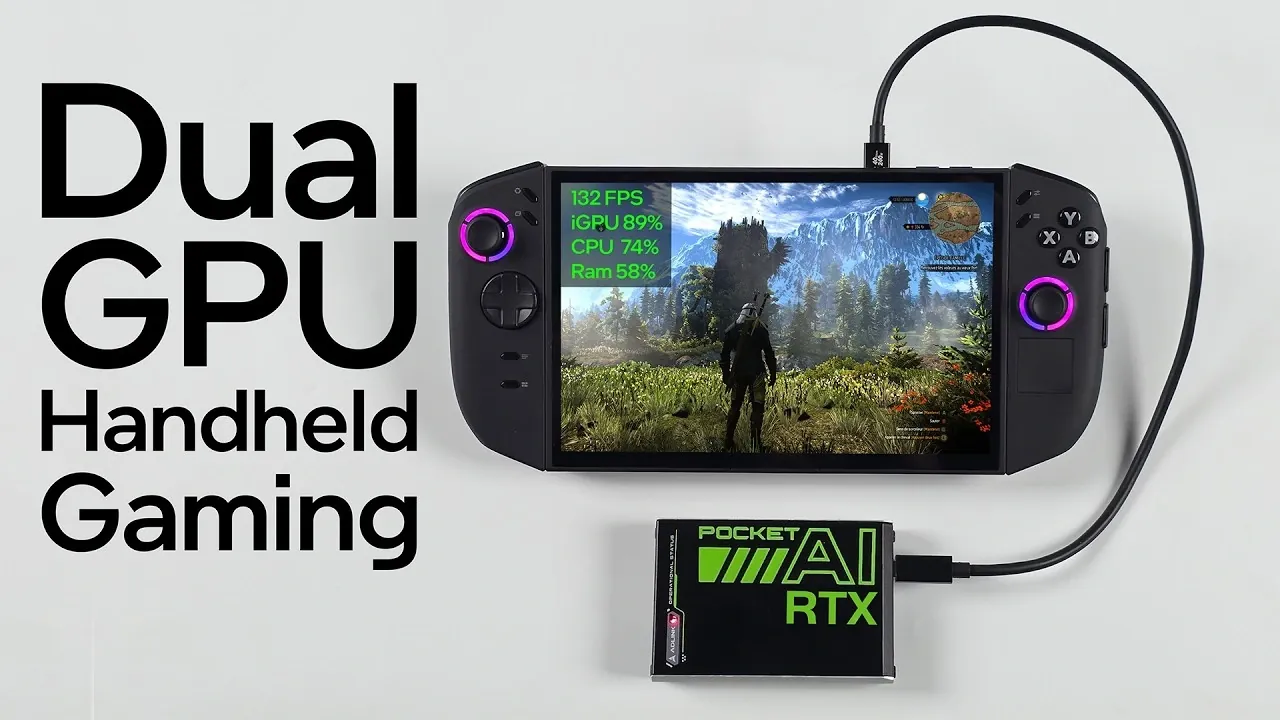
What if you could double, or even triple, your gaming performance on a handheld device, all while running on battery power? It sounds like the stuff of science fiction, but recent breakthroughs in hardware and software are making this bold vision a reality. Imagine playing graphically demanding titles like Cyberpunk 2077 or Spider-Man 2 on a portable gaming PC, powered not by a single GPU but by a dual GPU setup. By combining the strengths of an integrated GPU (iGPU) with a battery-powered external GPU (eGPU), this experimental approach promises to redefine what handheld gaming can achieve. But does it truly deliver the seamless, high-performance experience gamers crave, or does it come with strings attached?
In this feature, ETA prime explores the fascinating potential of battery-powered dual GPU gaming, using the Lenovo Legion Go 2 as a testbed. You’ll discover how an RTX A500 eGPU, acting as a frame generation accelerator, was paired with the device’s Radeon 890M iGPU to unlock remarkable performance gains. But it’s not all smooth sailing, challenges like latency, bottlenecks, and hardware limitations reveal the hurdles that must be overcome to make this technology viable for everyday gamers. Whether you’re a hardware enthusiast or just curious about the future of portable gaming, this experiment offers a glimpse into a world where handheld devices might one day rival full-fledged gaming rigs. Is this the next leap in gaming innovation, or are we still a few steps away from perfection? Let’s find out.
Dual GPU Handheld Gaming
TL;DR Key Takeaways :
- The experiment demonstrated the feasibility of dual GPU gaming on handheld devices by combining an integrated GPU (iGPU) with a battery-powered external GPU (eGPU), showcasing significant performance improvements in certain games.
- The Lenovo Legion Go 2, equipped with a Ryzen Z2 Extreme APU and Radeon 890M iGPU, was paired with an RTX A500 eGPU, which acted as a frame generation accelerator rather than a standalone graphics processor.
- Performance gains included doubled or tripled frame rates in demanding games like Cyberpunk 2077 and Spider-Man 2, but challenges such as latency, USB 4 bottlenecks, and inconsistent frame rates were observed.
- Technical constraints of the RTX A500 eGPU, including its 25W power draw, 4GB VRAM, and lack of a dedicated video output, limited its effectiveness in resource-intensive scenarios compared to the iGPU.
- Future advancements in USB 4 connectivity, lossless scaling software, and more powerful eGPU hardware with higher VRAM and dedicated outputs are essential to make dual GPU handheld gaming a practical reality.
The Setup
The Lenovo Legion Go 2 served as the foundation for this experiment, offering a robust platform for testing the potential of dual GPU gaming. This handheld gaming PC features a Ryzen Z2 Extreme APU and a Radeon 890M iGPU, providing a solid baseline for portable gaming performance. To enhance its capabilities, an RTX A500 eGPU—commonly referred to as Pocket AI—was integrated into the setup. Unlike traditional eGPUs, the RTX A500 was not used as a standalone graphics processor but as a frame generation accelerator.
The system was configured as follows:
- The iGPU handled primary rendering tasks, making sure the base gaming experience remained functional and consistent.
- The RTX A500 eGPU focused on advanced frame generation, feeding the processed frames back to the internal display via USB 4 connectivity.
- Lossless scaling software was employed to optimize frame generation, improving smoothness and minimizing visual artifacts.
This hybrid approach aimed to capitalize on the strengths of both GPUs, with the iGPU providing raw rendering power and the eGPU enhancing performance through advanced frame generation techniques.
Performance Gains and Challenges
The dual GPU configuration delivered notable performance improvements in several demanding games, including God of War: Ragnarok, Cyberpunk 2077, The Witcher 3, and Spider-Man 2. In some scenarios, frame rates doubled or even tripled, showcasing the potential of this hybrid setup. However, the extent of these gains varied depending on the specific game and its resource requirements.
Despite these improvements, the setup encountered several significant challenges:
- Latency Issues: Feeding generated frames back to the internal display via USB 4 introduced latency, which occasionally impacted gameplay responsiveness, particularly in fast-paced games.
- Performance Bottlenecks: The reliance on USB 4 connectivity created bottlenecks during graphically intensive scenes, limiting the overall performance gains.
- Inconsistent Frame Rates: While the eGPU improved smoothness in many cases, maintaining stable frame rates in resource-heavy games proved challenging.
These challenges highlight the need for further optimization in both hardware and software to fully realize the potential of dual GPU handheld gaming.
Battery Powered Dual GPU Gaming on a Handheld Experiment

Discover other guides from our vast content that could be of interest on gaming handhelds.
- AMD Ryzen Z2 Extreme: Powering the Next Handheld Gaming
- AMD Ryzen AI Max Plus 395 Overview : Powerful Handheld Gaming
- Sprig open-source handheld game console
- PocketSprite Tiny Handheld Game System Launches From $45
- ROG Ally 2 Gaming Handheld Rumors : Specs, Features and
- Evercade retro handheld game console from $80
- Awesome Ouya Handheld Game Console Created By Modder
- Louii handheld game console built from Wii components
- DIY portable Nintendo Wii handheld game system
- $649 GPD Win 2 Windows Handheld Gaming PC Unboxed
Technical Constraints
The design of the RTX A500 eGPU played a pivotal role in shaping the outcomes of this experiment. Unlike traditional eGPUs, the RTX A500 lacks a dedicated video output, functioning solely as a frame generation accelerator. While this design simplifies integration with handheld devices, it also imposes certain limitations on the eGPU’s versatility and performance.
Key technical constraints included:
- Power Draw: The eGPU’s 25W power consumption, while efficient, limited its performance ceiling, particularly in demanding gaming scenarios.
- VRAM Capacity: With only 4GB of VRAM, the eGPU struggled to handle games with high memory demands or complex rendering tasks, leading to performance drops in certain titles.
- iGPU vs. eGPU Performance: The Radeon 890M iGPU often outperformed the RTX A500 in raw gaming performance, raising questions about the eGPU’s practicality in this specific configuration.
While the eGPU contributed to smoother gameplay through frame generation, its limitations became evident in resource-intensive scenarios, underscoring the need for more robust hardware solutions.
Key Observations and Drawbacks
The experiment provided valuable insights into the potential and limitations of battery-powered dual GPU gaming on handheld devices. Key observations include:
- The absence of a dedicated video output on the eGPU created significant performance bottlenecks, particularly when relying on USB 4 for frame delivery.
- Ghosting and occasional frame drops were observed, detracting from the overall gaming experience and highlighting the need for improved frame generation algorithms.
- The external battery powering the eGPU added bulk and weight to the setup, reducing its portability and convenience, key factors for handheld gaming devices.
- In most cases, the Radeon 890M iGPU proved more capable than the RTX A500 eGPU for core gaming tasks, limiting the eGPU’s value proposition in this hybrid configuration.
These drawbacks emphasize the challenges of integrating external hardware into a portable gaming system, particularly when balancing performance, efficiency, and usability.
Future Prospects for Dual GPU Handheld Gaming
This experiment demonstrates that battery-powered dual GPU gaming on handheld devices is technically feasible and can deliver significant performance improvements in certain scenarios. However, the setup also exposes critical limitations, including latency issues, VRAM constraints, and the challenges of integrating external hardware into a portable form factor.
For developers and hardware enthusiasts, this experiment underscores the need for innovation in several key areas:
- USB 4 Connectivity: Enhancing data transfer speeds and reducing latency could significantly improve the performance of dual GPU setups.
- Lossless Scaling Software: Further refinement of frame generation algorithms could minimize ghosting and improve overall visual quality.
- eGPU Hardware: Developing more powerful and efficient eGPUs with dedicated video outputs and higher VRAM capacities could unlock greater potential for portable gaming.
While the current configuration may not be ideal for all users or games, it represents an important step toward achieving high-performance portable gaming. With continued innovation and optimization, the dream of seamless dual GPU gaming on handheld devices could soon become a practical and accessible reality.
Media Credit: ETA PRIME
Disclosure: Some of our articles include affiliate links. If you buy something through one of these links, Geeky Gadgets may earn an affiliate commission. Learn about our Disclosure Policy.
