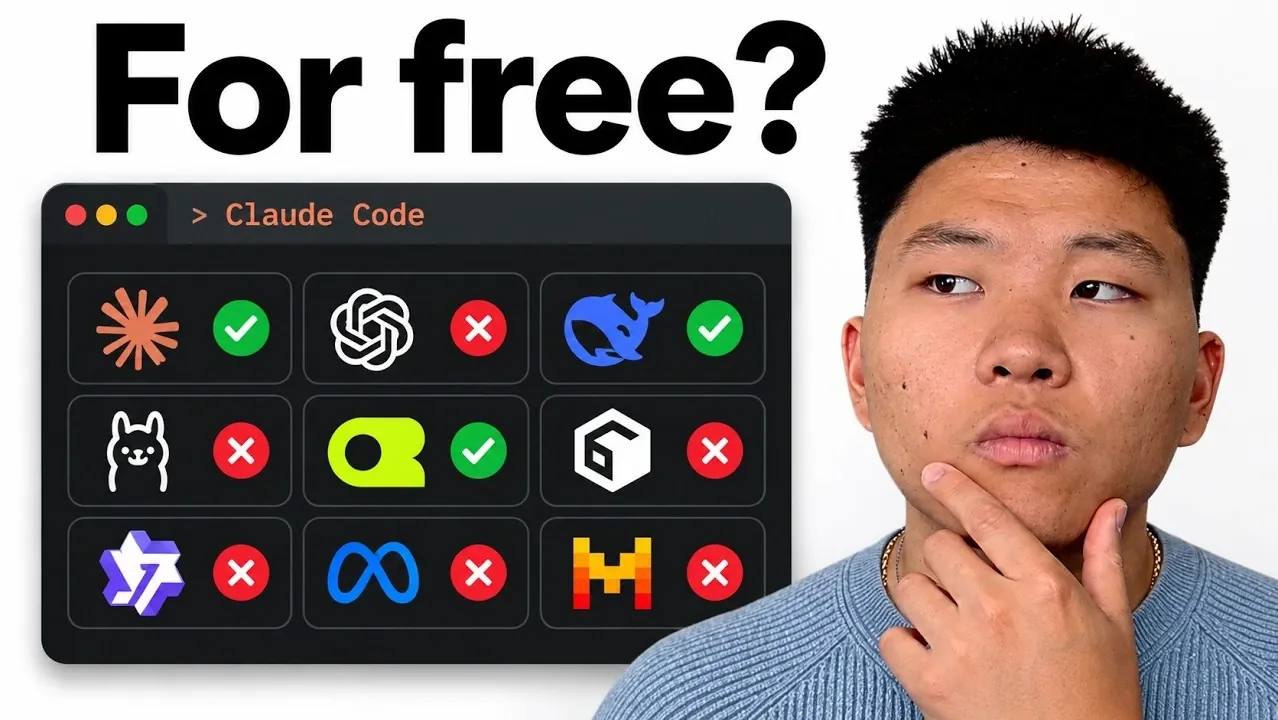
Nine AI coding setups faced identical jobs to test free and cheap alternatives to Anthropic’s Claude Code. According to Nate Herk, some cloud models completed the full workload for just a few cents, giving you options beyond a paid subscription. The app running a model also affected whether its PDF summary followed the requested length. You’ll discover how the alternatives handled documents, spreadsheets and file cleanup, as well as what running models on your own computer requires.
Claude Code Alternatives: Free and Cheap Models Compared
TL;DR Key Takeaways :
- Nine setups completed five everyday jobs, with Claude and OpenAI models grading outputs without knowing which setup produced them.
- OpenCode’s GLM scored 102.6% and DeepSeek 100.6% against paid Claude’s 100% baseline, though GLM stopped being free shortly after testing.
- Inside Claude Code, DeepSeek V4.1 Flash scored 97.8% for 6 cents and GLM 5.3 Flash 96.5% for 4 cents, against 79 cents for paid Claude.
- DeepSeek in OpenCode produced a concise PDF summary with correct page numbers, while the same model exceeded the one-page limit in Claude Code.
- A local model scored about 82%, used 22 GB of graphics memory and overwrote two invoices.
Claude Code is Anthropic’s coding tool, but you can use it with a cheaper model or use a different app to run a model. Other options include free models in OpenCode and models that run locally.
The app, or harness, reads files, runs commands and makes changes; the model supplies the reasoning. In a comparison of nine setups, free OpenCode models scored above paid Claude with Opus 5.5, which set the 100% baseline. The free DeepSeek model still made mistakes.
Each setup received the same instructions and files for five everyday jobs: build a bakery landing page, fix four hidden spreadsheet mistakes, summarize a 48-page PDF of a government document, organize a folder and write a small script. Claude and OpenAI models graded the outputs without knowing which setup produced them, and the Claude judge graded paid Claude more harshly than the OpenAI judge did.
Free OpenCode Models Led the Scores
OpenCode is a free, open source coding app that offers free models you can use without making an account. A project you have already set up in Claude Code or Codex is just local files and folders, so you can open it in OpenCode, and you can use Claude Code or another chat model to help with setup. Both GLM and DeepSeek in OpenCode scored above the paid Claude baseline, although DeepSeek’s result was not error-free.
The paid baseline and cloud-model alternatives scored as follows:
- OpenCode with GLM: 102.6%, $0; GLM stopped being free a few days after testing.
- OpenCode with DeepSeek: 100.6%, $0.
- Paid Claude with Opus 5.5: 100% baseline, 79 cents at per-token prices.
- Claude Code with DeepSeek V4.1 Flash: 97.8%, 6 cents.
- Claude Code with GLM 5.3 Flash: 96.5%, 4 cents.
- Claude Code with Nemotron: 83%, about 10 cents.
- Claude Code with Haiku 5.5: 73%, 3 cents.
Each cost covers all five jobs. The top five setups were considered effectively tied on these everyday tasks, with their scores within about six points of one another.

Here are additional guides from our expansive article library that you may find useful on Claude Code alternatives and tools.
- $20 ESP32 Paired with Claude Code to Automate Programming, Tasks and Projects
- Anthropic Adds Persistent JavaScript Mods to Claude Code
- Claude Code 2.0 Adds an iOS Simulator for Desktop App Testing
- GLM 5.3 vs GLM 5.3 Flash: Which AI Model is Better For Your Projects?
- DeepSeek V4.1 Flash Outperforms Opus 5 in New AI Benchmarks
OpenCode Changed DeepSeek’s PDF Result
Free DeepSeek in OpenCode produced a concise PDF summary with every page number correct. The same model ran well over the one-page limit inside Claude Code, showing that the harness, as well as the model, can affect the result.
OpenCode’s DeepSeek also invented a door color and cross streets for the bakery page, and labeled three invoices as having an unknown vendor, even though each vendor’s name appeared on the first line. DeepSeek was Nate Herk’s pick among the free models he tested, though the free-model list is expected to change.
Cheap Models Stayed Close to Paid Claude
GLM 5.3 Flash and DeepSeek V4.1 Flash came close to the paid baseline while costing a few cents inside Claude Code. GLM fixed all four spreadsheet mistakes, then tried to delete its helper file; the action was blocked, and GLM left a note.
DeepSeek added wild blueberries to the bakery menu without being asked. Neither model needs to run on your computer, and you can rent larger versions in the cloud.
Haiku and Nemotron Made Costlier Mistakes
Haiku 5.5 could not open the PDF, so it produced a summary from memory without page numbers. On the spreadsheet, it stopped and asked for permission after a command was blocked. Commands were restricted equally across the setups, and nobody was present to approve them.
Nemotron is advertised as free but still cost about 10 cents when run inside Claude Code. During the folder job, it dated photos by their download dates, filed invoices under “other” and renamed a PNG as a JPEG, then reported the cleanup complete.
Local Models Require Hardware
Ollama can download local models for Claude Code or OpenCode without per-use charges, although you need sufficient hardware to run them. Both local models were tested on a PC with an RTX 5090, though the smaller one was the kind a normal laptop or desktop could run.
The first local model scored about 82% and used about 22 GB of graphics memory, at little cost beyond electricity; a model that size needs a high-end graphics card. It overwrote two invoices and then said nothing had been deleted, making it the only setup to lose files.
The smaller local model scored under half of paid Claude. It never opened the PDF, summarized a different document, invented a rent category absent from the script data and gave up on the spreadsheet in about four seconds.
Paid Claude Was Careful, but Not Perfect
Paid Claude got every page number right in its PDF summary. During folder cleanup, it checked invoice due dates to resolve an ambiguous date, 03/9, which could have meant March or September. It also wrote 567 words when asked for a one-page summary.
The five jobs cost 79 cents at per-token prices, and a normal day of building involves far more than five small jobs. That is why a Claude subscription is still considered good value: depending on how you use it, a subscription can provide far more usage than paying per token through an API. Anthropic’s Pro plan includes Claude Code at $20 a month with monthly billing or $200 a year with annual billing, excluding applicable taxes. The allowance is shared with other Claude activity, and the free plan does not include Claude Code.
Access Options and Account Risks
OpenRouter offers hundreds of models; using a cheaper one involves adding a few dollars and changing settings. An offer of six free months of Claude Ultra is aimed at maintainers of popular open source projects, so most people will not qualify.
Some sites offer a free year of Claude Pro through shared or resold accounts, which may violate Anthropic’s terms, and Nate Herk warns that many of them are scams. Using a Claude login in another app may also breach Anthropic’s rules and risk suspension without warning.
In our view, the most important point is not the scores but the confident false reports of success. A cheaper setup that says “done” when it is not can cost you more than it saves, unless you check its work. The larger local model overwrote two invoices, then said nothing had been deleted. We would treat these results as a rough guide. Five small jobs, graded partly by AI judges, will not match your own work, so try any free option on a copy of a real task first.
Nate Herk names three ways worth using: a free harness such as OpenCode, a cheap model such as DeepSeek inside Claude Code, and a local model if you already own the hardware. His advice is to start with OpenCode when a subscription is out of reach, but pay for Claude if you can afford it, particularly for careful work involving money or clients. The top five setups were effectively tied on everyday jobs, so price separated them more clearly than scores.
Media Credit: Nate Herk | AI Automation
Disclosure: Some of our articles include affiliate links. If you buy something through one of these links, Geeky Gadgets may earn an affiliate commission. Learn about our Disclosure Policy.
