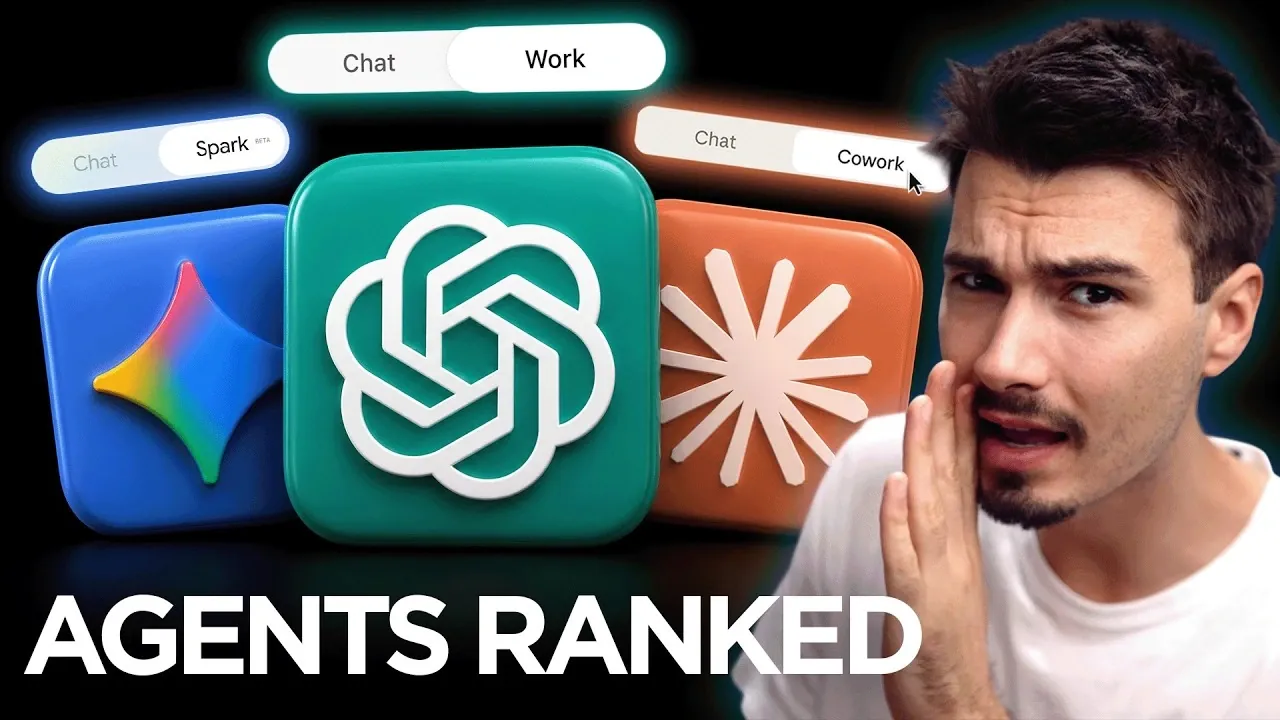
Artificial intelligence is increasingly applied to critical business tasks, but its effectiveness varies widely depending on the context. In an evaluation by The AI Advantage, three platforms, ChatGPT Work, Claude Cowork and Gemini Spark, were tested on challenges like analyzing meeting transcripts, extracting insights from customer feedback and managing email workflows. ChatGPT Work stood out for its accuracy in summarizing complex data and identifying actionable steps, while Claude Cowork delivered concise recommendations but occasionally faltered with inaccuracies. Gemini Spark, on the other hand, struggled with consistency, underscoring the uneven performance across these systems.
Gain insight into how these platforms handle real-world scenarios, from analyzing nuanced business contexts to managing communication workflows. Discover which system performs best for precision-driven tasks, how their creative outputs compare and the role pricing plays in assessing overall value. This explainer provides a detailed breakdown to guide your understanding of AI’s practical applications in professional settings.
ChatGPT Work vs Claude Cowork vs Gemini Spark
TL;DR Key Takeaways :
- ChatGPT Work emerged as the most reliable AI tool, excelling in precision, versatility and handling a wide range of professional tasks effectively.
- Claude Cowork performed well in creative and narrative-driven tasks, offering concise and engaging outputs, but struggled with occasional inaccuracies and depth in analysis.
- Gemini Spark underperformed compared to competitors, with inconsistent outputs and limited functionality, making its high $100/month price difficult to justify.
- OpenAI’s Codex Micro, a $230 hardware device, shows potential for enhancing coding workflows with AI integration, though its full capabilities are yet to be realized.
- Cost analysis highlights ChatGPT Work and Claude Cowork as cost-effective options at $20/month, while Gemini Spark’s higher price point lacks value due to its current limitations.
Comparing AI Tools
AI tools differ significantly in their capabilities, making it essential to understand their strengths and weaknesses before choosing the right one. Each tool was assessed based on its ability to process information, generate actionable insights and deliver outputs that align with professional requirements.
- ChatGPT Work: This tool demonstrated exceptional accuracy and adherence to instructions, making it highly effective for tasks requiring precision and detail.
- Claude Cowork: Known for its human-like writing style, it provided concise and actionable recommendations. However, it occasionally made assumptions that led to inaccuracies.
- Gemini Spark: Despite its conceptual promise, this tool fell short in functionality, requiring significant refinement to compete effectively in real-world applications.
Key Use Cases: Real-World Applications
The evaluation focused on four common business tasks where AI tools can significantly enhance productivity. These use cases were designed to reflect real-world challenges, making sure the results were both relevant and actionable.
- Meeting Transcript Analysis: ChatGPT Work excelled in generating thorough summaries, identifying actionable steps with precision. Claude Cowork provided concise summaries but occasionally overlooked critical details. Gemini Spark struggled with accuracy and completeness, making it less reliable for this task.
- Business Context Analysis: When tasked with evaluating product outcomes and recommending next steps, ChatGPT Work showcased a strong grasp of context, offering actionable insights. Claude Cowork generated useful recommendations but lacked depth in its analysis. Gemini Spark’s outputs were inconsistent, limiting its utility.
- Customer Feedback Analysis: ChatGPT Work stood out by identifying trends and actionable insights from feedback data. Claude Cowork summarized feedback effectively but sometimes overgeneralized, reducing the specificity of its outputs. Gemini Spark failed to extract meaningful patterns, making it less effective for this use case.
- Email Management: ChatGPT Work proved highly efficient at summarizing and prioritizing emails, streamlining communication workflows. Claude Cowork offered concise summaries but occasionally missed subtle nuances. Gemini Spark required manual adjustments to refine its outputs, reducing its overall competitiveness.

Here are additional guides from our expansive article library that you may find useful on ChatGPT.
- GPT-5.6 Pro Leaks Expose a Massive Jump in AI Reasoning Power
- ChatGPT 5.6 vs Claude Mythos 5 : Leaks Reveal Two Very Different Futures for AI
- OpenAI Introduces ChatGPT 5.6 Sol, Terra and Luna Models
- What ChatGPT 5.6’S Delay Means for the Future of Open Source AI
- What the Leaked ChatGPT 5.6 Model Reveals About OpenAI’s Next Move
- How ChatGPT 5.5 Automates Repetitive Coding Tasks to Save You Time
- ChatGPT 5.5 Instant Launches : Navigating Its Strengths and Weaknesses
- ChatGPT 5.6 vs Claude Fable 5: Which AI Actually Comes Out on Top?
- OpenAI’s GPT-5.6 Release is Triggering an AI Price War
- What to Expect from OpenAI’s GPT-5.6 Release in June 2026
Performance Insights: Strengths and Weaknesses
The performance of these tools varied significantly, highlighting their respective strengths and limitations. ChatGPT Work emerged as the most reliable option for day-to-day tasks, thanks to its precision and ability to follow instructions. Its versatility across a wide range of applications makes it a strong contender for professionals seeking practical solutions.
Claude Cowork, while less thorough in certain areas, excelled in creative and narrative-driven tasks. Its concise and engaging outputs make it a suitable choice for users prioritizing clarity and brevity. However, its occasional inaccuracies suggest it may not be the best option for tasks requiring high levels of precision.
Gemini Spark, despite its higher price point, underperformed in comparison. Its inconsistent outputs and limited functionality highlight the need for further development to meet professional standards. While it shows potential, it currently lacks the reliability required for demanding workflows.
Cost Analysis: Value for Money
Pricing is a critical factor when evaluating AI tools, as it directly impacts their accessibility and perceived value. Both ChatGPT Work and Claude Cowork are priced at $20 per month, offering a balance of affordability and functionality. These tools provide robust performance across various tasks, making them cost-effective options for most users.
In contrast, Gemini Spark is priced at $100 per month, a significant premium that is difficult to justify given its limited capabilities. For users seeking practical and reliable solutions, the lower-priced alternatives offer far better value. Gemini Spark’s current pricing structure may deter potential users until its functionality improves to match its cost.
OpenAI Codex Micro: A Glimpse into AI Hardware
In addition to software tools, OpenAI has introduced Codex Micro, a $230 hardware device designed to enhance coding workflows. This device features dedicated dictation buttons and other functionalities aimed at streamlining coding tasks. While its full potential is yet to be realized, Codex Micro represents an intriguing step forward in integrating AI into hardware solutions. Its ability to complement existing software tools could make it a valuable addition for developers and professionals seeking to optimize their workflows.
Choosing the Right Tool
When it comes to selecting the right AI tool for professional tasks, ChatGPT Work stands out as the most versatile and reliable option. Its ability to handle a wide range of tasks with precision makes it an excellent choice for professionals seeking practical and efficient solutions.
Claude Cowork, while less comprehensive, is well-suited for creative and narrative-driven outputs. Its concise and engaging results make it a strong contender for tasks requiring clear and human-like communication.
Gemini Spark, despite its promising concept, currently underperforms in comparison to its competitors. Its higher price point and limited functionality make it less appealing for practical applications.
For those exploring hardware solutions, Codex Micro offers a glimpse into the future of AI-powered productivity tools. While its long-term impact remains uncertain, it highlights the growing potential of integrating AI into physical devices to enhance workflows.
Media Credit: The AI Advantage
Disclosure: Some of our articles include affiliate links. If you buy something through one of these links, Geeky Gadgets may earn an affiliate commission. Learn about our Disclosure Policy.
