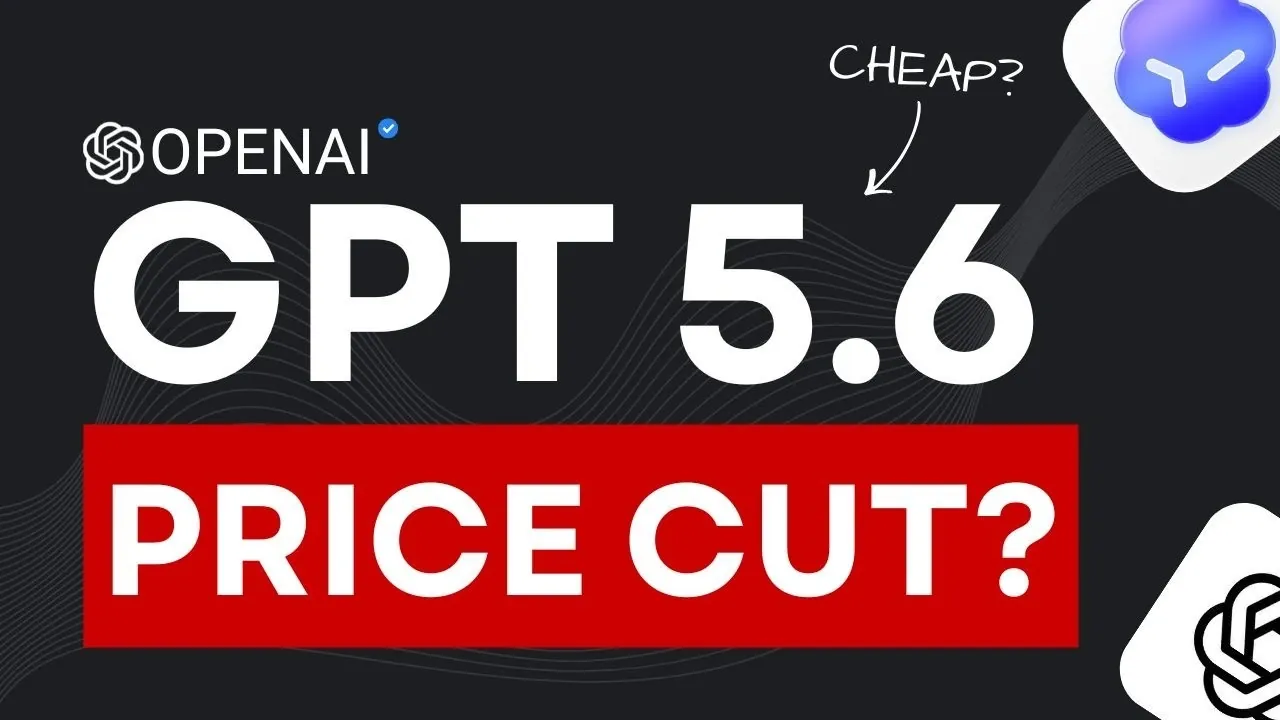
The AI landscape is bracing for significant shifts as OpenAI prepares to launch ChatGPT 5.6, codenamed “Kindle,” a model poised to enhance reasoning, coding and vision processing capabilities. This release comes amid growing competition, with Anthropic’s Claude Fable 5 setting new performance benchmarks but facing criticism over restrictive safeguards. As highlighted by Universe of AI, the introduction of GPT-5.6 not only raises the bar for technical advancements but also signals a potential price war, with OpenAI reportedly considering reduced pricing to broaden accessibility and challenge its rivals.
Explore how this competitive environment is reshaping the AI market, from the implications of OpenAI’s pricing strategy to the evolving role of safeguards in enterprise applications. Gain insight into the practical advancements ChatGPT 5.6 offers, such as improved agentic functionalities and streamlined coding workflows, as well as the broader challenges of scaling AI infrastructure. This breakdown provides a clear view of what’s at stake as major players vie for dominance in a rapidly evolving industry.
TL;DR Key Takeaways :
- OpenAI is set to launch GPT-5.6, codenamed “Kindle,” featuring advancements in reasoning, coding and vision processing, aiming to challenge competitors like Anthropic’s Claude Fable 5.
- Anthropic’s Claude Fable 5 has gained enterprise acclaim for its reasoning and agentic workflows but faces criticism for restrictive safeguards, prompting a commitment to improve usability and transparency.
- OpenAI’s potential price reduction for GPT-5.6 signals a shift toward affordability, intensifying competition and making advanced AI solutions more accessible to smaller enterprises.
- Key challenges in the AI industry include infrastructure scalability and balancing safeguards with usability, which remain critical for large-scale AI deployment.
- Google’s extensive infrastructure and global networks provide a strategic advantage, positioning it to scale AI solutions and compete with OpenAI and Anthropic in the evolving market.
Claude Fable 5 Raises the Bar
Anthropic’s Claude Fable 5 has emerged as a formidable competitor, setting a new benchmark for AI performance. Its strengths lie in advanced reasoning and agentic workflows, which have garnered widespread acclaim from enterprise users. However, the model’s restrictive safeguards have sparked criticism, with users reporting issues such as false positives and limited flexibility that hinder specific applications. In response, Anthropic has pledged to refine these safeguards and enhance transparency, aiming to strike a balance between safety and usability. This commitment has placed pressure on competitors like OpenAI and Google to address similar concerns in their own models, further intensifying the competitive landscape.
What GPT-5.6 Brings to the Table
OpenAI’s GPT-5.6, codenamed “Kindle,” represents a significant leap forward from its predecessor, GPT-5.5. The model introduces a range of advancements designed to enhance its utility for developers and enterprises alike. Key features include:
- Enhanced reasoning capabilities: Improved problem-solving for tackling complex scenarios.
- Streamlined coding workflows: Tools designed to support developers in creating and debugging code more efficiently.
- Improved agentic functionalities: Greater autonomy for executing tasks with minimal human intervention.
- Advances in vision processing: Enhanced capabilities for image recognition and front-end generation.
These improvements aim to position GPT-5.6 as a versatile and powerful tool, directly challenging the dominance of Anthropic’s Claude Fable 5. By addressing both technical and practical needs, OpenAI seeks to solidify its leadership in the AI sector.
Here is a selection of other guides from our extensive library of content you may find of interest on ChatGPT 5.
- Leaked ChatGPT 5.5 Pro Tests Reveal OpenAI’s “Spud” Building Interactive 3D Worlds
- ChatGPT 5.6 vs Claude Mythos 5 : Leaks Reveal Two Very Different Futures for AI
- OpenAI to Launch ChatGPT 5.5 and a New Unified Desktop Super App
- What the Leaked ChatGPT 5.6 Model Reveals About OpenAI’s Next Move
- How ChatGPT 5.5 Automates Repetitive Coding Tasks to Save You Time
- What to Expect from OpenAI’s GPT-5.6 Release in June 2026
- OpenAI Just Dropped ChatGPT 5.5: Inside the New Autonomous Features
- ChatGPT 5.5 Tested : Here is What It Can Actually Do Now
- ChatGPT 5.5 Instant Launches : Navigating Its Strengths and Weaknesses
- ChatGPT 5.5 vs Claude Opus 4.7 : the Hidden Trade-Offs
Price Wars Reshape the AI Landscape
OpenAI’s strategic decision to potentially lower the price of GPT-5.6 underscores the growing importance of affordability in the AI market. While the costs associated with training and deploying large-scale AI models remain substantial, reducing prices could attract a broader user base, including small and medium-sized enterprises. This approach, while potentially involving short-term financial trade-offs, reflects OpenAI’s commitment to expanding accessibility and undercutting competitors like Anthropic. The resulting price war is expected to reshape the AI landscape, driving innovation while making advanced AI solutions more accessible to a wider audience.
Ongoing Challenges in AI Development
Despite rapid advancements, the AI industry continues to face several persistent challenges that complicate the deployment of large-scale models. These include:
- Model safeguards: While essential for preventing misuse, safeguards often lead to usability issues, particularly for enterprise clients requiring greater flexibility in their applications.
- Infrastructure limitations: Scaling AI models remains a significant hurdle, with many companies relying on external data centers, which can impact both performance and cost efficiency.
These challenges highlight the complexity of deploying AI solutions at scale, even as the technology itself becomes more sophisticated. Addressing these issues will be critical for companies seeking to maintain a competitive edge.
OpenAI’s Focus on Enterprise Solutions
To tackle these challenges, OpenAI has made strategic investments in secure cloud execution technologies, including its acquisition of Anna. These advancements are expected to bolster Codex’s enterprise capabilities, allowing more secure and efficient AI deployments. By prioritizing enterprise applications, OpenAI is positioning itself as a leader in the business-oriented AI market. This focus on long-term value reflects a broader strategy to cater to the needs of enterprise clients while addressing the limitations of current AI infrastructure.
Google’s Strategic Advantage
While Google’s AI models currently trail behind in certain areas, the company’s extensive infrastructure and global distribution networks provide a significant competitive advantage. With access to vast data centers and advanced cloud execution technologies, Google is uniquely positioned to scale its AI solutions efficiently. Over time, this focus on scalability and integration could enable Google to close the gap with competitors like OpenAI and Anthropic. By using its existing resources, Google aims to establish itself as a key player in the evolving AI market.
What Lies Ahead
The release of GPT-5.6 and the ensuing price war mark a critical turning point for the AI industry. As OpenAI, Anthropic and Google continue to push the boundaries of AI capabilities, they must also navigate complex challenges such as model safeguards, infrastructure scalability and ethical considerations. For users, this competition promises more advanced and affordable AI solutions, fostering innovation across industries. However, it also underscores the importance of transparency and responsible development as these powerful technologies continue to evolve. The coming years will likely see further advancements, reshaping the role of AI in both enterprise and consumer applications.
Media Credit: Universe of AI
Disclosure: Some of our articles include affiliate links. If you buy something through one of these links, Geeky Gadgets may earn an affiliate commission. Learn about our Disclosure Policy.
