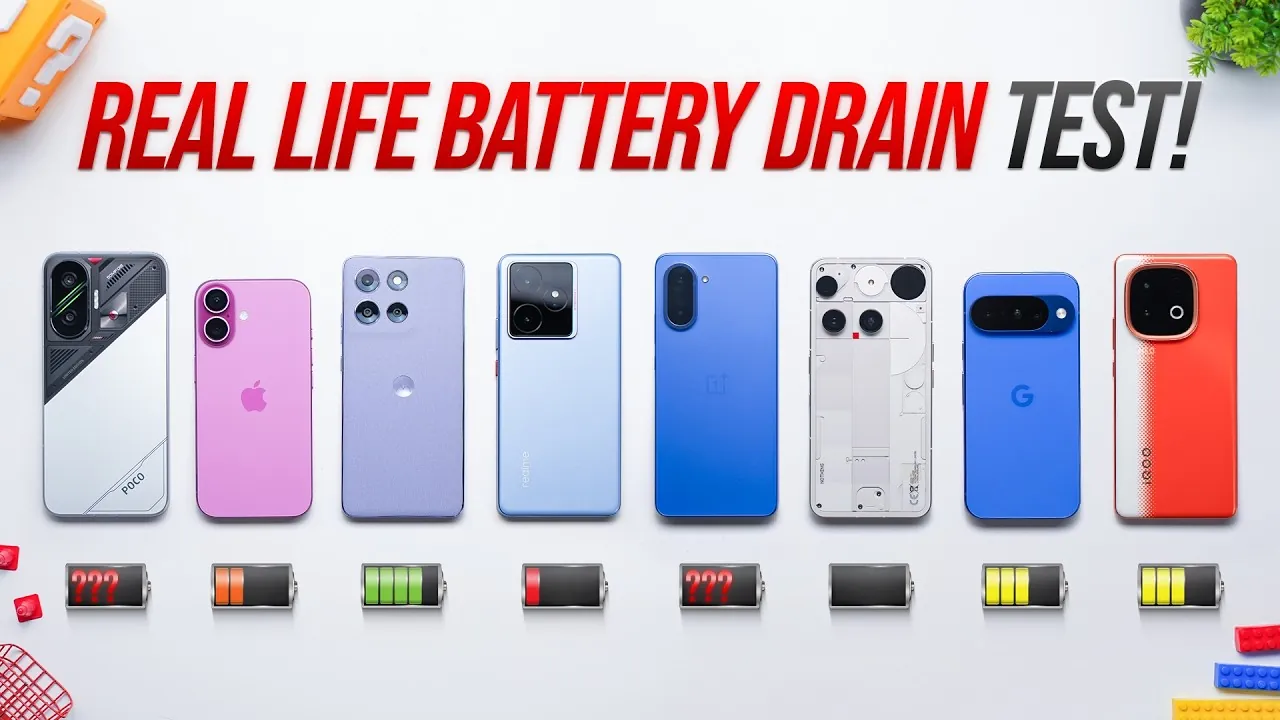
Battery life remains a critical factor for smartphone users, directly influencing how devices are evaluated in terms of usability and overall performance. To better understand how modern smartphones perform in this area, a detailed battery drain test was conducted on 16 devices by Beebom, encompassing both flagship and mid-range models. The findings challenge traditional assumptions, revealing that optimization often outweighs battery size in determining real-world performance. You can see the full test in the video below.

Test Setup: Making sure Fair Comparisons
To guarantee accurate and unbiased results, all 16 smartphones were tested under identical conditions. Each device underwent a factory reset, making sure battery health was at 100% and default performance settings were applied. Wi-Fi and Bluetooth were enabled, screen brightness was set to 50%, and no gaming or benchmarking apps were pre-installed. This setup was carefully designed to replicate real-world usage scenarios as closely as possible.
The test simulated a variety of everyday activities, including:
- Scrolling through Instagram
- Streaming videos on YouTube
- Recording videos
- Playing games
- Watching movies
- Making Google Meet calls
- Using Google Street View for navigation
- Listening to music
Each device was used continuously until it powered off, providing a clear measurement of screen-on time (SOT) and overall battery performance. This approach ensured a comprehensive evaluation of how each smartphone handles power consumption during typical daily tasks.
Test Results: Standouts and Surprises
The results revealed significant variations in battery performance across the tested devices, with some clear standouts and unexpected underperformers.
– Top Performer: The Vivo T4 emerged as the leader, delivering an impressive 15 hours and 7 minutes of SOT. This result highlights Vivo’s ability to optimize both hardware and software, allowing it to outperform competitors with larger batteries.
– Efficiency Leader: The iPhone 16 demonstrated exceptional efficiency despite its smaller battery capacity. When normalized for battery size, it ranked among the top performers, showcasing Apple’s expertise in seamless hardware-software integration.
– Underperformers: The Poco F7, despite having the largest battery in the test, failed to meet expectations. Its performance underscores that battery size alone does not guarantee better longevity. Similarly, the Nothing Phone 3, equipped with a silicon-carbon battery, did not outperform traditional lithium-ion models, challenging assumptions about the superiority of newer battery technologies.
Key Observations: Factors Influencing Battery Performance
The test provided valuable insights into the factors that truly impact smartphone battery life. These findings can help users make more informed decisions when selecting a device:
- Optimization Over Capacity: Devices like the iPhone 16 demonstrated that smaller batteries can outperform larger ones when paired with efficient software and hardware integration.
- Battery Technology: While silicon-carbon batteries show promise in theory, this test revealed no significant advantage over traditional lithium-ion batteries in real-world usage.
- Usage Patterns: Activities such as video playback and recording were among the most power-intensive tasks, while music playback consumed relatively less energy.
- Flagship vs. Mid-Range: Flagship devices generally exhibited better energy efficiency, but mid-range models like the Vivo T4 proved that optimization can significantly narrow the gap.
These observations highlight the importance of focusing on efficiency and optimization rather than relying solely on battery capacity or newer technologies.
What This Means for Smartphone Users
For consumers, the test underscores the importance of looking beyond battery size when evaluating smartphones. While a larger battery may seem appealing, it doesn’t always translate to longer usage times. Instead, prioritize devices that excel in hardware-software optimization, as these are more likely to deliver superior real-world performance.
Additionally, consider your specific usage habits. If your daily activities include power-intensive tasks like gaming or video recording, opt for devices known for their efficiency in these areas. On the other hand, if your usage is lighter, such as browsing or music playback, a mid-range device with good optimization may suffice. Simple adjustments, such as reducing screen brightness or disabling unused features like Bluetooth, can also help extend battery life.
Optimization: The Key to Better Battery Life
The 2025 Android Battery Drain Test highlights that battery performance is a complex interplay of hardware, software, and usage patterns. While advancements like silicon-carbon batteries hold potential, their benefits remain limited without proper optimization. Brands like Apple and Vivo have demonstrated that efficient energy management can deliver exceptional results, even with smaller batteries.
As smartphone technology continues to evolve, the focus should remain on achieving a balance between innovation and optimization. For consumers, understanding these dynamics can lead to smarter purchasing decisions and a more satisfying user experience.
Explore further guides and articles from our vast library that you may find relevant to your interests in Android battery drain test.
- 2025 Android Battery Test Results
- Samsung Galaxy Flagship Battery Test: Full Results and Analysis
- How to fix Android battery drain
- Ultimate Foldable Battery Test: Pixel 9 Pro Fold vs. Magic V3 vs. Z
- Battery Test: Google Pixel 9 Pro XL vs. Galaxy S24 Ultra (Video
Source & Image Credit: Beebom
Disclosure: Some of our articles include affiliate links. If you buy something through one of these links, Geeky Gadgets may earn an affiliate commission. Learn about our Disclosure Policy.
