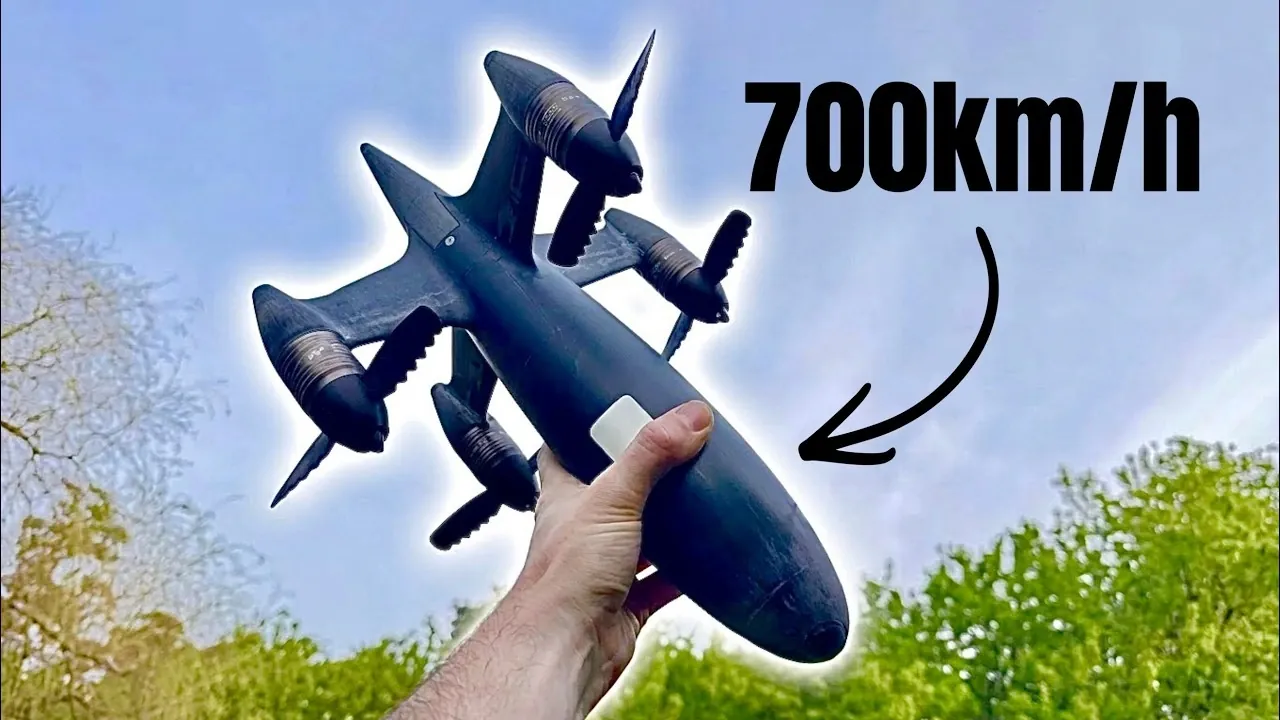
Building the fastest drone in the world requires precision, creativity and a willingness to tackle complex challenges head-on. In a detailed walkthrough, biggsy_fpv shares the journey behind the Blackbird drone, which set a Guinness World Record by reaching an incredible speed of 626 km/h. Central to this achievement was the ability to overcome critical engineering hurdles, such as mitigating frame resonance and optimizing aerodynamic efficiency. By rethinking traditional design principles and employing advanced simulations, the team developed a platform capable of pushing the boundaries of drone performance.
Explore how custom-built components like tailored propellers and advanced cooling systems played a pivotal role in achieving record-breaking speeds. You’ll gain insight into the iterative testing process that refined the drone’s performance, from improving thrust-to-weight ratios to minimizing electrical resistance. This guide offers a clear breakdown of the strategies and innovations that made the Blackbird’s success possible, providing valuable takeaways for anyone interested in high-speed drone engineering.
Breaking the 600 km/h Barrier
TL;DR Key Takeaways :
- The Blackbird drone set a Guinness World Record with a top speed of 626 km/h, showcasing new advancements in electric-powered drone technology.
- Key engineering challenges included minimizing frame resonance, optimizing aerodynamics and addressing signal interference at extreme speeds.
- Innovative solutions, such as custom propellers, advanced cooling systems and optimized wiring, were critical to achieving record-breaking performance.
- Rigorous testing, iteration and refinement played a pivotal role in overcoming technical hurdles and fine-tuning the drone for maximum efficiency and stability.
- The Blackbird’s success has spurred further competition in high-speed drone development, with teams now aiming to surpass 700 km/h, driving innovation in propulsion and battery technologies.
Creating the fastest drone begins with a clear and ambitious objective: surpassing the 600 km/h speed threshold. Inspired by existing records, the Blackbird team set out to redefine the limits of drone engineering. Early prototypes revealed significant challenges, such as frame resonance and tuning instability, which required innovative solutions. From the outset, the project demanded a complete rethinking of traditional drone design principles to achieve this ambitious milestone.
The team’s approach was methodical, starting with simulations and small-scale models to test aerodynamic concepts. These early efforts laid the groundwork for the full-scale prototypes, which were subjected to rigorous testing and refinement. The goal was not just to break the record but to do so with a design that could be replicated and improved upon in future iterations.
Key Engineering Challenges
Achieving extreme speeds requires overcoming a series of complex engineering hurdles. Aerodynamics played a pivotal role in minimizing drag and maximizing speed. Compact, streamlined designs were essential to reduce air resistance, while high-performance components ensured the drone could deliver exceptional thrust and efficiency.
Some of the critical challenges included:
- Frame Stiffness: At high speeds, even minor vibrations or oscillations could destabilize the drone. Reinforcing the frame to eliminate flexing was vital to maintaining structural integrity and making sure consistent performance.
- Component Selection: Custom motors and propellers were designed to optimize thrust-to-weight ratios, while high-performance batteries provided the necessary power density to sustain extreme speeds.
- Signal Interference: Video transmission systems faced interference at extreme speeds, requiring robust solutions to ensure clear communication and control during test flights.
Each of these challenges required innovative solutions, as traditional drone designs were not equipped to handle the demands of such high-speed performance.

Become an expert in drones with the help of our in-depth articles and helpful guides.
- DJI Mini 6 Pro Speculation Points to a September 2027 Debut
- 8+ Big drones capable of carrying large payloads and heavy equipment
- DJI Air 4 Leads 2026 Lineup with Upgraded Low-Light Camera
- DJI Neo auto-follow drone for effortless content creation $199
- Rumoured DJI Neo 3 Drone Targets a September 2026 Launch
- DJI Osmo 360 II Officially Launches Tomorrow
- Insta360 Luna Ultra’s 8K Video Tops the DJI Osmo Pocket 4
- Leaked DJI Neo 3 May Feature a 1/1.3-Inch Sensor Upgrade
- DJI Neo 2 is Ideal for Beginners: Palm Launch, 12-Minute Flight Time and More
- iPhone Duo vs. Galaxy Z Fold 8: Did Apple Just Catch Samsung?
Innovative Solutions to Complex Problems
To overcome these challenges, innovative approaches were essential. The Blackbird team implemented several new solutions that pushed the boundaries of conventional drone design:
- Custom Propellers and Motors: Tailored configurations optimized thrust and efficiency, making sure the drone could achieve maximum speed without compromising stability or control.
- Advanced Cooling Systems: Inspired by the Meredith effect used in aviation, these systems efficiently dissipated heat from motors and batteries, preventing overheating during high-speed runs and making sure consistent performance.
- Wiring Optimization: By carefully designing the layout of speed controllers and electrical connections, the team reduced resistance and weight, improving overall energy efficiency and reliability.
These incremental improvements, while small on their own, collectively contributed to the drone’s record-breaking performance. Each solution was tested extensively to ensure it could withstand the demands of high-speed operation.
Testing, Iteration and Refinement
Breaking speed records is not a one-time effort but a process of rigorous testing and constant refinement. Each test flight provided valuable data, revealing areas for improvement in aerodynamics, battery management and component performance. Incremental adjustments, such as fine-tuning propeller angles or optimizing motor timing, gradually brought the drone closer to its goal.
The breakthrough came when the Blackbird surpassed the 600 km/h barrier, eventually achieving an average speed of 626 km/h. This milestone, certified by Guinness World Records, underscored the importance of persistence and meticulous attention to detail in overcoming technical challenges. The team’s ability to analyze and act on test data was a key factor in their success, demonstrating the value of a systematic approach to innovation.
A Record-Breaking Achievement
The Blackbird’s record-breaking flight was a testament to the team’s engineering expertise and creativity. Overcoming challenges like battery overcharging risks and aerodynamic inefficiencies required innovative thinking and precision. The result was a drone that not only set a new speed record but also demonstrated the potential of electric propulsion in high-performance applications.
This achievement has inspired other teams to push the boundaries of what is possible in drone engineering. The Blackbird’s success serves as a benchmark for future efforts, highlighting the importance of collaboration, innovation and a relentless pursuit of excellence.
The Race for Supremacy
The world of high-speed drone development is fiercely competitive. Shortly after the Blackbird’s achievement, other teams surpassed the 626 km/h milestone, highlighting the relentless pace of innovation in this field. To stay ahead, you must continuously explore new technologies and strategies. Plans to exceed 700 km/h are already underway, pushing the boundaries of what’s possible.
The race for supremacy in high-speed drone engineering is not just about breaking records; it’s about advancing the technology that underpins these achievements. From improved battery chemistry to more efficient propulsion systems, the innovations developed in this field have the potential to influence a wide range of applications, from commercial drones to aerospace engineering.
Media Credit: biggsy_fpv
Disclosure: Some of our articles include affiliate links. If you buy something through one of these links, Geeky Gadgets may earn an affiliate commission. Learn about our Disclosure Policy.
